


In this article
- The two breeds in one sentence each
- Size and physical strength
- Day-to-day temperament
- Ears and tail: both breeds were cropped and docked for decades
- Guarding: two styles that work
- Energy and exercise: the most practical difference
- Health and lifespan: the honest conversation
- Monthly cost
- Who each one is for
- Frequently asked questions
Doberman and Rottweiler guard the home with the same seriousness, but they are different dogs for different routines: the Doberman is speed, closeness and a need for movement; the Rottweiler is territorial calm, more weight and more independence. We breed Dobermans, and what follows compares the two breeds by what each standard describes and by what each routine demands.
First of all: both, well bred, are excellent family dogs. The wrong choice does not produce a bad dog, it produces a tiring life together. That is what this article tries to prevent.
The two breeds in one sentence each
The Doberman was created in late 19th-century Germany by a tax collector who needed an escort: a fast, athletic dog, glued to its owner. The Rottweiler is older, a dog that drove cattle and pulled butchers' loads: quiet strength, attachment to territory.
That origin explains almost everything below.
Size and physical strength
Internet comparisons usually sum up this item as "the Rottweiler is the bigger of the two." The official FCI standards, which are the ones the CBKC adopts in Brazil, tell a more useful story.
- Doberman, FCI standard No. 143: 68 to 72 cm at the withers in males and 63 to 68 cm in females, weighing around 40 to 45 kg and 32 to 35 kg. A sprinter's body, lean and tall.
- Rottweiler, FCI standard No. 147: 61 to 68 cm in males and 56 to 63 cm in females, weighing close to 50 kg and 42 kg. More mass spread over a lower body.
In other words: the Doberman is the taller one and the Rottweiler is the heavier one. That changes ordinary things in daily life. An adult Doberman's muzzle reaches the kitchen counter and the set table in the dining room, and the first lesson in living together will be about that. The Rottweiler does not reach the table, and in exchange dislocates your shoulder when he decides to change direction.
In practice, on the leash: an untrained Doberman pulls you; an untrained Rottweiler drags you. Both need leash handling taught early, the Rottweiler with less margin for error because of his weight.
Day-to-day temperament
The most visible difference in everyday life:
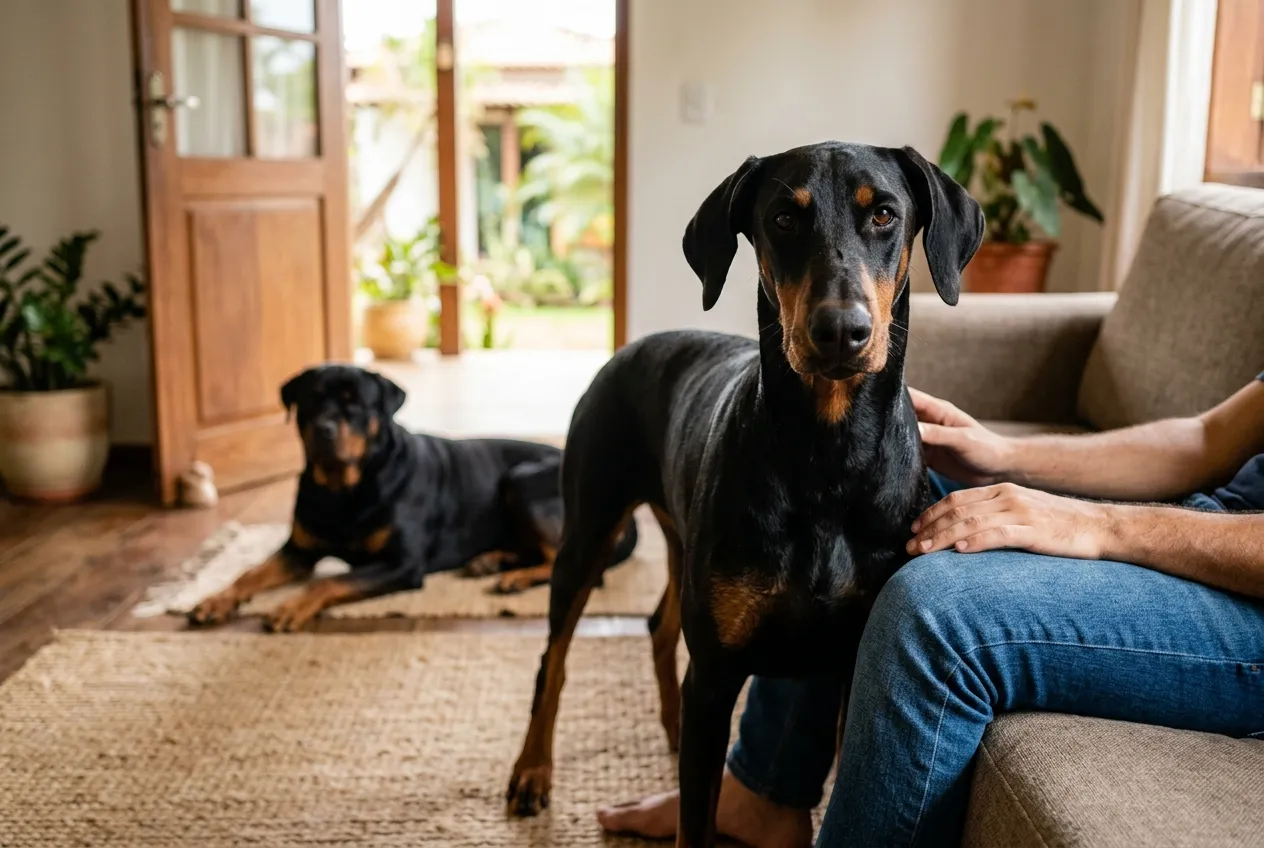
- The Doberman is clingy. He is nicknamed the "velcro dog" with good reason: he wants to be in the room you are in, preferably leaning on you. For those who like that, it is the best part of the breed. For anyone who wants a more independent dog, it gets tiring.
- The Rottweiler watches from a distance. He loves the family just as intensely, but he loves from his own rug, watching the door. Quieter inside the house, less demanding.
One important warning: this is the breed's tendency, not a portrait of your dog. Within a single litter there are puppies who are more attached and puppies who are more reserved, and it is by following the weeks closely that a breeder can say which one fits your home. Color and sex do not predict any temperament.
With visitors, the Doberman tends to accept them faster when the owner signals that everything is fine. The Rottweiler usually takes longer to consider the matter closed. In both cases, puppy socialization is what defines the adult: we wrote about it in the puppy guide.
Ears and tail: both breeds were cropped and docked for decades
Anyone searching for photos of the two online still finds Dobermans with pointed ears and Rottweilers with short tails, and concludes that this is how they are. Neither breed is born that way. Ear cropping (conchectomy) and tail docking (caudectomy) are banned in Brazil by CFMV Resolution 877/2008 (art. 7, as amended by Resolution 1.595/2024), and what appears in those old photos is cosmetic surgery.

In our house the matter is settled: the puppies keep their natural ears and an intact tail. The difference shows up in reading the dog, which is what matters most to whoever will live with him. An intact ear moves, and an ear that moves is information: you notice the dog relaxing or going on alert before anything else happens. It applies to both breeds, and applies even more to the tail, which is the part of the body that talks the most. The decision is detailed in why we do not crop the ears.
Guarding: two styles that work
Both protect the house, but the style is different. The Doberman is alarm and interception: he notices early, warns loudly, arrives fast. The Rottweiler is deterrence: his presence solves most situations before anything happens. If what you need is a dog that moves with the family and protects on the move, the Doberman has the edge. If it is a fixed presence on a large piece of land, the Rottweiler does it asleep.
Energy and exercise: the most practical difference
Here lies the decision for most families:
- Doberman: 60 to 90 minutes of real exercise a day, every day. Without it, he invents a job: destroying cushions, digging, barking. It suits people who walk, run, play fetch.
- Rottweiler: 40 to 60 minutes is enough for most adults. He accepts a lazy Sunday without turning the house into a proving ground.
A very busy routine and little time outdoors? The Rottweiler forgives more. An active life and a wish for constant company? The Doberman was designed for that.
Health and lifespan: the honest conversation
Both breeds have their points of attention, and a breeder who hides that does not deserve your reservation.
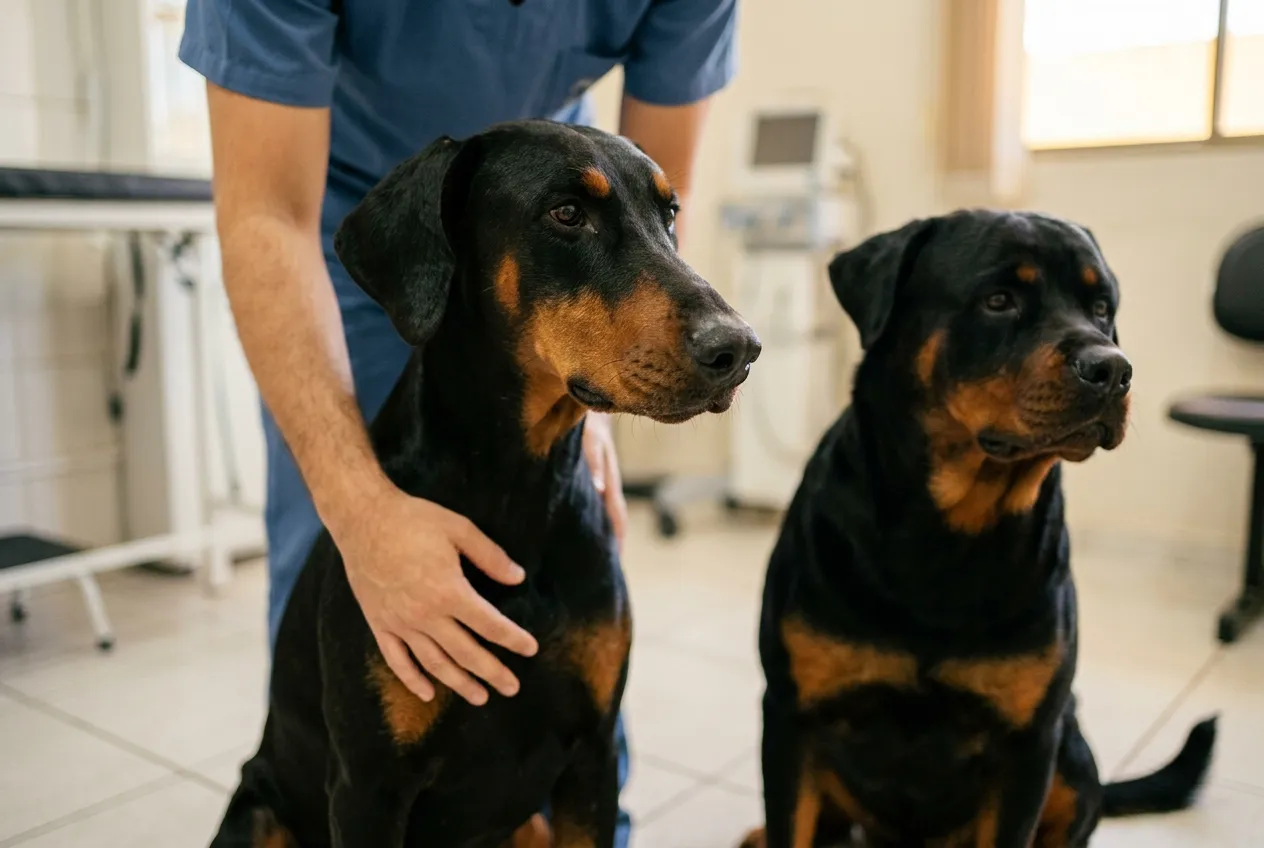
- Doberman: the serious issue is dilated cardiomyopathy (DCM). That is why the parents' cardiac exam is a prerequisite, before any conversation about reservation. Typical lifespan of 10 to 12 years.
- Rottweiler: hip and elbow dysplasia because of weight, and a relevant incidence of some tumors. Typical lifespan of 8 to 10 years.
In both cases, the difference between tested parents and anonymous parents shows up in the vet bill years later.
Monthly cost
Similar, with a slight edge for the Doberman: fewer kilos of food (a male eats 400 to 500 g/day against 500 to 700 g for the Rottweiler), short coat on both, equivalent veterinary care. The real difference in cost is in a well-made purchase, with tests and pedigree, and it applies to both breeds.
Who each one is for
- Choose the Doberman if: you want a dog glued to the family, have 1 hour a day of exercise guaranteed, like to train and want a guard that walks alongside you.
- Choose the Rottweiler if: you want calm presence, have space, prefer a less demanding dog and accept fewer years together with more kilos of dog.
Frequently asked questions
Which of the two does better in an apartment?
Both fit in an apartment, and neither fits in an apartment without a street routine. The Rottweiler takes up more space lying still and complains less about a day without a walk; the Doberman takes up less space and demands his outing every single day. Anyone with guaranteed time outdoors handles the Doberman better in a building. The adjustments for floors, elevator, heat and balcony are in Doberman in an apartment.
Which of the two is better with children?
Both get along well when socialized early and supervised. The Doberman plays more; the Rottweiler tolerates more. We have a whole article about Doberman with children.
Which is fiercer?
Wrong question. Fierceness without control is a defect. What you look for in any guard dog is stability: act when needed, ignore when not needed. That comes from selected genetics and socialization, in both breeds.
Can I have both?
You can, and it makes quite a pair. Preferably opposite sexes, introduced with care, and with an owner who can handle 90 kg of combined dog.
Leaning toward the Doberman? See how much a well-raised puppy costs or talk to us about the upcoming litters.

About the author
Marcelo Vaz
Entrepreneur and founder of Dobs Kennel
Marcelo Vaz is an entrepreneur and the founder of Dobs Kennel, a Doberman kennel in Nísia Floresta (RN), Brazil. As a boy, he already knew which dog he wanted. That passion for the Doberman stayed with him over the years and became the kennel he now runs with the seriousness of someone who waited a long time for it. “We are not veterinarians, but we study every subject in depth and only write what is backed by science and reliable sources,” he says.
- RegistryCBKC / FCI
- Kennel nameImperio Real Norte
- WhereNísia Floresta, RN
Keep reading


Comments
Ask the breeder directly. Every comment is moderated before it appears, and your email is never published.
Be the first to comment: ask the breeder directly.