

In this article
- Why the breed works better in an apartment than it seems
- The math that really matters: energy spent per day
- Five practical adjustments in the apartment
- What we sort out before the puppy takes the elevator
- The building and the neighbors
- When we don't recommend an apartment
- Frequently asked questions
- What to take from this reading
Yes, a Doberman does well in an apartment. Inside the home he's discreet, sleeps a good part of the day and doesn't bark for nothing. There is only one condition, and it isn't negotiable: he needs to burn energy every day, outside the apartment. Big square footage with no walks doesn't solve it; a small apartment with the right routine works.
The doubt comes from the idea that the breed "needs space". Space helps, but it isn't the deciding factor.

Why the breed works better in an apartment than it seems
Three traits of the breed work in favor of people who live in a building.
He's a shadow dog. The Doberman wants to be in the same room as you, and that is what he considers a good day. What matters to him is the family, much more than the square meter it occupies. In an apartment, the family is always three meters away.
Short coat, almost no maintenance. It doesn't shed in tufts, doesn't mat, doesn't need clipping. One brushing a week with a rubber glove and the coat stays in place. For someone who lives up close with the dog in an enclosed space, that weighs more than you'd imagine.
Barking with economy. A well-raised Doberman alerts and stops. He isn't a dog that barks from boredom or at any noise in the hallway, which is a common complaint from building neighbors. When a Doberman barks a lot, there is almost always anxiety or leftover energy behind it, and what needs to change is his routine.
The math that really matters: energy spent per day
A healthy adult Doberman needs 60 to 90 minutes of activity a day, split into at least two outings. Brisk walks count, and so do running, fetch and swimming when available. The ten-minute loop around the block just to do his business doesn't count.
Alongside that comes the part almost everyone forgets: mental tiredness. He's a working dog, with a working dog's head. Fifteen minutes of obedience training, a snuffle mat or an interactive toy with kibble tire him out more than you'd think. A mentally occupied dog sleeps; a bored dog invents jobs, and the job he invents tends to be your sofa.
If you work away from home all day and can't guarantee the two outings, the size of the place stops being the subject. The routine is what will get tight, and it gets just as tight in a house with a yard.
Five practical adjustments in the apartment
1. Smooth flooring is the silent enemy
Porcelain tile and laminate are slippery for a dog of 35 to 45 kilos who bolts to the door when the doorbell rings. A puppy, needless to say, even more so: the joints are still forming, and repeated slipping takes its toll years later. Rubber-backed rugs in the hallways and at the running spots solve it for very little money.
2. Stairs and sofa in the first months
Until eight or ten months, keep the puppy from going up and down stairs often and from jumping off the sofa or the bed. The skeleton of a large-breed dog finishes forming late, and repeated impact in this phase is a joint risk factor. A little ramp or the simple habit of carrying him down solves it.
3. The elevator and the lobby are part of the training
Your dog will meet strangers in an enclosed space several times a day. That is great for socialization and terrible if nobody prepared the dog for it. Take the puppy to the elevator while he's still small, many times, without going anywhere, with a treat and calm. What you want is for the elevator to be the most boring place in the world for him.
It's exactly the kind of exposure that has to happen within the window we describe in socialization in the first 12 weeks.
4. Heat and ventilation
A short coat is deceiving. The Doberman has little subcutaneous fat and suffers a lot in the heat, especially in a west-facing apartment that bakes in the afternoon. Water always available, a shaded spot with air circulation and walks at the cool hours of the day. In the summers of Brazil's Northeast and Southeast, walking at two in the afternoon on asphalt burns the paw pad.
5. Window, balcony and the curiosity of a tall dog
FCI standard no. 143, which is the one the CBKC adopts for the breed, calls for 68 to 72 cm at the withers in males and 63 to 68 cm in females. Translated into your apartment's floor plan: standing on his hind legs, a male within the standard clears a low windowsill with no effort at all, and his curiosity gets there before your fright does. Protective screens on windows and balconies stop being an optional item. It's cheap, it's definitive, and it prevents falls, a real risk with a dog in a building.

What we sort out before the puppy takes the elevator
A good part of what decides whether the dog will be easy in the building has already happened before you pick him up.

The ideal is for the puppy to be born and grow up in the ordinary noise of a lived-in home. A puppy who spent his first weeks in a silent kennel at the back of the yard arrives at the building and gets one fright after another, because everything becomes new at once: the hum of the elevator, the intercom, the echo of the lobby, the neighbor's shopping cart. Getting used to noise is the part of socialization nobody films and that shows up two years later.
We also don't crop ears or tails. Ear cropping and tail docking are prohibited in Brazil by CFMV Resolution 877/2008 (art. 7, as amended by Resolution 1.595/2024), and for someone who lives in a building that has a practical effect that is rarely discussed. An uncropped ear moves, and an ear that moves is information: the neighbor in the elevator sees a dog that has relaxed, instead of a dog with permanently upright ears. We explain the whole decision in why we don't crop the ear.
A common doubt from people who are going to raise a puppy in a building is how long it takes until the puppy stops crying alone at night. The honest answer is that it depends almost entirely on the first week, and the first week depends on you. The script for it is in the puppy's first week at home.
The building and the neighbors
Read your condominium's bylaws before bringing the puppy home, so you know what you're dealing with. There are Brazilian court decisions that overturn rules absolutely prohibiting any animal when the animal presents no proven risk or nuisance, but nobody wants to start life with the new dog fighting with the building manager.
In practice, what sorts out the coexistence is less legal and simpler: a dog that doesn't bark for nothing, that walks on the leash without dragging the owner, that doesn't lunge at anyone in the elevator. That is built in the first months of living together. In the week of the move it's already too late.
The breed's reputation works in your favor in the building. The Doberman who walks calmly through the lobby, obeys and doesn't react to noise impresses far more than any explanation about the myth of the aggressive dog.
When we don't recommend an apartment
Being honest here is part of the job. There are situations in which we do not recommend an apartment:
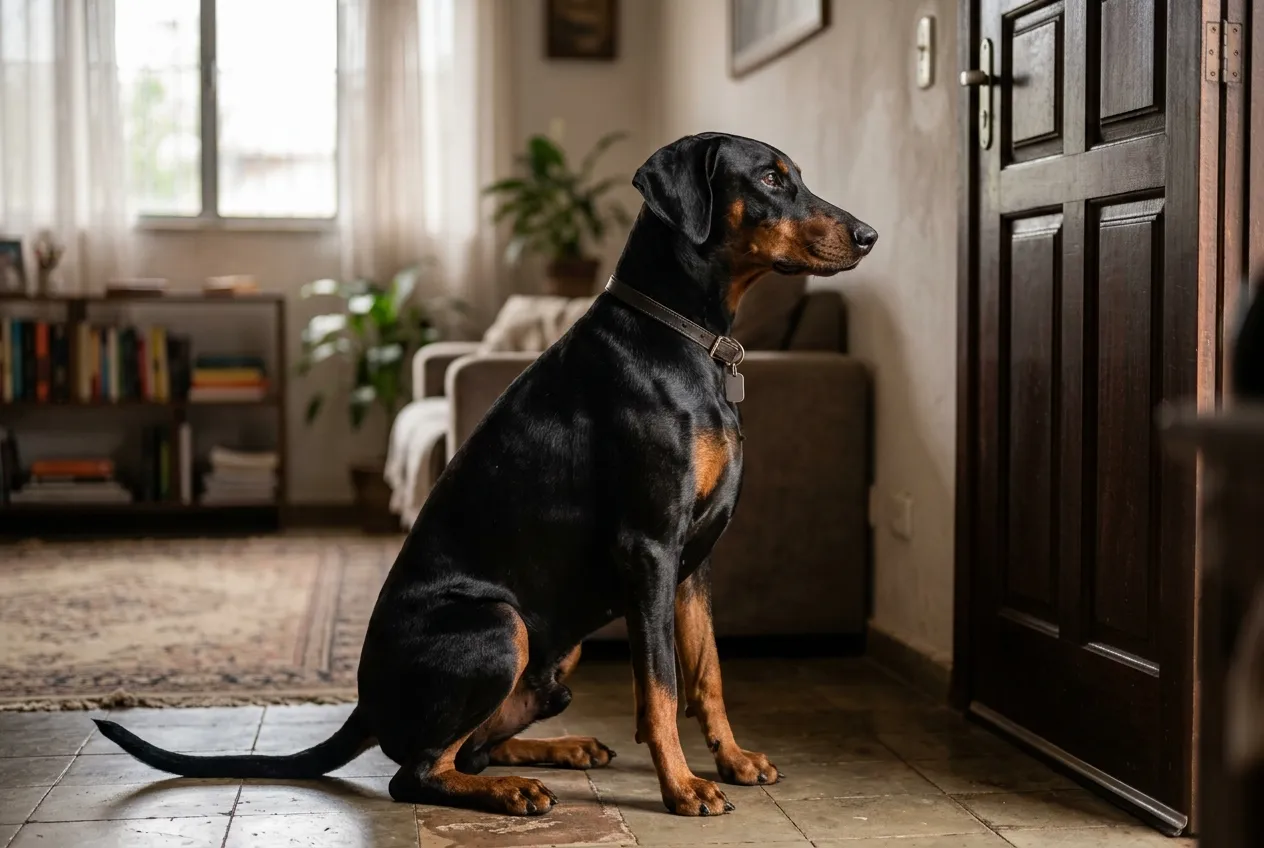
- A house empty for ten, twelve hours every day, with no dog walker or daycare. The Doberman is too attached for that, and separation anxiety in a dog this size destroys the house and his own health.
- Nobody willing to go out in the rain. The need for exercise doesn't check the weather forecast.
- Someone who wants a gate guard dog. The Doberman is not a dog to live loose in the yard keeping watch. He guards the family by being with them.
- A first experience with dogs, without the support of a trainer. The issue here is intelligence: he learns too fast to be raised without direction, and absorbs the wrong with the same speed he absorbs the right. The five commands that change coexistence are in Doberman training.
Frequently asked questions
What is the minimum apartment size for a Doberman?
There is no number. There are Dobermans doing very well in a 60 square meter apartment with an owner who walks, and unhappy Dobermans in a 300 square meter penthouse with no walks. What decides is the exercise routine. The floor plan comes after.
Does a Doberman bark a lot in an apartment?
No, when he's well exercised and comes from a good origin. He alerts when someone arrives and stops. Repetitive barking for no reason is a sign of boredom, anxiety or insecurity, and the way forward is to investigate the cause instead of trying to silence the dog.
Can you have a guard dog living in a building?
You can, with an adjustment of expectations. In an apartment, guarding is alarm and presence inside the home, and the building's front desk remains the first barrier. The Doberman fits that role well because he notices early, alerts and closes the subject when the owner arrives. The breeds that work in this situation are compared in a guard dog for an apartment.
Can I leave a Doberman alone during the day?
A few hours, yes, as long as he has been out beforehand and has something to do. What doesn't work is a full workday every day with no solution in the middle, like a dog walker or daycare.
Is a Doberman puppy in an apartment a lot of work?
It's the work of any large-breed puppy: pee in the wrong place in the first weeks, a chewing phase between the third and the seventh month, and a sleep routine that isn't yours yet. The difference is that he learns fast. With a consistent routine, the peeing tends to be sorted out within a few weeks.
Do I need a yard for him to do his business?
No. A large dog adapts well to the routine of going on the outings, and many prefer it that way. What needs attention is the regularity of the schedule, especially in the first year.
What to take from this reading
An apartment isn't an obstacle to raising a Doberman. Lack of routine is. If you have time for two outings a day, the willingness to go out in the rain and the head to occupy an intelligent dog, the building becomes a detail.
If you're thinking about a puppy, talk with the breeder about your real routine, not the ideal one. In a litter there are puppies that are more restless and puppies that are calmer, and whoever follows those weeks knows which one suits your home. Meet the next litter or talk to us so we can go over this before any decision.

About the author
Marcelo Vaz
Entrepreneur and founder of Dobs Kennel
Marcelo Vaz is an entrepreneur and the founder of Dobs Kennel, a Doberman kennel in Nísia Floresta (RN), Brazil. As a boy, he already knew which dog he wanted. That passion for the Doberman stayed with him over the years and became the kennel he now runs with the seriousness of someone who waited a long time for it. “We are not veterinarians, but we study every subject in depth and only write what is backed by science and reliable sources,” he says.
- RegistryCBKC / FCI
- Kennel nameImperio Real Norte
- WhereNísia Floresta, RN
Keep reading


Comments
Ask the breeder directly. Every comment is moderated before it appears, and your email is never published.
Be the first to comment: ask the breeder directly.