


In this article
- Can dogs eat eggs? The short answer
- What's inside an egg
- Egg, chicken or liver: what each one provides
- Benefits of eggs for dogs: what's real
- Can dogs eat raw eggs?
- Hard-boiled eggs for dogs: how to prepare them
- Eggshell for dogs
- How many eggs can a dog eat a day? The math by weight
- Eggs at every stage of a Doberman's life
- When to feed eggs: timing, meals and frequency
- What changes in a breed like the Doberman
- When not to feed eggs, or only after talking to your vet
- How to tell if eggs agree with your dog
- When eggs turn into a homemade diet
- Frequently asked questions
- Where the numbers come from
Yes, dogs can eat eggs: whole, preferably cooked, unseasoned and in an amount that fits within the 10% of daily calories set aside for extras. For a large adult dog such as a Doberman, at 32 to 45 kg, the routine we suggest is one egg, three or four times a week, chopped or mashed over the food; for smaller dogs the portion drops in proportion to body weight, as the table further down shows. For puppies it stays between a quarter and half an egg, and in seniors the egg takes on a role people tend to forget: helping hold on to muscle mass.
On October 5, 2026, we published a four-slide series on Instagram about eggs in the Doberman's diet. Afterwards, a question came in from the owner of a 3-month-old female puppy: add egg to the food, or stick with the food alone for now? This article answers that question in more depth than a carousel can hold.
Can dogs eat eggs? The short answer
- Preferably cooked, with the white and yolk set firm; raw only with the precautions explained further down.
- The whole egg, with no salt, oil, butter, milk, onion, garlic or seasoning.
- All of the day's extras, added together, stay at or below 10% of calories. The egg shares that space with training treats.
- Puppy: ¼ to ½ egg, 2 to 3 times a week. Adolescent: ½ to 1 egg, 3 times. Adult: 1 egg, 3 to 4 times. Healthy senior: ½ to 1 egg, 3 to 4 times, with calories counted.
- Mixed into a meal and well away from intense exercise, as a complement to a complete and balanced food.
- No shell and no calcium supplement, especially for large-breed puppies and pregnant females.
All of this applies to a healthy dog at a proper weight that eats a complete and balanced food. A diagnosed illness, a prescription diet or an allergy changes the math, and in those cases the decision belongs to the veterinarian who looks after your dog.
What's inside an egg
The figures below come from USDA FoodData Central, the food composition database of the United States Department of Agriculture (USDA), for a 50 g whole chicken egg without the shell, which is roughly the medium-to-large egg sold in Brazil. Cooking changes energy and protein very little; lutein loses the most, about 30% in a boiled egg. The table goes beyond the items the series highlighted, because what an egg lacks guides its use as much as what it has.
| Nutrient | In 1 egg (50 g) | What matters for the dog |
|---|---|---|
| Energy | 72 kcal | This is the number that sets the portion. It equals about 20 g of dry food. |
| Protein | 6.3 g | Complete amino acid profile and excellent digestibility. |
| Fat | 4.8 g, of which 1.6 g saturated | Almost all in the yolk. Concentrated energy that carries vitamins A, D and E. |
| Choline | 147 mg | An essential nutrient that often falls short in homemade diets. |
| Selenium | 15 µg | Part of the body's defense against oxidative stress. |
| Zinc | 0.65 mg | Skin, coat and immunity, in a small dose per egg. |
| Vitamin B12 and riboflavin (B2) | 0.45 µg and 0.23 mg | Energy metabolism. |
| Vitamin A | 80 µg | All in the yolk. |
| Vitamin D | 1.0 µg (41 IU) | A small amount; it doesn't replace what the food already supplies. |
| Lutein and zeaxanthin | 252 µg | The yellow pigments in the yolk. |
| Calcium | 28 mg | Next to nothing. |
| Phosphorus | 99 mg | More phosphorus than calcium, nearly all in the yolk. |
| Copper | 0.04 mg | Very low, which is good news in a breed predisposed to copper buildup in the liver. |
Swipe the table sideways to see all the columns.
The figure that does the most to guide how eggs are used is the calcium-to-phosphorus ratio, about 1:3.5. A complete food keeps more calcium than phosphorus, at a ratio between 1:1 and 2:1. That is why the egg goes in as a complement to the food: in a small portion it leaves that balance alone, but if it took up a large part of the bowl, it would throw off the mineral math the food is built on.
Egg white and yolk do different jobs
The white is almost entirely protein and water. The yolk holds the energy, the fat, the choline and the vitamins.
| In a 50 g egg | White (33 g) | Yolk (17 g) |
|---|---|---|
| Energy | 17 kcal | 55 kcal |
| Protein | 3.6 g | 2.7 g |
| Fat | 0.1 g | 4.5 g |
| Choline | 0.4 mg | 139 mg |
| Vitamin A | 0 | 65 µg |
| Lutein and zeaxanthin | 0 | 186 µg |
| Phosphorus | 5 mg | 66 mg |
Swipe the table sideways to see all the columns.
White and yolk come from separate USDA records, so their sum doesn't match the whole egg exactly.
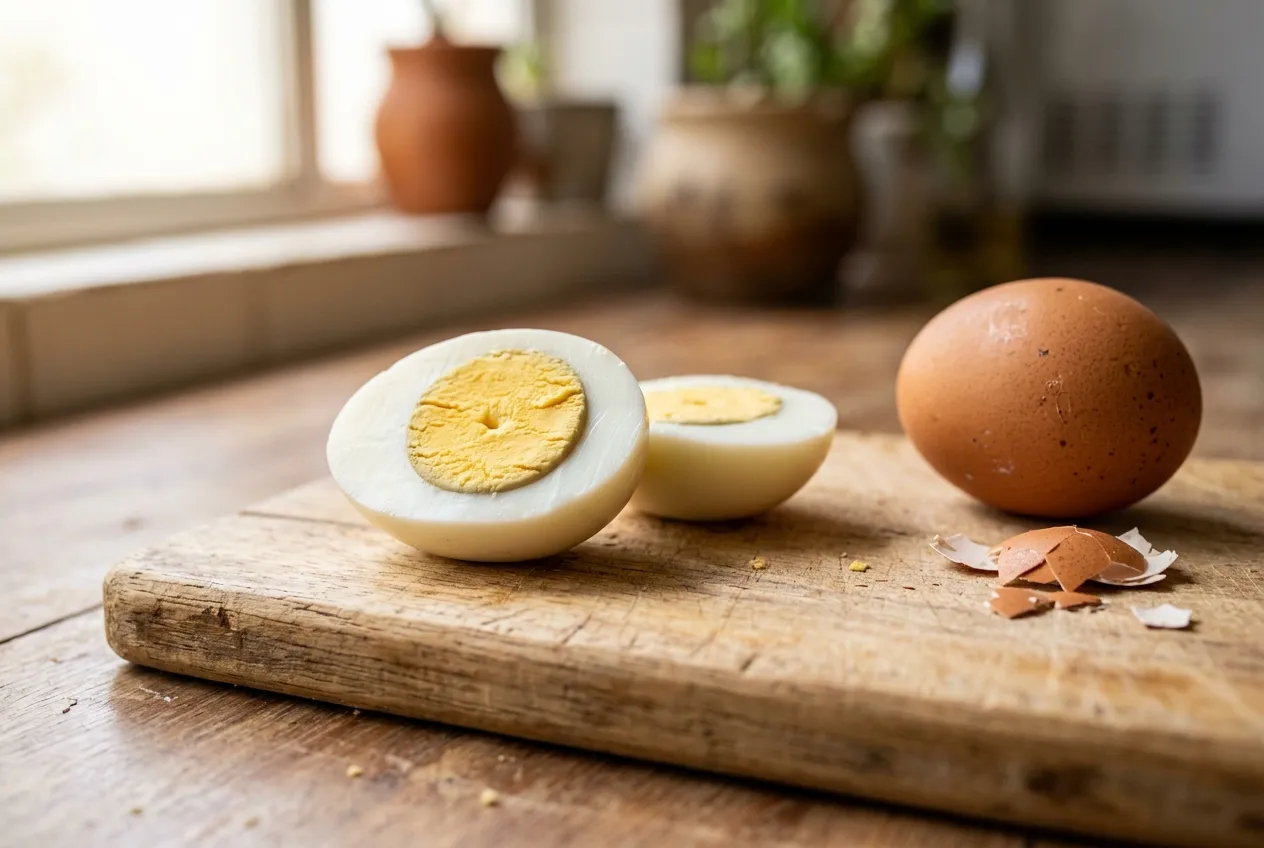
Three quarters of the calories and practically all of the choline are in the yolk. That opens up two options. An overweight dog that loves eggs can get just the cooked white, at 17 kcal, as a light treat; a thin dog, a senior or a dog with a poor appetite gets more out of the yolk. For a healthy dog, the whole egg is the right balance, and there's no reason to throw the yolk away.
Egg, chicken or liver: what each one provides
People who think about eggs usually think about chicken breast and liver too, the most common home-cooked add-ons. Comparing them per 100 g shows they have different uses, and liver has one feature that matters a great deal in Dobermans.
| Per 100 g | Whole egg | Roasted chicken breast, skinless | Raw beef liver |
|---|---|---|---|
| Energy | 143 kcal | 165 kcal | 135 kcal |
| Protein | 12.6 g | 31.0 g | 20.4 g |
| Protein per 100 kcal | 8.8 g | 18.8 g | 15.1 g |
| Fat | 9.5 g | 3.6 g | 3.6 g |
| Choline | 294 mg | 85 mg | 333 mg |
| Copper | 0.07 mg | 0.05 mg | 9.8 mg |
| Vitamin A | 160 µg | 6 µg | 4,968 µg |
Swipe the table sideways to see all the columns.
Chicken delivers twice the protein per calorie, so for lean protein it has the edge. Eggs bring three and a half times the choline in chicken, plus vitamin A and lutein, which chicken practically lacks, and a fat content that makes the meal far more appealing. Liver sits in another category: it has more than a hundred times the copper in an egg and about thirty times the vitamin A, a nutrient that builds up in the body when there's a surplus. A small amount of liver can be part of a formulated diet, but it doesn't work as a free-choice treat, and in Dobermans, because of the copper, it calls for even more care. Of the three, eggs are the simplest add-on to use safely day to day.
Benefits of eggs for dogs: what's real
The caption of the series listed seven benefits of eggs. All of them have a basis, though they don't carry equal weight, so the table below separates what the evidence supports from what is secondary.
| What the caption listed | What is known | How to read it |
|---|---|---|
| High-quality protein | Well supported. In a Brazilian study, dried egg showed 91.3% crude protein digestibility in Beagles, and in a preference test with 20 dogs, the food containing 4% egg was the one they chose. | The quality is real. A complete food already provides enough protein for a healthy adult, so eggs add quality and flavor without being indispensable. |
| Source of choline | Choline is an essential nutrient, and complete foods are already formulated with it. In homemade diets it is often missing. | Carries real weight for people who cook for their dog. With a complete food, it works as a top-up. |
| Biotin and B vitamins | They take part in skin, coat and energy metabolism. A true deficiency is rare in a dog eating a complete food. | Eggs don't treat hair loss. A poor coat in a Doberman calls for investigation: thyroid, allergy, parasites and, in blues and fawns, color dilution alopecia. |
| Lutein and zeaxanthin | The link to the retina is well studied in people. In dogs, the scientific basis is much thinner. | Interesting, but secondary. |
| Selenium and zinc | They are in eggs, in small amounts per egg. | A complete food already covers the requirement. Up-to-date vaccines, deworming and the right weight do far more for immunity. |
| Fat and vitamins A, D and E | Nearly all of it is in the yolk, as concentrated energy. | Helps a thin, active dog or a senior with no appetite. Works against a dog that is already overweight. |
| Muscle mass support | Protein is the raw material of muscle, which only builds or holds with enough exercise and energy. | On its own, an egg doesn't build muscle. It helps most in seniors, as we show further on. |
Swipe the table sideways to see all the columns.
Can dogs eat raw eggs?
Yes. Raw egg is not toxic to dogs, and many dogs eat raw eggs with no problem at all. What weighs against it is the risk, small for each egg but real: a raw egg can carry Salmonella, and an infected dog often doesn't get sick but goes on to carry the bacteria and pass it to the people it lives with. That is why the AVMA (the American Veterinary Medical Association) and the FDA (the U.S. Food and Drug Administration) recommend avoiding raw animal protein, eggs included. The other issue is avidin in raw egg white, a protein that binds biotin: an occasional raw egg makes no difference, and the problem that has been described comes from large amounts of raw egg white, every day, over a long period. Cooking solves both.
If you choose to feed raw, a few precautions reduce the risk:
- Fresh eggs from an inspected source, with a clean, intact shell, kept in the fridge.
- Cracked right before serving; wash your hands, the bowl and the counter afterwards.
- The whole egg, now and then, and never large amounts of raw egg white every day.
- Avoid it for puppies, senior or sick dogs, pregnant females and in homes with a baby, an older adult or someone with weakened immunity.
For everyday feeding, cooked is still what we recommend: it delivers the same protein and the same fats without any of these precautions.
Hard-boiled eggs for dogs: how to prepare them
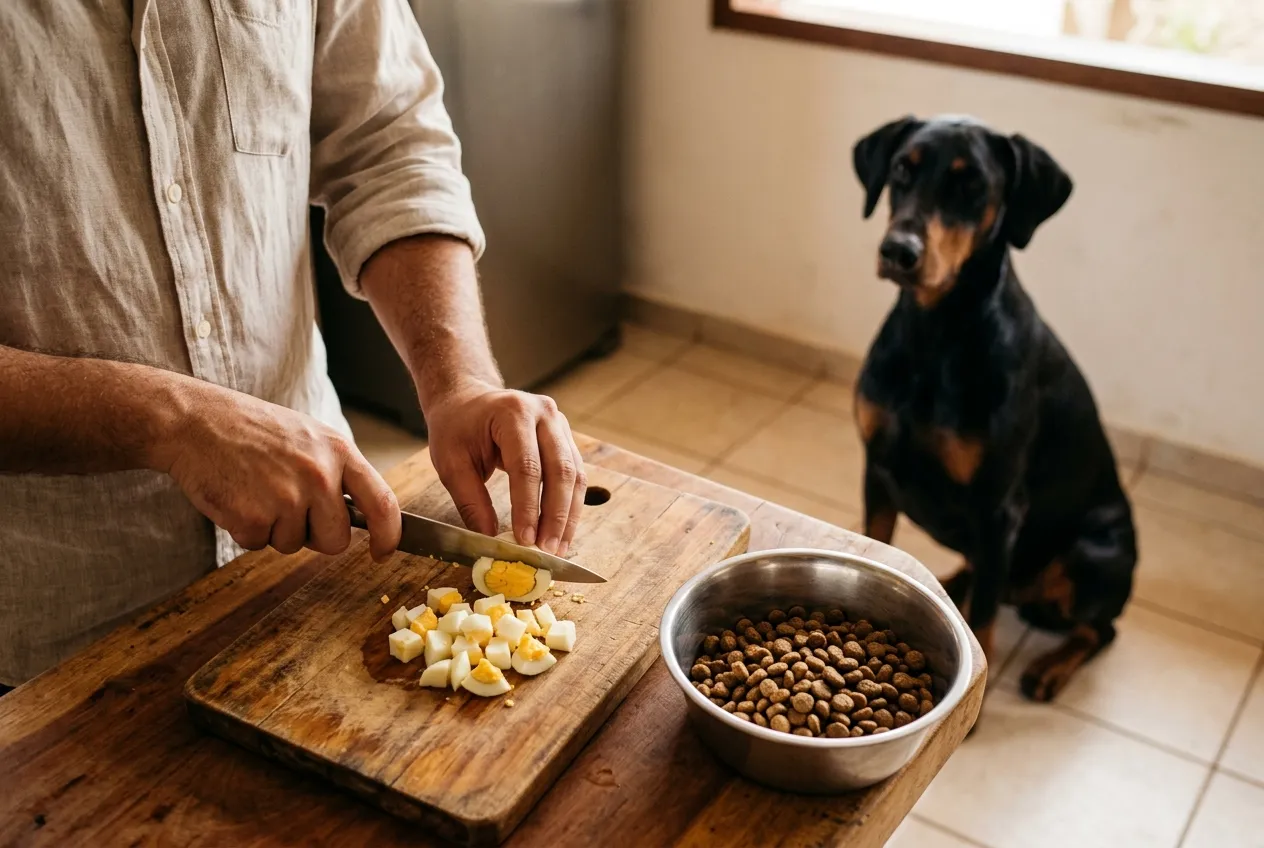
- Cook the whole egg in boiling water for 10 to 12 minutes, until the white and yolk are firm, with no soft spots.
- Cool it under running water, peel it and throw the shell away.
- Chop or mash it to suit the dog's size: crumbs for a puppy, bigger pieces for an adult.
- Mix it into the meal's food or cut it into cubes for training. One boiled egg makes about 40 small 1 cm pieces, at about 2 kcal each.
- Store leftovers in the fridge, in a closed container, and use them within a few days. A boiled egg left out of the fridge for hours should be thrown away.
| Preparation | Okay? | Why |
|---|---|---|
| Hard-boiled | Yes, the best option | Safe, easy to portion, no added fat. |
| Scrambled in a nonstick pan, with nothing added | Yes | As long as there's no oil, butter, milk, salt or seasoning, and it's cooked through. |
| Poached until fully set | Yes | Same logic as hard-boiled. |
| Fried | No | The oil adds calories and fat, which are hard on the pancreas. |
| Omelet or eggs from your own plate | No | Usually made with salt, onion and garlic, toxic to dogs even when cooked or powdered. |
| Raw or with a runny yolk | With precautions | See the section on raw eggs. Never for puppies, seniors, sick dogs or homes with a baby. |
Swipe the table sideways to see all the columns.
Eggshell for dogs
Eggshell is almost entirely calcium carbonate, and calcium carbonate is 40% calcium. The shell of a large egg, weighing around 5 to 6 g, carries close to 2 g of calcium, dozens of times what the whole egg contains (28 mg). That is exactly why it shows up in homemade recipes as a calcium source, and also why it shouldn't be given on your own initiative. In large-breed puppies, excess calcium is what the guidelines of FEDIAF, the European Pet Food Industry Federation, treat as a risk to the developing skeleton. In a pregnant female, extra calcium can predispose her to eclampsia after whelping. In an adult eating a complete food, it is simply surplus. Eggshell only has a place when a veterinarian calculates the amount within a formulated homemade diet, and never raw, because the surface can carry Salmonella.
How many eggs can a dog eat a day? The math by weight
The rule that organizes everything is the calorie rule. The nutrition guidelines of AAHA, the American Animal Hospital Association, recommend that treats and any food outside the complete diet add up to no more than 10% of the day's energy. Eggs, training treats, fruit and anything else that isn't the dog's regular food all go into that same count.
To estimate daily energy, the standard resting energy formula is used: 70 multiplied by body weight in kg raised to the power of 0.75. The same AAHA guidelines give the factor that multiplies this result: 1.4 to 1.6 for a neutered adult, 1.6 to 1.8 for an intact adult and 1.0 to 1.2 for an inactive dog or one that gains weight easily; for puppies, 3.0 up to 4 months of age and 2.0 after that. For seniors, FEDIAF indicates on average 10% to 15% less energy than for adults. These are starting points, and FEDIAF itself notes that each dog strays from the average because of activity, environment and coat. What confirms the math is the body: ribs you can feel without effort and a waist visible from above.
The same math works for a 5 kg dog or a 60 kg dog, and the table shows it. The Doberman rows are highlighted because it is the breed we raise; from one dog to the next, what changes is the weight, and the math stays the same.
| Adult dog | Energy per day (neutered to intact) | Cap on extras (10%) | Cap in eggs | Sensible routine |
|---|---|---|---|---|
| 5 kg | 330 to 420 kcal | 33 to 42 kcal | about ½ egg | ¼ egg, 2 to 3 times a week |
| 10 kg | 550 to 710 kcal | 55 to 71 kcal | about 1 egg | ½ egg, 2 to 3 times a week |
| 20 kg | 930 to 1,190 kcal | 93 to 119 kcal | up to 1½ eggs | ½ to 1 egg, 3 times a week |
| Female Doberman, 32 kg | 1,320 to 1,700 kcal | 132 to 170 kcal | up to 2 eggs | 1 egg, 3 to 4 times a week |
| Male Doberman, 40 kg | 1,560 to 2,000 kcal | 156 to 200 kcal | 2 to 2½ eggs | 1 egg, 3 to 4 times a week |
| Male Doberman, 45 kg | 1,700 to 2,190 kcal | 170 to 219 kcal | 2½ to 3 eggs | 1 egg, 3 to 4 times a week |
| 60 kg | 2,110 to 2,720 kcal | 211 to 272 kcal | 3 to 3½ eggs | 1 egg, 3 to 4 times a week |
Swipe the table sideways to see all the columns.
The last two columns do different jobs. The cap is the safety limit for all of the day's extras combined, and almost no dog needs to reach it with eggs. The sensible routine is what we recommend as a habit: it leaves room for training treats and keeps the egg as variety. For an inactive dog or one that gains weight easily, the cap drops by about a third, and so does the routine.
To check it yourself: a 50 g egg has 72 kcal. A neutered 40 kg male Doberman burns about 1,650 kcal a day, and one egg is a little over 4% of that. Add up the other extras and see whether the total stays under 10%. The scale, or the feel of the ribs after four to six weeks, tells you whether the math worked out.
Eggs at every stage of a Doberman's life
The egg's role changes over a lifetime. In puppies, the concern is the balance of the growth food; in adolescents, the calorie budget that training uses up; in adults, weight; in seniors, the egg starts helping to maintain muscle. The ranges below are typical for the breed, and the FCI standard puts adults between 32 and 35 kg for females and between 40 and 45 kg for males.
| Stage | Typical age and weight | Energy per day (estimated) | Portion | Frequency | Main point |
|---|---|---|---|---|---|
| Puppy | 2 to 6 months, 8 to 25 kg | 1,000 to 1,600 kcal | ¼ to ½ egg | 2 to 3 times a week | Don't dilute the growth food |
| Adolescent | 6 to 18 months, 25 to 40 kg | 1,550 to 2,200 kcal | ½ to 1 egg | 3 times a week | Share the space with training treats |
| Adult | 18 months to 7 years, 32 to 45 kg | 1,300 to 2,200 kcal | 1 egg | 3 to 4 times a week | Keep an athlete's weight |
| Senior | 7 years and up | 1,300 to 1,650 kcal on average | ½ to 1 egg | 3 to 4 times a week | Protein to preserve muscle, with kidneys and weight checked |
Swipe the table sideways to see all the columns.
Can puppies eat eggs? (2 to 6 months)
This is the stage that calls for the most care, and it's where the question we received comes in: a 3-month-old female puppy, egg with the food or the food alone? Large-breed puppy food remains the foundation and the only source the puppy needs to grow. Eggs can come in as a small complement once the puppy is settled on its food and the stools are normal.

The reason for caution is balance. Growth food sets calcium, phosphorus and energy so the puppy grows slowly and evenly; too many extras dilute that calculation and add calories. FEDIAF states in its guidelines that overfeeding speeds up growth and can cause skeletal deformities, especially in large and giant breeds, and recommends that puppies never be fed free-choice. Calcium is the other side of the problem: ground eggshell or a supplement given on your own is the classic mistake, because high calcium harms the developing skeleton.
- How much: start with ¼ of a cooked egg, chopped and mixed into the food. Don't go beyond ½ egg, 2 to 3 times a week.
- When: at one of the day's meals, in the morning, so there's time to watch stools and behavior.
- One new food at a time. If loose stools, vomiting or itching show up, you have a clear suspect.
- Never to fatten up a thin puppy. A lean Doberman puppy whose ribs you can feel is in good shape; the chubby one is the one to worry about.
- Get your puppy's veterinarian to sign off, especially if there was diarrhea in the first days at home.
In the first days after arrival, nothing new goes into the bowl: the puppy eats what it was already eating, as we explain in our guide to the puppy's first week at home. What to look for on the food label at this stage is covered in nutrition for large-breed puppies.
Adolescent, 6 to 18 months
An adolescent Doberman is still growing. According to FEDIAF's growth curve for this weight range, it reaches about 90% of its adult weight at around 1 year and finishes maturing physically at around 2 years. The food stays a large-breed growth formula until the veterinarian advises the switch. What's new at this stage is training: it is when the dog learns the most and when training treats take up the biggest share of the 10% allowance.
Here eggs work very well as a high-value reward. Cut into 1 cm cubes, one egg makes about 40 small pieces, enough for one or two sessions. If the egg became a training treat that day, it stays out of the bowl. The sensible routine is ½ to 1 egg, three times a week, counting what went into training. The commands that most call for a strong reward are in our article on Doberman training.

Adult, 18 months to 7 years
For a healthy adult, the egg is variety and enjoyment: 1 egg, three to four times a week, mixed into one of the meals. Activity sets the margin. A Doberman that works, competes in a sport or runs every day burns more and fits the egg in easily. An apartment Doberman, neutered and with two short walks a day, burns far less, and for that dog the egg has to be taken out of the food portion.
The risk for an adult isn't the egg, it's the weight. Because the gain is gradual, check ribs and waist every month; if your hand has to press in to find the ribs, the egg comes out until the weight is back where it should be.
Senior, 7 years and up
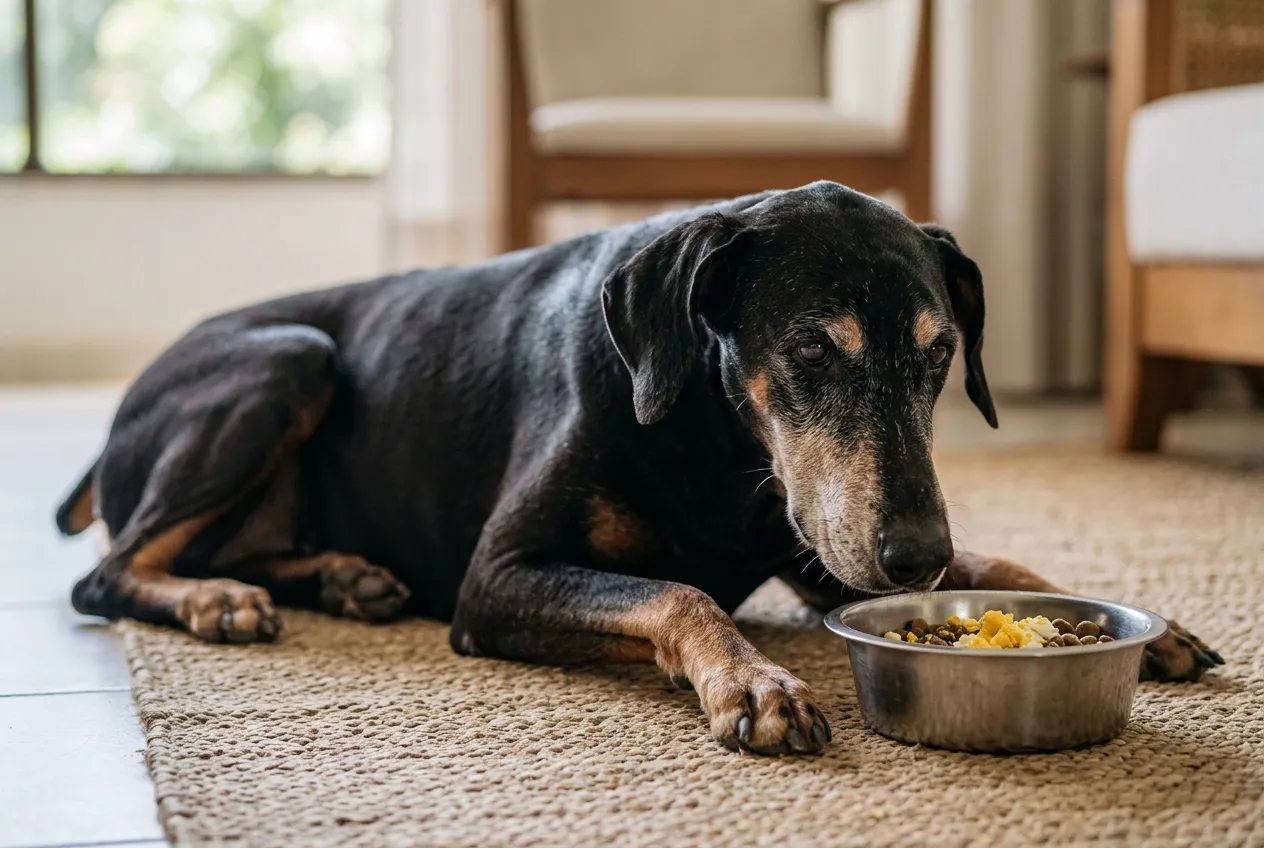
This is the stage where eggs have the most to offer. With age, dogs lose muscle mass, and the 2023 AAHA Senior Care Guidelines state that healthy seniors do not need protein restriction and that the diet at this stage can include a slight increase in the quantity and quality of protein to offset the loss of lean mass. Eggs are high-quality protein, soft and tasty.
That benefit comes with conditions. The kidneys need to be checked, with blood and urine tests up to date: the egg's phosphorus is in the yolk, and for a dog with kidney disease on a controlled diet any extra changes the math, so it only goes in with guidance. Calories also matter more, because seniors tend to move less. And when appetite drops, a little crumbled yolk over the food can help spark interest in the bowl. The sensible routine is ½ to 1 egg, three to four times a week, always with the weight checked. What changes in the health routine at this stage is covered in how long Dobermans live, and switching food for seniors in feeding a Doberman at each life stage.
Special situations
- Pregnant or nursing female. Energy needs rise sharply, especially during lactation. The foundation is the diet the veterinarian recommends for this stage, and eggs can come in as a tasty complement. No eggshell or extra calcium during pregnancy: the excess can predispose her to eclampsia after whelping.
- Dog recovering or off its food. Eggs are palatable and easy to digest and can help a dog start eating again, but a dog that has stopped eating needs a diagnosis before any change to the bowl.
- Sport or working dog. Can get more, within the cap, on high-output days, always well apart from exertion, because of the stomach.
- Dog on a weight-loss diet. The whole egg stays out. If the dog really loves it, the cooked white, at 17 kcal, works as a light treat.
When to feed eggs: timing, meals and frequency
- With a meal. Mixed into the food, the egg becomes part of a controlled meal. Handed out between meals, it becomes a treat nobody counts and teaches the dog to beg.
- Away from intense exercise. The Doberman is a deep-chested dog, and bloat with gastric torsion (gastric dilatation-volvulus, GDV) is a real emergency in the breed. Meals, with or without egg, should be kept well apart from running, ball games or rough play, both before and after.
- Spread across the week. If it's four eggs a week, spread them over alternate days.
- Start on a calm day. Don't introduce eggs at the same time as a food change, a trip, a vaccine or a dewormer. If something goes wrong, you need to know what caused it.
- In training, take it out of the bowl. A day the egg was used as a reward is a day it stays out of dinner.
- Stop during vomiting or diarrhea. It comes back only after the dog has been normal for a few days.
What changes in a breed like the Doberman
The calorie math applies to any dog. There are three points where the Doberman calls for extra attention. None of them rules eggs out, and in none of them does the egg act as a treatment.
Heart
Dilated cardiomyopathy is one of the diseases that most shortens a Doberman's life. There is no evidence that eggs protect or harm the heart, and nothing in the series or in this article replaces screening with echocardiogram and Holter, which we describe in how to assess a Doberman's heart health. A complete and balanced diet is the starting point, and anyone who decides to cook for their dog needs to take extra care with the formulation, as we explain further down.
Liver and copper
The Doberman is one of the breeds in which copper buildup in the liver has been described, a condition that can progress to chronic hepatitis. A study of 546 dog livers, published in 2018, showed that liver copper concentration rose between 1982 and 2015 and that the effect is not limited to predisposed breeds. On this point eggs do very well: 0.07 mg of copper per 100 g, against 9.8 mg in beef liver. What counts in this breed is the whole diet added up, with organ meats, mineral supplements and the copper already in the food. If your Doberman has had abnormal liver enzymes or eats a prescription liver diet, ask your veterinarian before adding any food.
Weight and stomach
A deep chest, a stomach that can twist and a body built to be lean: the Doberman depends on the right weight more than many breeds do. The gastric torsion survey we cite in how long Dobermans live points to eating fast, having a single meal a day and using a raised bowl as risk factors; a chopped egg in a normal-sized meal doesn't change that picture. Weight changes a great deal. The most cited study on the subject, conducted by Purina, followed Labradors from puppyhood and showed that the group fed 25% less lived longer, at the median, and took longer to develop chronic disease. One egg a day without cutting back the food is energy that adds up.

When not to feed eggs, or only after talking to your vet
- Egg allergy or intolerance. Egg is not the most common allergen in dogs. In a review published in 2016, among 297 dogs with skin reactions caused by food, egg showed up in 11 (4%), behind beef (34%), dairy (17%), chicken (15%), wheat (13%), soy (6%) and lamb (5%). The authors caution that these figures don't measure how often the allergy occurs in the general population, but they show the reaction exists. Itching, paw licking, recurring ear infections and loose stools after eating egg mean it should come out of the routine.
- Pancreatitis, current or past. The yolk is concentrated fat.
- Kidney disease. For a dog on a renal diet, any extra changes the calculated phosphorus count. The AAHA senior guidelines indicate that protein restriction starts to be considered from stage 2 of kidney disease, and from that point eggs only go in with guidance.
- Diabetes, hypothyroidism or high blood fats. These are conditions in which fat metabolism changes, and the amount needs to be set with the veterinarian.
- A prescribed therapeutic diet, whether for the liver, kidneys, allergy or weight loss. Any extra alters what was calculated.
- A newly arrived puppy or one with diarrhea. First the routine settles, then something new can come in.
How to tell if eggs agree with your dog
In the first days after you introduce eggs, stools should stay firm and well formed, with no unusual gas. Over four to six weeks, the weight should hold steady and the ribs should be easy to feel. New itching, ear infections, paw licking or recurring loose stools are reasons to take the egg out and talk to your veterinarian. Any change in the coat, if it comes, shows up over weeks, because hair takes time to grow, and it depends more on the whole diet and on skin health than on the egg itself.
When eggs turn into a homemade diet
Every conversation about eggs ends up at natural or homemade diets: if eggs are good, why not make the whole meal at home? A well-designed homemade diet exists and is a legitimate choice, but the track record of people who try it on their own is poor. A study from the University of California, Davis evaluated 200 homemade diet recipes for dogs, taken from veterinary textbooks, pet care books and websites, 129 of them written by veterinarians. In 95% of them at least one essential nutrient was missing, and the gaps included choline, vitamin D, zinc and vitamin E. The four recipes written by board-certified veterinary nutritionists were complete.
Anyone who wants to move away from a complete food needs a veterinarian trained in nutrition, who builds the recipe for the dog's weight, age and health, with mineral and vitamin supplementation in the right place, and who follows up with lab work. Building a diet from something seen on social media is the shortest path to a deficiency, and that applies to this article too, which teaches how to use eggs within a complete diet. The cost of each feeding choice goes into the monthly budget we worked out in how much it costs to keep a Doberman per month.
Frequently asked questions
Can dogs eat eggs every day?
Yes, if the calorie math works out and the weight doesn't climb. For most adult dogs, Dobermans included, it isn't necessary: three to four times a week is already a good routine and leaves room for training treats. Every day makes sense for a lean, very active dog, or for a senior that needs protein, with your veterinarian's approval.
How many eggs can a dog eat a day?
Under the 10% rule, the cap is about half an egg for a 5 kg dog, one egg for 10 kg, one and a half for 20 kg and around two for an adult Doberman, less if the dog is neutered and inactive. That cap covers all extras together, so in practice one egg in a day is already plenty for a big dog, and it doesn't even need to be every day.
Can a 3-month-old puppy eat eggs?
Yes, cooked, in portions of ¼ to ½ egg, two to three times a week, once the puppy is settled on its food and the stools are normal. The growth food remains the foundation. No shell and no extra calcium.
Can dogs eat egg yolks? What about egg whites?
They can eat both, cooked. The yolk concentrates calories, fat, choline and vitamins; the white is almost pure protein, at 17 kcal. For a healthy dog, the whole egg is best. The white alone suits a dog on a diet; extra yolk suits a thin dog or a senior with no appetite, with guidance.
Can dogs eat scrambled or fried eggs?
Scrambled, yes, as long as it's made in a nonstick pan with no oil, butter, milk, salt or seasoning, and cooked through. Fried, no: the oil adds fat and calories.
Do raw eggs make a dog's coat shinier?
There's no evidence that raw eggs give more shine than cooked ones. A shiny coat comes from a complete diet, fatty acids, healthy skin and parasite control, and a cooked egg delivers the same fats and biotin the body can use. If you choose raw, the precautions in the raw-egg section apply.
My dog ate a raw egg. What now?
A single raw egg usually passes without trouble. Watch the dog for two to three days: vomiting, diarrhea, fever or lethargy call for the veterinarian. During that time, wash your hands well after picking up the stools and take extra care if there are children, older adults or people with weakened immunity at home.
Can a dog with diarrhea eat eggs?
This is not the time for anything new in the bowl. If the veterinarian recommends a bland diet for a few days, they will tell you what goes into it. A puppy with diarrhea, or any dog with vomiting, blood in the stool or lethargy, goes to the veterinarian before any adjustment at home.
Is egg yolk bad for dogs because of cholesterol?
For a healthy dog, the cholesterol in eggs is not the central issue. In dogs, atherosclerosis appears mainly in association with hormonal diseases: in a necropsy study, dogs with atherosclerosis were 53 times more likely to have diabetes and 51 times more likely to have hypothyroidism than dogs without the lesion. What deserves attention in the yolk is fat and calories, because of obesity and pancreatitis.
Can dogs eat eggshells?
Not as a routine. One shell has close to 2 g of calcium, and excess calcium harms the skeleton of a large-breed puppy and can predispose a female to eclampsia. Only when a veterinarian calculates the amount within a formulated homemade diet, and never raw.
Can dogs eat quail eggs?
Yes, by the same logic. A quail egg weighs about 9 g and has 14 kcal, so five of them equal one chicken egg in energy. Cooked, peeled and in a counted portion.
Can eggs give dogs diarrhea?
They can, especially when introduced suddenly, in a large amount or to a sensitive dog. That's why the introduction starts small. Loose stools that clear up within a day are usually the food change; repeated vomiting, lethargy, blood in the stool or symptoms lasting more than a day call for the veterinarian, and with a puppy that wait should be shorter, because puppies dehydrate quickly.
Do eggs make dogs gain weight?
They do if they aren't counted. One egg has 72 kcal, close to 20 g of dry food. Given every day on top of the usual portion, it turns into extra weight within a few months.
Can I mix eggs into dry dog food?
Yes, and it's the best way. Crumble the cooked egg over the food at serving time and don't leave the mix sitting in the bowl for hours, especially in hot weather.
Does this advice apply to dogs of other sizes?
The calorie rule does, and the table shows the math from 5 to 60 kg. What changes from one dog to another is weight, age, activity and health. For a 5 kg dog, a whole egg goes over the day's cap on extras, nearly double it, and the portion is ¼ egg; for a 10 kg dog, one egg fills the entire allowance.
Where the numbers come from
This article brings together reference nutrition information and does not replace a consultation with your dog's veterinarian, who knows its test results, weight and history. The sources:
- Composition of whole egg, egg white, yolk, chicken breast and beef liver: USDA FoodData Central, records 171287, 172183, 172184, 171477 and 169451; quail egg, 172191.
- Raw or undercooked animal protein: AVMA policy on cat and dog diets and FDA guidance on raw pet food diets.
- The 10% rule and energy factors: 2021 AAHA Nutrition and Weight Management Guidelines.
- Protein in seniors and kidney disease: 2023 AAHA Senior Care Guidelines.
- Energy by age, puppy growth and calcium in large breeds: FEDIAF Nutritional Guidelines, October 2021 edition.
- Onion and garlic: Merck Veterinary Manual, Allium toxicosis. Calcium and eclampsia: Merck Veterinary Manual, eclampsia in small animals.
- Eggshell composition: Journal of the Royal Society Interface, 2021.
- Food allergy in dogs: Mueller RS, Olivry T, Prélaud P. BMC Veterinary Research, 2016.
- Homemade diets: Stockman J, Fascetti AJ, Kass PH, Larsen JA. JAVMA, 2013;242(11):1500-1505.
- Liver copper: Strickland JM et al. J Vet Intern Med, 2018;32(6):1943-1950; Spee B et al. Comparative Hepatology, 2005, on the copper toxicosis variant in Dobermans.
- Atherosclerosis in dogs: Hess RS, Kass PH, Van Winkle TJ. J Vet Intern Med, 2003;17(4):489-494.
- Calorie restriction and longevity: Kealy RD et al. JAVMA, 2002;220(9):1315-1320.
- Egg digestibility and palatability in dogs: Andrade T et al. Semina: Ciências Agrárias, 2019;40(1).

About the author
Marcelo Vaz
Entrepreneur and founder of Dobs Kennel
Marcelo Vaz is an entrepreneur and the founder of Dobs Kennel, a Doberman kennel in Nísia Floresta (RN), Brazil. As a boy, he already knew which dog he wanted. That passion for the Doberman stayed with him over the years and became the kennel he now runs with the seriousness of someone who waited a long time for it. “We are not veterinarians, but we study every subject in depth and only write what is backed by science and reliable sources,” he says.
- RegistryCBKC / FCI
- Kennel nameImperio Real Norte
- WhereNísia Floresta, RN
Keep reading


Comments
Ask the breeder directly. Every comment is moderated before it appears, and your email is never published.
Be the first to comment: ask the breeder directly.