


In this article
- The real math of longevity
- The heart: the most important conversation in the breed
- Why screening takes two exams, not one
- What else shortens life (and is avoidable)
- Lean is the cheapest medicine there is
- The plan for each life stage
- Greater Natal's heat goes into the math
- Questions that come in on WhatsApp
- The breeder's role in this math
The question from anyone thinking about getting a Doberman (or who already loves one): how long will he live? The honest answer: on average 10 to 13 years — and the gap between the low end and the high end of that range is rarely luck. It comes down to tested genetics, the right weight and a heart exam done at the right time. Let's look at what stretches it and what shortens it.
The real math of longevity
The Doberman is a big, athletic dog, and large size tends to take a toll on longevity. Within the normal range for the breed, a well-bred, well-cared-for dog reaches 10 in good health and often goes past 12. What pulls that average down almost always has a name, and the main culprit is a single one.
It's worth knowing how big we're talking, because size explains half of the math. The official breed standard (FCI No. 143, the same one the CBKC adopts) puts the male at 68 to 72 cm at the withers, weighing around 40 to 45 kg, and the female at 63 to 68 cm, at 32 to 35 kg. It's a tall dog with a lean frame, without the bulk a Rottweiler carries at the same height. That combination is good news for the joints and bad news for the heart, which spends a whole lifetime pumping for a long body.
The heart: the most important conversation in the breed
Dilated cardiomyopathy (DCM) is the disease that cuts the most Doberman lives short in the world. It weakens the heart muscle silently, for years, before any symptom shows. Two facts every owner needs to know:
- It is largely genetic — which is why a serious breeder tests breeding dogs before mating them. It's the difference between inheriting a risk you can monitor and inheriting a sentence.
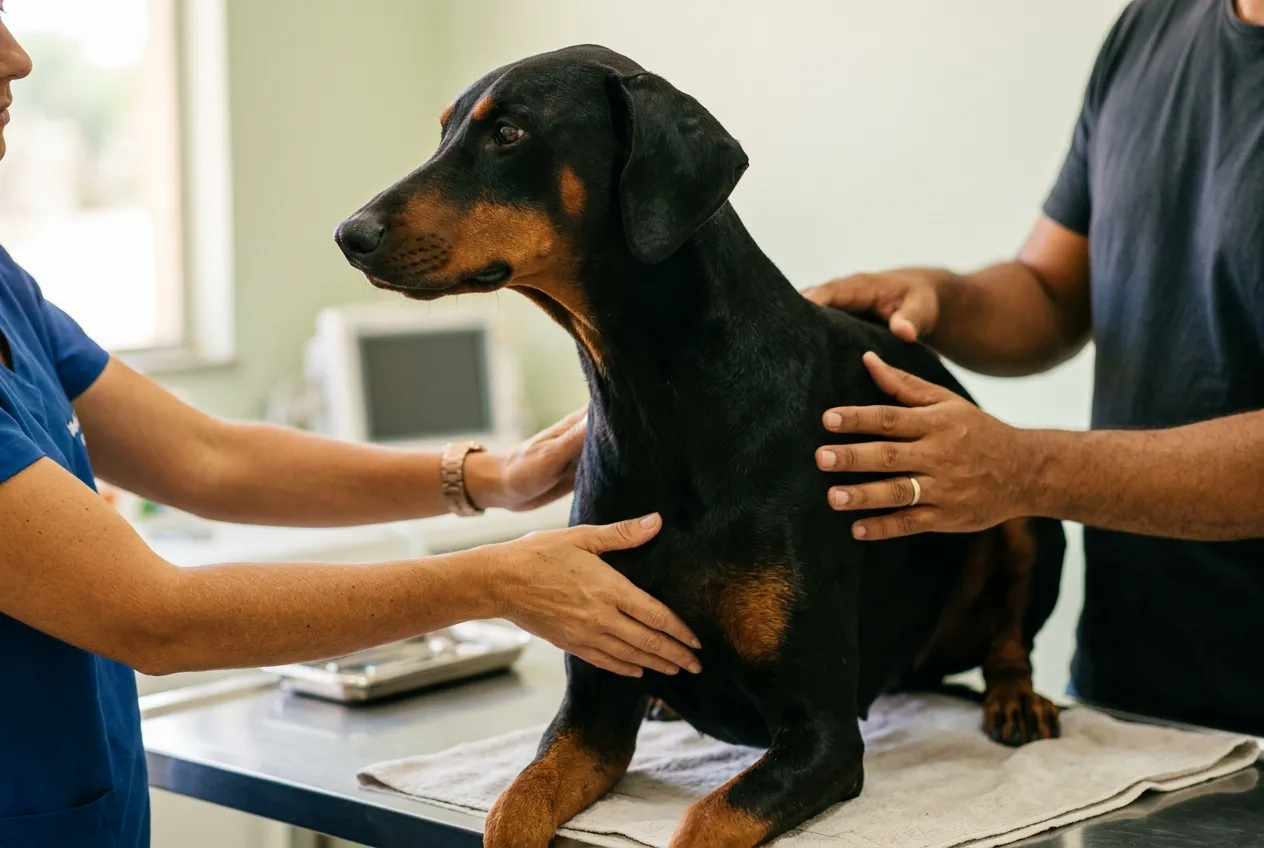
- It can be detected before symptoms: an annual echocardiogram and Holter from adult life on catch the disease early, when treatment adds years of life. We explain the step by step in how to assess a Doberman's heart health.
Why screening takes two exams, not one
Whoever comes to the subject for the first time asks whether the echo alone is enough. It isn't, because the two exams look at different things. The echocardiogram measures the size and contraction strength of the left ventricle, in other words, it sees the muscle giving way. The Holter is an electrocardiogram recorder the dog wears at home for 24 hours, living his normal routine, and it counts the beats out of rhythm (the ventricular premature complexes).
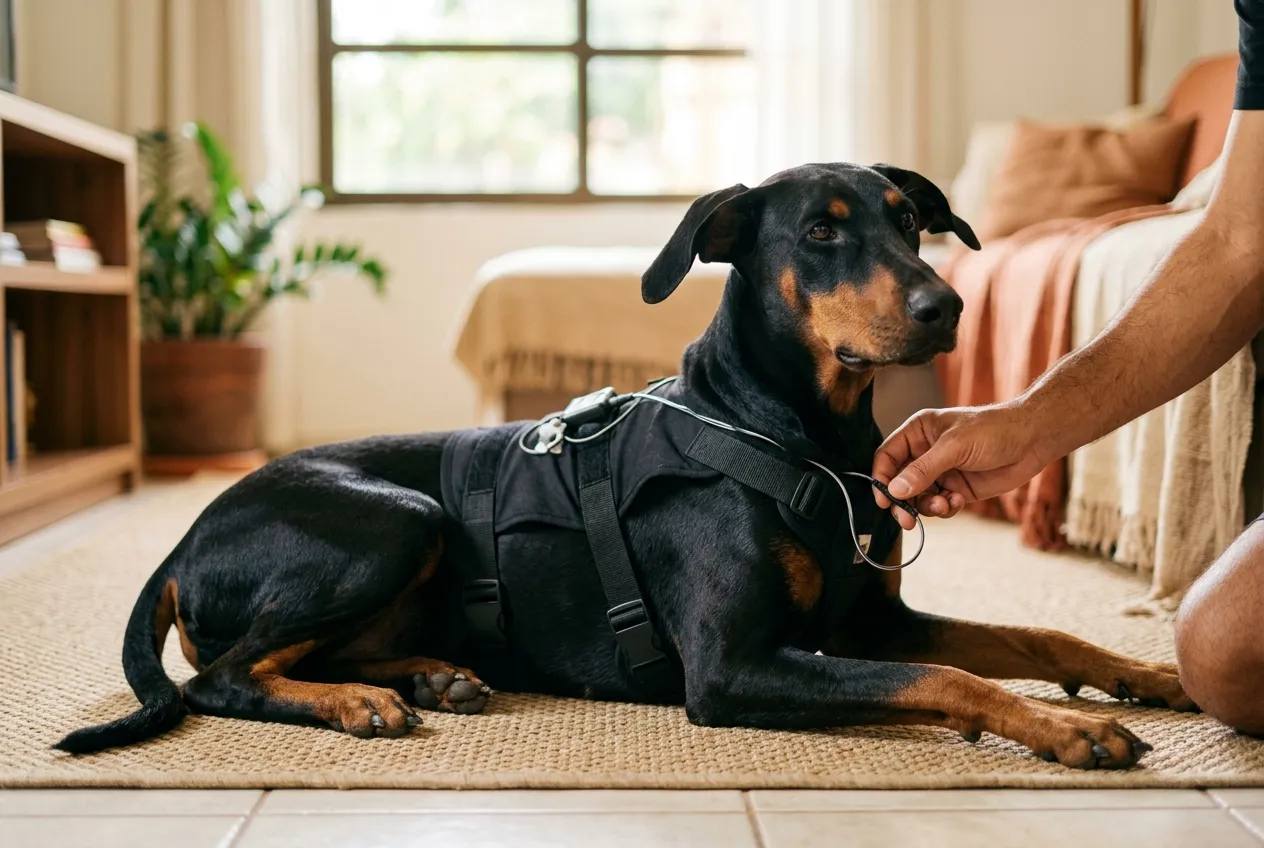
The order in which the disease shows up changes from dog to dog. Some Dobermans start with the arrhythmia while the ventricle is still within normal limits, and others are the other way around. That's why the European screening protocols call for both in the same year, from 3 years of age on, and treat the Holter count as a graded alarm: a few premature complexes in 24 hours are expected noise, a few dozen mean repeating the test within a few months, and going past a hundred in a single day is already a finding that requires follow-up, even with the dog running normally in the yard.
A practical detail that saves money: schedule both in the same week. The Holter is rented by the day, and the cardiologist's report comes out cheaper and more useful when he reads the two exams side by side.
Write the date of the last echo on the fridge. It's the cheapest reminder there is.
What else shortens life (and is avoidable)
- Obesity: joints suffering, heart overloaded. A Doberman is an athlete; an athlete's body is kept in shape with the right nutrition from puppyhood and daily exercise.
- Gastric torsion: a typical emergency in deep-chested breeds. Lower the risk by splitting the food into two or three meals and avoiding intense exercise right after eating. A swollen belly and retching with no vomit means the hospital now, not tomorrow.
- Origin without criteria: a puppy from an accidental litter or from a resale inherits the risk nobody tested. It's the part of longevity that is decided before you meet the dog — we cover that difference in planned litter × accidental litter.
About torsion, a detail almost nobody mentions. The classic Purdue University study of deep-chested breeds identified as risk factors eating fast, being fed a single meal a day, using a raised feeder and having a first-degree relative that had already had a torsion. The raised feeder became a fashion with the promise of helping digestion, and the study linked it to exactly the opposite. If your Doberman is going to be neutered, talk to the vet about doing the preventive gastropexy under the same anesthesia: the stomach is fixed to the abdominal wall and volvulus is no longer possible. If the question is whether to neuter, and at what age, we gathered the studies in the article on when to neuter a dog and the Doberman case.
Lean is the cheapest medicine there is
There is a study that changed how we look at weight in dogs. Purina followed two groups of sibling Labradors for fourteen years, on the same food, changing only the amount served. The group that ate about 25% less had a median lifespan almost two years longer and reached the first sign of osteoarthritis much later. The study was done with Labradors, and it is still the cleanest demonstration veterinary medicine has that keeping a dog lean buys lifespan.

Checking doesn't need a scale. Run your flat hand along the side of the chest: you should feel the ribs with a thin layer of skin over them, without having to press, the same way you feel the bones on the back of your own hand. Seen from above, a Doberman at a healthy weight has a marked waist right behind the last ribs. Seen from the side, the line of the belly rises toward the groin. If the waist is gone, the dog is overweight, even if the serving on the food bag says everything is fine.
The chart on the bag calculates by current weight. If the dog has put on weight, it tells you to feed him even more.
The plan for each life stage
| Stage | What to do | Why |
|---|---|---|
| Puppy (up to 18 months) | Large-breed nutrition, socialization, vaccines up to date | Skeleton and temperament are formed here |
| Adult (2 to 6 years) | Annual checkup; from age 3, echocardiogram and Holter in the routine | This is the window where DCM starts silently |
| Senior (7 to 9 years) | Six-month checkups, adjusting diet and exercise, watching for a new cough or tiredness | Catching any change early is worth years |
| Geriatric (10 years or more) | Blood tests and blood pressure along with the checkup, non-slip flooring at home, short and frequent walks | Falls and loss of muscle mass take away his independence before the disease does |
Swipe the table sideways to see all the columns.
Greater Natal's heat goes into the math
This comes from daily observation, not from an internet chart. Here in Rio Grande do Norte the thermometer goes past 30 °C most of the year, and the Doberman has a very short coat with no undercoat. He heats up fast and sheds heat poorly, even more so the black one, which absorbs the sun. In real life, the noon walk that seems harmless in a mild-climate city becomes a heatstroke risk, and the dog that stays panting, lying in the shade, for twenty minutes after playing is warning you that he went past the limit.
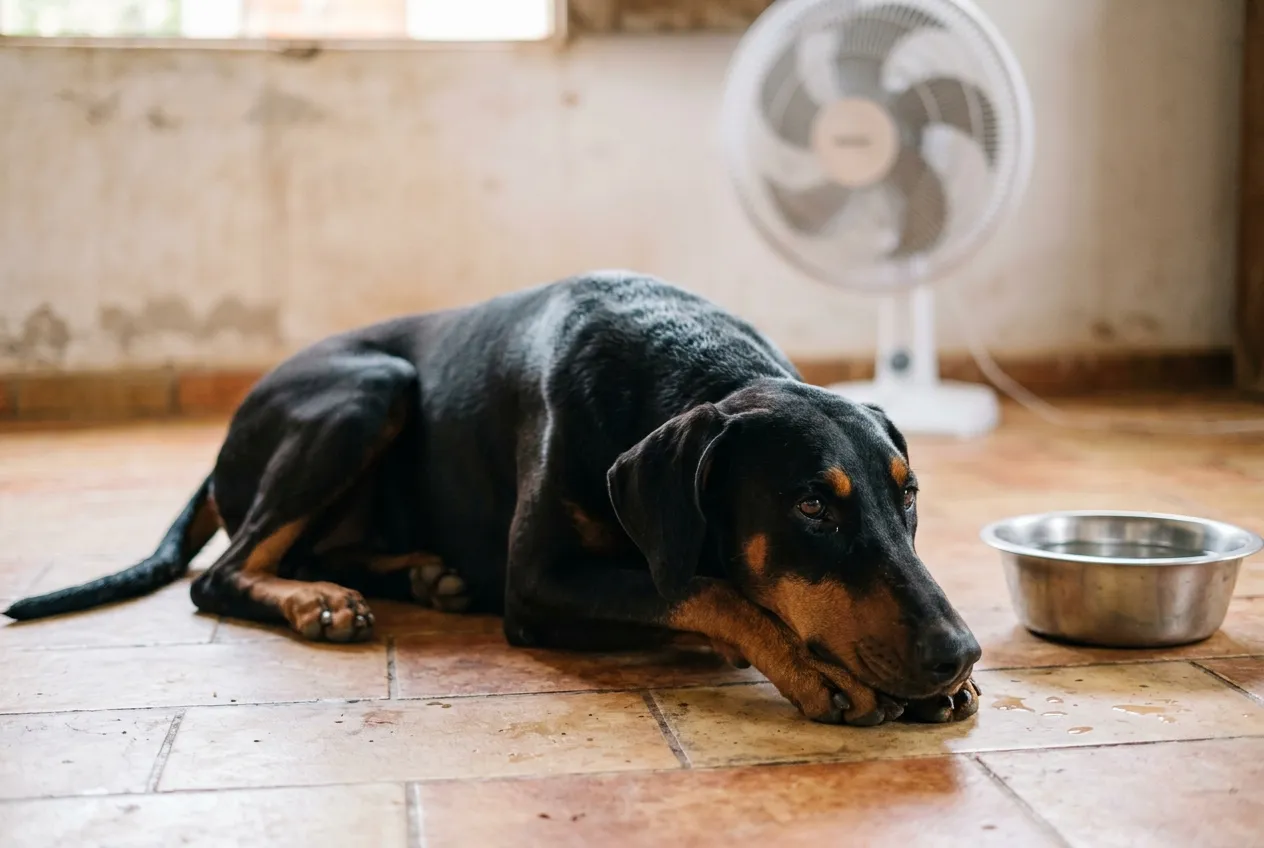
In practice: exercise before 8 a.m. and after 5 p.m., cool water in more than one room and shade that is still shade at two in the afternoon. A puppy that lives with the family indoors learns early to look for the cool floor and the fan; a dog that lives loose at the back of the yard, exposed all day, ages faster and nobody notices the process. Someone who lives in an apartment has a thermal advantage and a space disadvantage, and the two even out with routine, as we show in Doberman in an apartment.
Questions that come in on WhatsApp
Do Dobermans with natural ears live longer?
The ear itself doesn't change life expectancy. What matters is what the surgery represents. Cosmetic conchectomy (ear cropping) and caudectomy (tail docking) are prohibited in Brazil by CFMV Resolution 877/2008 (art. 7, as amended by Resolution 1.595/2024), and a puppy that went through them faced pain, anesthesia and infection risk with no medical indication, in exactly the week when he should be doing nothing but socializing. We don't crop, and the whole reason is in why we don't crop the ears.
Do males live less than females?
In large-breed dogs the literature suggests a small advantage for females, and in practice it disappears next to weight, heart and origin. Sex and color don't decide how long the dog lives, the same way they don't decide his temperament.
Does a pedigree make the dog live longer?
Not because of the paper itself. The pedigree is for tracing: it says who the dog came from and lets you check what was tested in that family. A registered Doberman whose parents never had an echo carries the same risk as a dog with no papers at all. The value is in what the registry lets you investigate, and the difference between a guarantee and tracing is in what the CBKC pedigree guarantees.
He's 6 already and never had an echo. Is it worth starting now?
It is very much worth it. DCM has a long hidden phase, and a good share of the dogs diagnosed in that phase respond well to medication, gaining years of useful and active life. The worst scenario is the owner finding out about the disease on the day of the fainting or of the night cough, when the heart has already dilated. Start with the pair of exams and keep them annual.
The breeder's role in this math
A good part of a long life is decided before the puppy is born: in choosing tested breeding dogs, in the ethical removal of lines with a bad history from breeding and in transparency with whoever buys. That's why the question "how long does a Doberman live?" is also answered with another one: where did he come from? If you're at that stage of the decision, our guide to how to recognize a serious breeder helps you ask the right questions.
At Dobs Kennel, this work has names and faces. Eros, our brown and tan stud, comes from the Americas line. Kira, black and tan and a brown carrier, brings European blood documented in the pedigree, with Teraline Rohan in the tree. The choice was deliberate: we work with lines of champions from the Americas and Europe, with purity registered with CBKC/FCI, because joining two well-documented trunks gives more material to select from and fewer surprises hidden down the road. The whole tree is open in why we paired Eros and Kira.
Here the breeding dogs go through a heart evaluation and the puppies leave with support for the dog's whole life — because our longevity math starts at the pedigree. Want to talk about it with the people who raise them? Message us on the site's WhatsApp.
About the author
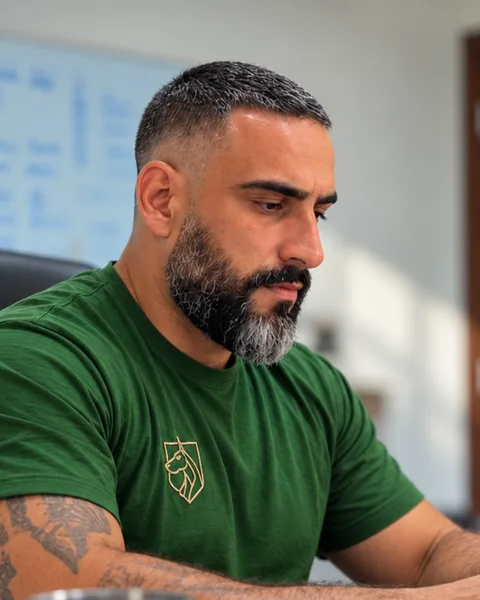
Marcelo Vaz
Entrepreneur and founder of Dobs Kennel
Marcelo Vaz is an entrepreneur and the founder of Dobs Kennel, a Doberman kennel in Nísia Floresta (RN), Brazil. As a boy, he already knew which dog he wanted. That passion for the Doberman stayed with him over the years and became the kennel he now runs with the seriousness of someone who waited a long time for it. “We are not veterinarians, but we study every subject in depth and only write what is backed by science and reliable sources,” he says.
- RegistryCBKC / FCI
- Kennel nameImperio Real Norte
- WhereNísia Floresta, RN
Keep reading


Comments
Ask the breeder directly. Every comment is moderated before it appears, and your email is never published.
Be the first to comment: ask the breeder directly.