


In this article
- Can dogs eat mango? The short answer
- What's inside a mango
- Mango, banana, apple or watermelon: sugar and calories side by side
- Benefits of mango for dogs: what's real
- Can dogs eat mango skin?
- Mango pit: the real danger
- How to give mango to a dog
- How much mango can a dog eat? The math by weight
- Mango at every stage of life
- What changes in a breed like the Doberman
- When not to give mango, or only after talking to your vet
- Green mango, dried mango, juice, ice cream: what about mango products?
- Frequently asked questions
- Where the numbers come from
Can dogs eat mango? Yes: ripe, without the skin, without the pit and in small pieces, as a treat that fits within the 10% of daily calories set aside for extras. For a large adult dog such as a Doberman, at 32 to 45 kg, a sensible routine is between 60 and 90 grams of mango, two or three times a week; for smaller dogs the portion drops in proportion to body weight, as the table further down shows. What really calls for care is not the flesh but the pit, which has already put dogs on the operating table.
Can dogs eat mango? The short answer
- Yes to the flesh, ripe, without the skin and without the pit.
- In cubes of about 2 cm (roughly 8 g each) or mashed, never the whole fruit or a slice with the pit.
- All of the day's extras, added together, stay at or below 10% of calories. Mango shares that space with training treats and with any other fruit.
- Puppy settled on its food: one or two cubes, once or twice a week. Adult: the portion in the table, two to three times a week. Senior: the same math, with more attention to weight.
- No sugar, condensed milk, ice cream, boxed juice or sweetened dried mango.
- Keep the pit away from the dog, including the pit of a mango that falls in the yard.
All of this applies to a healthy dog at a proper weight that eats a complete and balanced food. Diabetes, obesity, a diagnosed illness or a prescribed diet change the math, and in those cases the decision belongs to the veterinarian who looks after your dog.
What's inside a mango
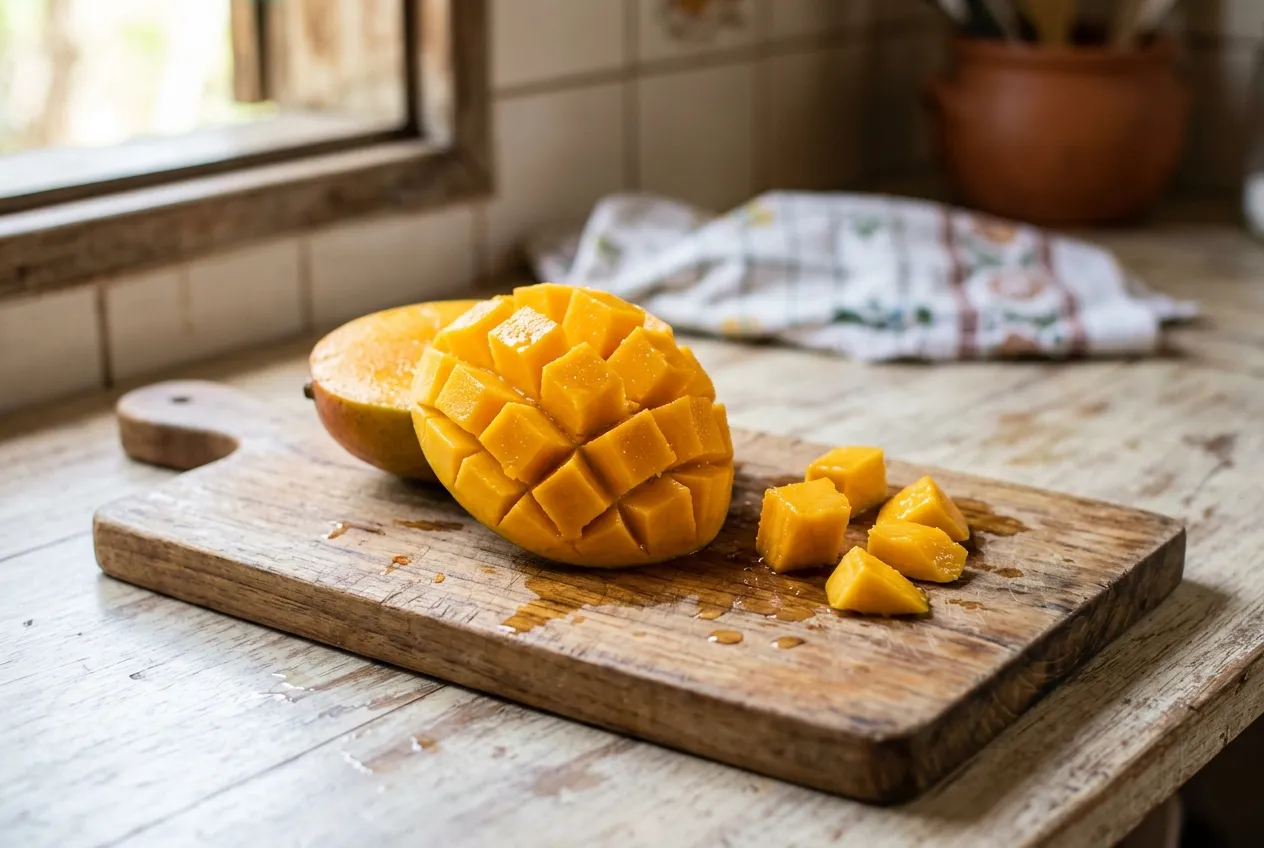
A mango is, above all, water and fruit sugar: 83.5 g of water and 13.7 g of sugars in every 100 g of flesh, according to the food composition database of the United States Department of Agriculture, the USDA. The rest is a modest amount of fiber and a good bundle of vitamins, mainly C and A, the latter from the beta-carotene that gives the fruit its orange color.
| Nutrient | In 100 g of mango | In a 50 g portion |
|---|---|---|
| Energy | 60 kcal | 30 kcal |
| Water | 83.5 g | 41.7 g |
| Sugars | 13.7 g | 6.8 g |
| Fiber | 1.6 g | 0.8 g |
| Protein | 0.8 g | 0.4 g |
| Fat | 0.4 g | 0.2 g |
| Vitamin C | 36.4 mg | 18.2 mg |
| Vitamin A (equivalent) | 54 µg | 27 µg |
| Beta-carotene | 640 µg | 320 µg |
| Vitamin E | 0.9 mg | 0.45 mg |
| Folate | 43 µg | 21.5 µg |
| Potassium | 168 mg | 84 mg |
| Copper | 0.11 mg | 0.06 mg |
Swipe the table sideways to see all the columns.
The table shows why mango works as a treat and not as a meal: almost no protein or fat, and energy that comes almost entirely from sugar. That isn't a flaw; it is what defines how it's used. A dog already gets everything it needs from a complete food; the fruit comes in as variety in flavor, texture and freshness.
Mango, banana, apple or watermelon: sugar and calories side by side
People who give their dogs fruit tend to rotate among the same four or five. Compared per 100 g, mango is the sweetest on the list, even though it has fewer calories than banana, and it has more than double the sugar of watermelon and strawberry.
| Fruit (100 g, raw) | Energy | Sugars | Vitamin C |
|---|---|---|---|
| Mango | 60 kcal | 13.7 g | 36.4 mg |
| Banana | 89 kcal | 12.2 g | 8.7 mg |
| Apple, with skin | 52 kcal | 10.4 g | 4.6 mg |
| Papaya | 43 kcal | 7.8 g | 60.9 mg |
| Watermelon | 30 kcal | 6.2 g | 8.1 mg |
| Strawberry | 32 kcal | 4.9 g | 58.8 mg |
Swipe the table sideways to see all the columns.
In practice: for a dog that gains weight easily, watermelon and strawberry give more volume with less sugar, and mango goes in a smaller portion. For a lean, active dog, the difference matters little, as long as the sum of the extras stays within the 10%.
Benefits of mango for dogs: what's real
It's common to read that mango "strengthens immunity" in dogs because of its vitamin C. The claim is misleading. Unlike us, a dog produces its own vitamin C in the liver, so it isn't an essential nutrient in the dog's diet, as explained in a text published by the Canadian veterinary association. The vitamin C in mango is a bonus, not a necessity.
What mango actually delivers:
- A treat with more water and less fat than most commercial dog biscuits, useful for anyone who wants to please the dog without adding fat.
- Beta-carotene, vitamin E and folate in modest amounts, which add to the diet without replacing anything.
- Freshness in the heat. Frozen cubes become a cooling, entertaining treat that the dog licks and chews slowly.
- Variety of flavor and texture to use as a reward, without changing the food.
What it doesn't do: it doesn't treat disease, doesn't replace a prescribed supplement and doesn't fix an incomplete food.
Can dogs eat mango skin?
It isn't poison, but it's better to take it off. The skin is tough and fibrous, and the American Kennel Club's advice is to remove it because dogs digest it poorly. There is also a detail few people know about: the skin concentrates resorcinols, substances related to the urushiol in poison ivy. In people, contact allergy to mango is rare; a 2021 review gathered just 37 cases described worldwide. There is no record of this being a common problem in dogs, and the practical reason to peel remains digestion.
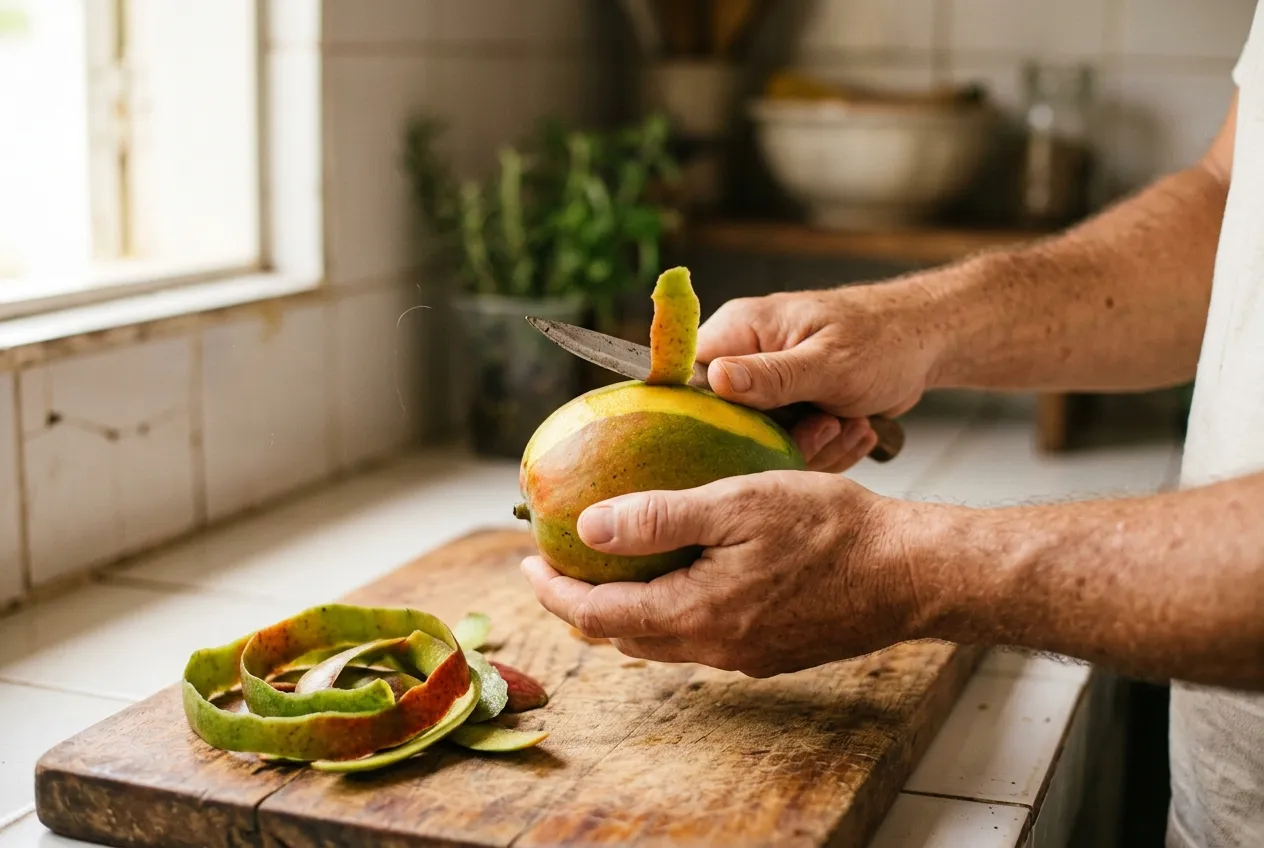
The skin can also carry pesticide residue and dirt from transport. Peeling takes care of both at once.
Mango pit: the real danger
If there is one part of the mango that can turn into an emergency, it's the pit. It is large, hard, fibrous and slippery, and it is exactly the right size to go down the throat of a medium or large dog and lodge in the intestine. A case series published in 2023 in the Journal of Applied Veterinary Sciences describes three adult dogs that arrived with a day of abdominal pain, vomiting and lethargy and had not defecated, because of a swallowed mango pit. The X-rays showed dilated loops of intestine and a foreign body; all three needed surgery to open the intestine and remove the pit. The author recommends throwing fallen mangoes and pits in the trash instead of leaving them in the yard.

The pit also contains small amounts of compounds that release cyanide, as the American Kennel Club notes. For a dog to reach a toxic dose, it would have to chew and digest actual pit, which is rare; the risk that sends dogs to surgery is the blockage.
My dog swallowed the pit: what to do
- Don't induce vomiting on your own: a large pit can get stuck on the way back up.
- Call the veterinarian and say how big the dog and the pit are and how long ago it happened.
- Watch for repeated vomiting, a sore belly, loss of appetite, lethargy or no stools. Any one of these signs is a reason for immediate care, especially in a deep-chested dog such as the Doberman.
- Even with no signs at all, an evaluation is worthwhile: a pit can sit in the stomach without showing any sign right away.
In a home with a mango tree, the habit that protects most is picking up the fallen mangoes every day, before the dog finds them.
How to give mango to a dog
The best mango for a dog is a ripe one, soft and fragrant, the same kind you would eat. Tommy, Palmer, espada or rosa, any variety on the market will do; the espada variety has more stringy fibers, which can get caught between the teeth, so it's worth cutting it smaller.
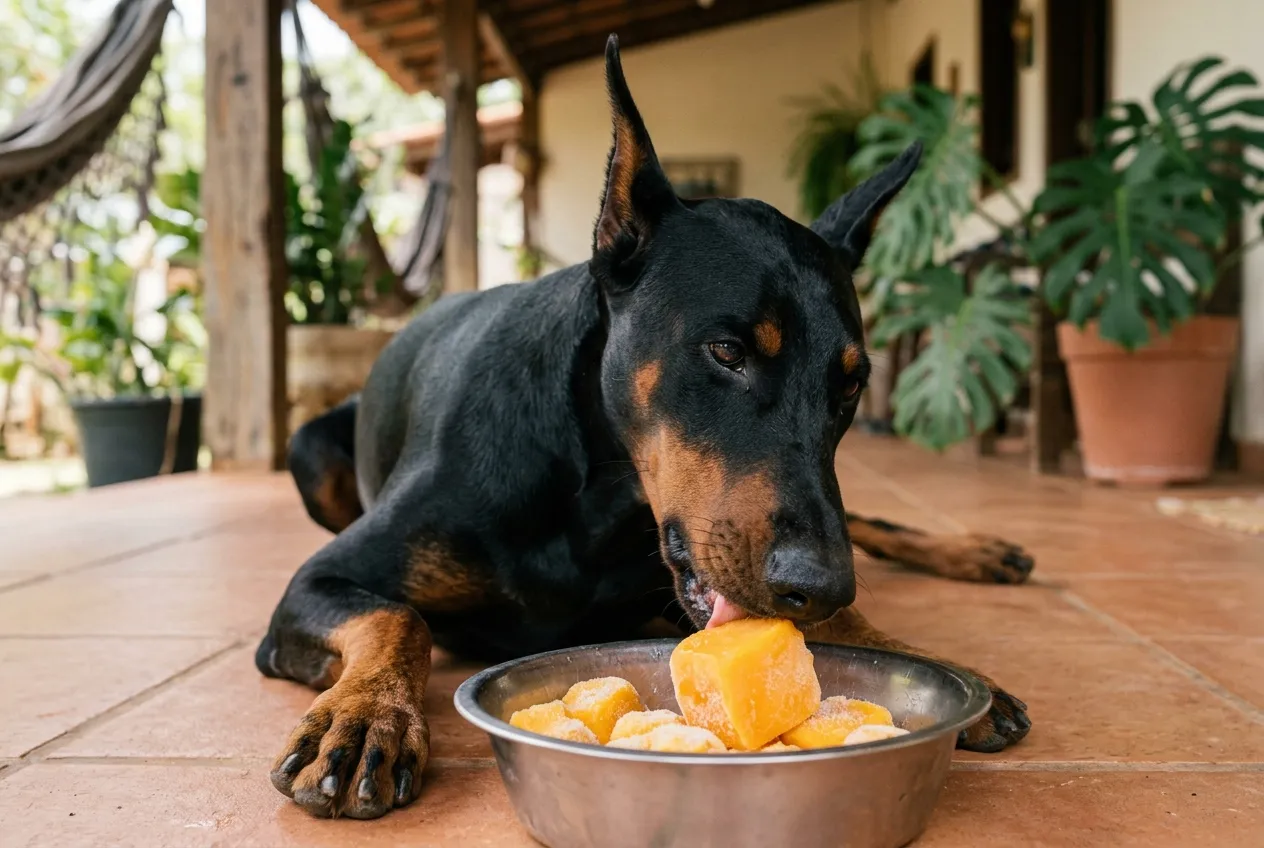
- Wash the fruit, peel it and separate the flesh from the pit.
- Cut it into cubes of about 2 cm for a medium or large dog, and smaller for a small dog or a puppy.
- Offer it plain, mixed into the food as variety, or mashed inside a stuffable toy.
- In hot weather, freeze the cubes and offer them as a cooling treat, counting the portion as usual.
- Throw the skin and pit away in a trash can the dog can't reach.
The first time, start with one or two cubes and watch the stools over the next 24 hours. Diarrhea or gas is a sign that the portion went too far or that this dog doesn't tolerate the fruit well.
How much mango can a dog eat? The math by weight
The rule that organizes everything is the calorie rule. The nutrition guidelines of AAHA, the American Animal Hospital Association, recommend that treats and foods outside the complete food add up to no more than 10% of the day's energy. Mango, training treats, egg and any other food outside the regular food all go into that same count.
Daily energy comes from the standard resting energy formula, 70 multiplied by body weight in kg raised to the power of 0.75, multiplied by the factor from the same guidelines: 1.4 to 1.6 for a neutered adult and 1.6 to 1.8 for an intact adult. The table uses that range. The Doberman rows are highlighted because it is the breed we raise; the math is the same for any dog, and what changes is the weight.
| Adult dog | Energy per day (neutered to intact) | Cap on extras (10%) | Cap in mango | Sensible routine |
|---|---|---|---|---|
| 5 kg | 330 to 420 kcal | 33 to 42 kcal | 55 to 70 g | 15 to 18 g (2 cubes), 2 to 3 times a week |
| 10 kg | 550 to 710 kcal | 55 to 71 kcal | 90 to 120 g | 20 to 30 g (2 to 4 cubes), 2 to 3 times a week |
| 20 kg | 930 to 1,190 kcal | 93 to 119 kcal | 155 to 200 g | 40 to 50 g (5 to 6 cubes), 2 to 3 times a week |
| Female Doberman, 32 kg | 1,320 to 1,700 kcal | 132 to 170 kcal | 220 to 280 g | 60 to 70 g (7 to 9 cubes), 2 to 3 times a week |
| Male Doberman, 40 kg | 1,560 to 2,000 kcal | 156 to 200 kcal | 260 to 330 g | 70 to 80 g (9 to 10 cubes), 2 to 3 times a week |
| Male Doberman, 45 kg | 1,700 to 2,190 kcal | 170 to 219 kcal | 280 to 365 g | 80 to 90 g (10 to 11 cubes), 2 to 3 times a week |
| 60 kg | 2,110 to 2,720 kcal | 211 to 272 kcal | 350 to 450 g | about 100 g (12 cubes), 2 to 3 times a week |
Swipe the table sideways to see all the columns.
The last two columns do different jobs. The cap is the limit for all of the day's extras combined, and no dog needs to reach it with mango. The sensible routine is about a quarter of the cap, because the fruit is sweet and because it leaves room for the training treat. For an inactive dog or one that gains weight easily, the cap drops by about a third, and so does the routine.
To check it yourself: 80 g of mango has 48 kcal and 11 g of sugar. A 40 kg male Doberman, neutered, burns close to 1,650 kcal a day, and that portion represents less than 3% of it. What confirms the math, after four to six weeks, is the body: ribs you can feel without effort and a waist visible from above.
Mango at every stage of life
Puppy
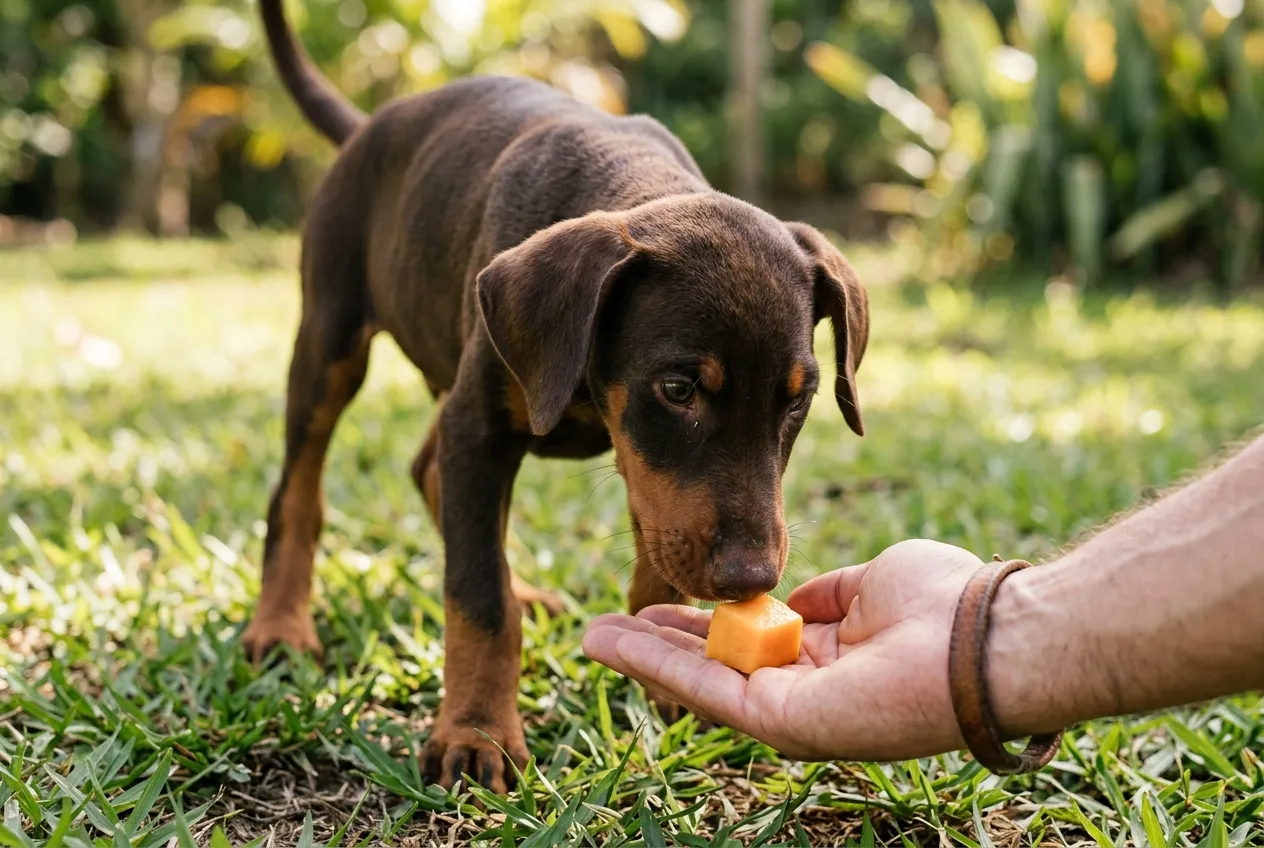
Only once the puppy is settled on its growth food, with firm stools, which usually happens in the new home after the first weeks. Start with one cube, once or twice a week, and watch. A large-breed puppy needs to grow at the right pace, and the growth food is what guarantees calcium, phosphorus and energy in the right measure; mango is just a treat. For what goes in the bowl each month, see feeding a Doberman at each life stage.
Adolescent, 6 to 18 months
It works well as a training reward in a small piece, because it is soft, fragrant and eaten quickly. Using the adult math with the dog's weight at the time is the more cautious version, since a growing dog burns more energy; training treats go into the same 10%.
Adult
The portion in the table, two to three times a week, alternating with other fruits and with the training treat. In summer, the frozen version is the most worthwhile.
Senior
A senior dog burns less energy, and the European nutrition guidelines, from FEDIAF, indicate on average 10% to 15% fewer calories than for an adult. Mango is still allowed, in a slightly smaller portion, and the soft flesh is easy for a dog with worn teeth. Pay extra attention to weight: in a senior dog, an extra kilo weighs on the joints and the heart.
What changes in a breed like the Doberman
The math applies to any dog. In the Doberman, three points call for attention, and in none of them does mango act as a treatment.

Weight and stomach
A deep chest, a stomach that can twist and a body built to be lean: the Doberman depends on the right weight more than many breeds do. Too many sweet treats are the shortest path to an extra kilo. Give mango away from intense exercise and in a small portion, never a full bowl at once. The risk factors for gastric torsion are in how long Dobermans live.
Liver and copper
The Doberman is among the breeds in which copper buildup in the liver is described, as we explain in the article on eggs in a dog's diet. Mango does fine on this point: it has 0.11 mg of copper per 100 g, far from organ meats. It doesn't factor into the math.
Heart
There is no evidence that mango protects or harms the heart. What changes the outcome of cardiomyopathy in the Doberman is screening with echocardiogram and Holter, which catches the disease before symptoms, as we describe in how to assess a Doberman's heart health, along with a complete and balanced diet.
When not to give mango, or only after talking to your vet
- Diabetic dog: sweet fruit only goes in with the approval of whoever manages the insulin, because control depends on steady meals and calories.
- Obese dog or one on a weight-loss diet: prefer the less sweet fruits, such as watermelon and strawberry, or save the extras for the training treat.
- Prescribed diet for kidney, liver, gut or allergy: nothing goes in without checking first.
- Diarrhea, vomiting or a sensitive stomach at the moment: wait for the gut to return to normal.
- A dog that swallows without chewing: mash the flesh instead of giving cubes.
Green mango, dried mango, juice, ice cream: what about mango products?
- Green mango: it is harder and more acidic and brings no advantage. Prefer the ripe one.
- Dried mango: it concentrates the sugar in a small piece, and many versions have added sugar. If you use it, only the unsweetened kind, in tiny slivers.
- Juice: it loses the fiber and keeps the sugar. The boxed kind usually has added sugar. Not worth it.
- Mango ice cream, popsicles and yogurt: sugar, milk and, in "sugar-free" versions, sometimes xylitol, which is toxic to dogs, according to the FDA. Make the popsicle at home with nothing but frozen flesh.
- Mango tree leaves and branches: not food; if the dog chews them, take them out of reach.
Frequently asked questions
Can dogs eat mango every day?
They can, if the calorie math works out and the weight doesn't climb, but it isn't necessary. Two to three times a week is already a good routine and leaves room for other fruits and for the training treat.
Can puppies eat mango?
Yes, once settled on the food and with normal stools, in one or two small cubes, once or twice a week. The growth food remains the foundation.
Can dogs eat mango with the skin on?
It's better to take it off. The skin is hard to digest and concentrates resorcinols, relatives of the urushiol in poison ivy. It isn't poison to the dog, but peeling avoids discomfort and pesticide residue.
Can dogs eat mango pits?
No. The pit can get stuck or end up lodged in the intestine and has already taken dogs to surgery. If the dog swallowed one, call the veterinarian and watch for vomiting, abdominal pain, lethargy or no stools.
How much mango can I give my dog?
A sensible routine is 15 to 18 g for a 5 kg dog, 40 to 50 g for 20 kg and 70 to 80 g for a 40 kg Doberman, two to three times a week. The table above has all the weights.
Can mango give dogs diarrhea?
In excess, it can, because of the sugar and the fiber. Start with a little, increase gradually and watch the stools. Diarrhea that lasts more than a day calls for a veterinarian.
Can dogs eat frozen mango?
Yes, and in hot weather it's one of the best ways to offer it. Cut it into cubes before freezing and count the portion as usual.
Can diabetic dogs eat mango?
Only with the approval of the veterinarian who manages the insulin. Mango has 13.7 g of sugar per 100 g, and diabetes control depends on consistency in meals.
Is mango better than banana for dogs?
Neither is better in itself. Mango has fewer calories (60 against 89 kcal per 100 g) and more vitamin C; banana has similar sugar and more energy. Alternating the two, within the 10%, is the best of both worlds.
Can dogs eat green mango?
It isn't toxic, but it is harder and more acidic and brings no advantage. Give the ripe mango.
Can dogs drink mango juice?
It's not worth it. Juice loses the fiber and keeps the sugar, and the boxed kind usually has added sugar. The flesh in cubes is always the better choice.
Can Dobermans eat mango?
Yes, like any healthy dog: ripe, without the skin and without the pit, 60 to 90 g two to three times a week for an adult of 32 to 45 kg, away from intense exercise and with the weight under control.
Where the numbers come from
This article brings together reference nutrition information and does not replace a consultation with your dog's veterinarian, who knows its test results, weight and history. The sources:
- Composition of mango and of the fruits compared: USDA FoodData Central, records 169910 (mango), 173944 (banana), 171688 (apple with skin), 169926 (papaya), 167765 (watermelon) and 167762 (strawberry).
- Skin, pit and portion: American Kennel Club, "Can Dogs Eat Mango?", updated April 2026.
- Pit and intestinal obstruction: Abu-Seida, A. M. Mango Seed Causing Acute Intestinal Obstruction in Dogs: A Case Series. Journal of Applied Veterinary Sciences, vol. 8, no. 4, pp. 123–126, 2023.
- Resorcinols in the skin and contact allergy: Contact Allergy Induced by Mango (Mangifera indica): A Relevant Topic?, review, Medicina, 2021.
- Vitamin C in dogs: Matthew Kornya, "Vitamin C in Veterinary Medicine", Canadian Veterinary Medical Association website.
- 10% rule and energy factors: 2021 AAHA Nutrition and Weight Management Guidelines.
- Energy of the senior dog: FEDIAF Nutritional Guidelines, October 2021 edition.
- Xylitol: FDA, "Paws Off Xylitol; It's Dangerous for Dogs".

About the author
Marcelo Vaz
Entrepreneur and founder of Dobs Kennel
Marcelo Vaz is an entrepreneur and the founder of Dobs Kennel, a Doberman kennel in Nísia Floresta (RN), Brazil. As a boy, he already knew which dog he wanted. That passion for the Doberman stayed with him over the years and became the kennel he now runs with the seriousness of someone who waited a long time for it. “We are not veterinarians, but we study every subject in depth and only write what is backed by science and reliable sources,” he says.
- RegistryCBKC / FCI
- Kennel nameImperio Real Norte
- WhereNísia Floresta, RN
Keep reading


Comments
Ask the breeder directly. Every comment is moderated before it appears, and your email is never published.
Be the first to comment: ask the breeder directly.