
In this article
- Before you start: the rules of the session
- The marker: the piece almost everybody skips
- 1 · The name, the base of everything
- 2 · Sit, the pause button
- 3 · Down, the sit that lasts
- 4 · Stay, the command that saves the visit
- 5 · Heel, when the walk stops being a tug of war
- 6 · Come, the command that one day saves his life
- Bonus: shaking paws in 10 minutes
- The four-week plan
- The four mistakes that ruin a Doberman
- When to call a professional
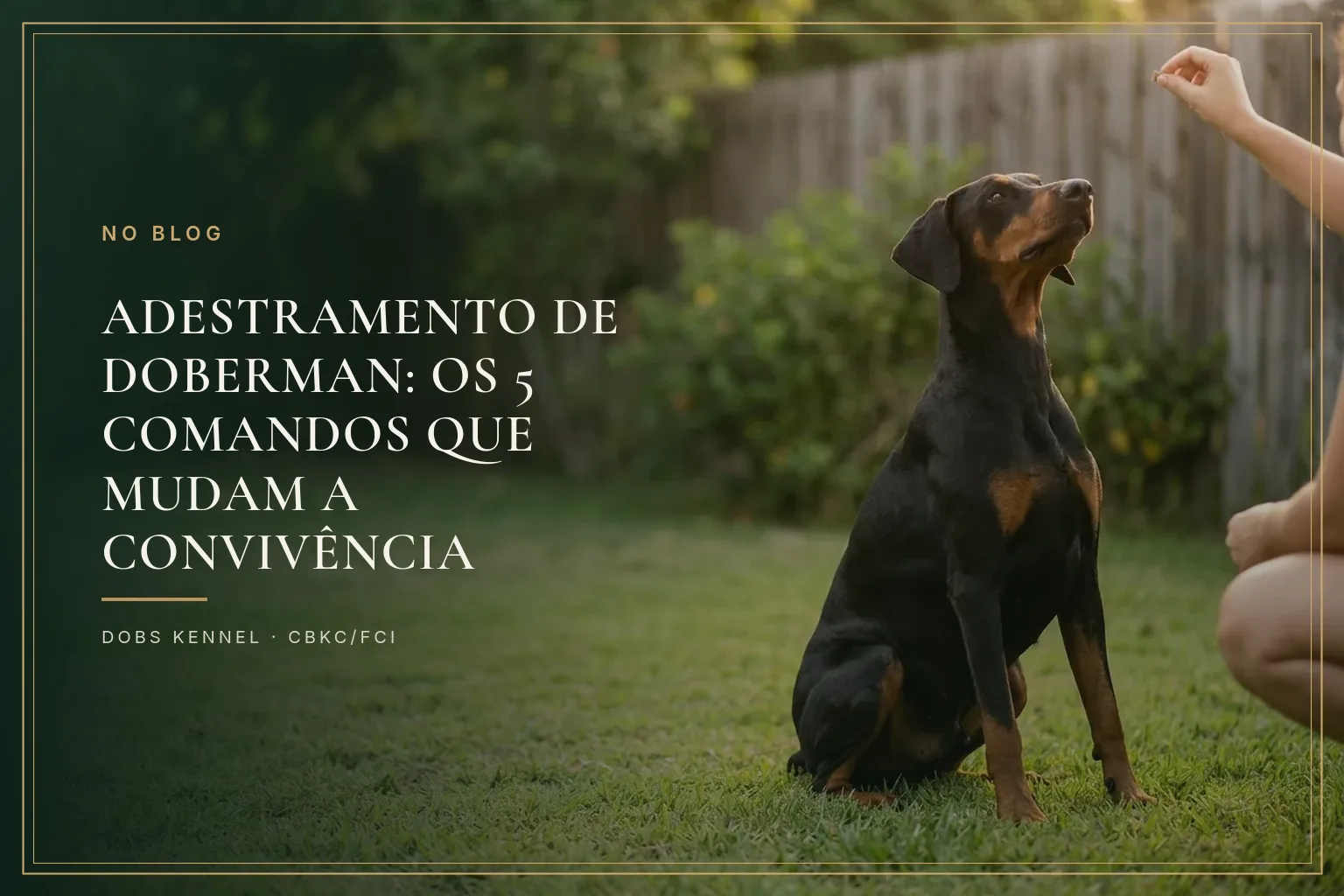
A Doberman doesn't need complicated training: he needs five commands taught well, five-minute sessions and an owner who stays consistent. This guide isn't about theory. It gives you the step by step of each command, with the number of repetitions, how many days it takes, what to do when he doesn't obey and the mistakes that ruin the work. It's the same method we hand to the families who take one of our puppies home.
Before you start: the rules of the session
Ignore this part and none of the commands below will work properly. It applies to all of them.
- 5 minutes, 3 times a day. A Doberman switches off with mindless repetition. Twenty reps in a row and he starts looking away. Three short sessions beat one long one, every time.
- Train him hungry. Before the meal, not after. A dog with a full belly doesn't work for treats.
- One command at a time. Only move on to the next one when the current one comes out 8 times in 10 tries.
- Always finish on a win. Even if you have to ask for something easy at the end. The last thing in the session is the part that sticks.
- Never shout. The Doberman is the breed that works to please his owner, and the breed that takes shouting to heart. A method built on fright creates an insecure dog, and an insecure dog is where the real problems come from.
The marker: the piece almost everybody skips
Before the first command, teach your dog a word that means "what you just did was right, the reward is coming now". It can be "yes!", a click from a clicker, whatever you prefer, as long as it's always the same one.
How to install it in 2 days: with the dog loose near you, say "yes!" and hand over a treat at that same instant. Without asking for anything in return. Repeat 10 times, 3 times a day. In two days, when you say "yes!" he'll turn his head waiting for the food. There it is, the marker is installed.
Why this matters: the dog links the reward to the exact instant he got it right, and not to whatever he was doing three seconds later. With no marker, you reward the dog who has already stood back up, and standing back up is what he learns.
1 · The name, the base of everything
What it's for: the name isn't identification, it's a command. It means "look at me now". Without it, no other command reaches a dog standing three meters away.
- Stand a meter from the dog, with him distracted.
- Say the name once only, in a normal tone.
- The instant he turns his head: "yes!" and hand over the treat.
- If he doesn't turn within 2 seconds, don't repeat the name. Make a small noise to pull his attention, and when he looks, mark and reward exactly the same way.
- 10 repetitions per session. When he gets 8 out of 10, increase the distance and train with noise around him.
Timeline: 3 to 5 days for a puppy to answer indoors.
The mistake that kills it: spending the name on nothing. Calling him over to tell him off, repeating it three times in a row, using the name when there's no need for it. The name turns into background noise. The name never scolds. A dog who gets punished by his own name learns to ignore it.
2 · Sit, the pause button
What it's for: a sitting dog isn't getting into anything. It's the command you'll use most in your life.
- With the dog standing in front of you, hold a treat closed inside your hand, level with his nose.
- Move your hand slowly up and back, over the top of his head. The nose follows it, the back end goes down on its own: that's physics, not obedience.
- The instant his rear touches the floor: "yes!" and hand it over.
- Repeat 5 times. Only on the sixth do you start saying the word "sit", half a second before you make the hand movement.
- After about 3 days, make the movement with an empty hand and give the treat from the other hand. From there, shrink the movement down until only the word is left.
Timeline: 2 to 3 days for the movement, 1 to 2 weeks to answer the word on its own.
If he doesn't sit: if he jumps up to get the treat, your hand is too high, so lower it until it's almost touching his nose. If he walks backwards instead of sitting, train him with his back to a wall.
Once he's learned it: ask for a sit before the leash goes on, before the food, before you open the door. That's how it turns into a habit, and that's how the dog learns that good things come after asking politely.
3 · Down, the sit that lasts
What it's for: this is the long waiting position. A dog lying down will hold still for half an hour; sitting, for two minutes.
- Start with the dog sitting.
- Treat closed in your hand, in front of his nose. Take your hand straight down, all the way to the floor, between his front paws.
- Once his nose is on the floor, drag your hand slowly away from him, drawing an "L". The body comes down behind it.
- Elbows on the floor: "yes!" and hand it over.
- After 5 successes, add the word "down" before the hand movement.
If his rear pops back up: you pulled your hand away too fast. Draw the "L" more slowly. If he won't go down at all, sit on the floor with one knee bent and have him go under your knee to reach the treat, and the body lies down on its own.
4 · Stay, the command that saves the visit
What it's for: the doorbell rings, the dog holds his place, and your visitor comes in without being met by 35 kilos of enthusiasm.
- Dog sitting. Open palm held out toward him, and say "stay".
- Don't move from where you are. Count one second, mark and reward. That's it, the first lesson of the stay lasts one second.
- Build up to 3 seconds. Then 5. Then 10.
- Only when he can hold 10 seconds with you standing still do you start adding distance: one step back and straight back to him. One step. Over the following days, two, three.
- Only once he owns both time and distance does the distraction come in: someone walking past, a toy on the floor, the doorbell.
- Always release him with a word ("okay!", "free!"). The dog needs to know when the command is over, because otherwise he decides for himself, and then you don't have a stay at all.
The golden rule: raise one variable at a time, either time, or distance, or distraction. Never two together. Skipping a step teaches the dog to break the command.
If he gets up: don't tell him off. Put him back in place without a word and drop to an easier level (less time or less distance). A mistake is a sign that you moved up too fast, not that the dog is stubborn.
Timeline: 2 to 3 weeks for a 30-second stay with you out of his line of sight.
5 · Heel, when the walk stops being a tug of war
What it's for: a grown Doberman who pulls will drag a person down the street. And pulling isn't corrected with strength, it's corrected by taking the reward out of the act of pulling.
- Start indoors or in the yard, with no new smells around. The street is the last step, not the first.
- Short leash, dog on your left side. Treat in your left hand, at waist height.
- Take 3 steps. If the leash stays loose: "yes!" and the treat comes at the height of your leg (never out in front, because a treat out in front teaches pulling).
- The instant the leash goes tight, you freeze. Turn into a statue. Don't pull back, don't say anything.
- Wait. When he loosens the leash and looks at you, mark and start walking again. Walking is the reward.
- Build up to 5 steps, 10, half a block. Only take it to the street when he can do 20 steps of loose leash in the yard.
Brace yourself: for the first three days you'll cover 20 meters in 15 minutes. That's normal, and it is exactly the training. Within a week or two he understands that a loose leash is what makes the world move.
About equipment: a no-pull harness helps at the start and spares your back, but it's a crutch, because what teaches is the consequence, not the gear. Choke chains and shock collars are off the table: they break a Doberman's trust and create exactly the reactive dog nobody wants.
6 · Come, the command that one day saves his life
What it's for: this is the most important one of all, and the one most often destroyed by well-meaning owners.
- Use a long line of 5 to 10 meters in a safe place. Never train the recall off leash at the start, because if he ignores you and nothing happens, you've just taught him that "come" is optional.
- Let him get distracted. Call once only: "Come!" in a bright tone, never an angry one.
- While he's on his way, keep him coming with your voice. When he arrives, throw a party out of all proportion: 3 or 4 treats in a row, praise, affection. Arriving has to be the best thing in his day.
- If he doesn't come, use the long line to bring him in gently, and celebrate the same way when he gets there. Never let a "come" go unanswered.
- 5 repetitions per session, never more. The recall burns out fast: repeat it too much and the command turns into noise.
The rule you can never break: nothing bad ever happens after a "come". If you call the dog over for the bath he hates, to cut his nails or to argue about the chewed shoe, he learns that answering is bad, and on the day he's running toward the street, he won't come. Need to do something unpleasant? Go to him.
Timeline: 3 to 4 weeks for a reliable recall in a controlled place. A recall under heavy distraction (another dog, a busy street) takes months, and that's normal.
Bonus: shaking paws in 10 minutes
This one doesn't change life at home, but it's the trick every visitor asks for and the one that lifts beginners the most, because it teaches the owner to train as much as it teaches the dog.
- Dog sitting in front of you.
- Close a treat inside your hand and offer him the closed fist at chest height.
- He'll sniff it, lick it, try to open it with his nose. Wait. Don't say anything.
- The moment frustration makes him lift a paw to scrape at your hand, and it will come, it's a dog reflex, mark it right then: "yes!" and open your hand.
- Repeat 5 times. On the sixth, say "paw" half a second before you offer the fist.
- After 10 successes, offer your open, empty hand. When he puts the paw on it, mark and reward with the other hand.
If he only nudges with his nose: hold the fist a little lower, at paw height. If he still doesn't lift it, give a light tickle behind the paw to prompt the movement, and mark the instant it leaves the floor.
The four-week plan
One month, 15 minutes a day, in the order that works:
| Week | What to train | Goal by the end of the week |
|---|---|---|
| 1 | Marker + name + sit | Looks when he hears his name; sits with the hand signal |
| 2 | Sit on the word alone + down + a 10-second "stay" | Sits and lies down with no hand signal; holds still with you nearby |
| 3 | Heel in the yard + "stay" with distance | 20 steps of loose leash; stays with you 3 meters away |
| 4 | Come on the long line + heel on the street + paw | Comes when called in the yard; walks without dragging you |
Arraste a tabela para o lado para ver todas as colunas.
The four mistakes that ruin a Doberman
- Repeating the command. "Sit, sit, SIT!" teaches him that the command is the third time. Say it once and help the dog get it right.
- Rewarding late. A treat 3 seconds after the success rewards what he's doing now, not what he did. That's why the marker exists.
- Rewarding by accident. He jumps on the visitor and gets petted to "calm him down", and he has just learned that jumping brings affection. A Doberman learns the right thing and the wrong thing at the same speed.
- Training annoyed. If the day was bad, skip the session. Five minutes with you impatient undo a good week.
When to call a professional
Basic training is something any family can do at home, and this guide is enough for it. Look for a trainer who works with positive reinforcement if any of this shows up: growling when you come near the food or a toy, fear that doesn't fade with time, reactivity toward other dogs on the street, or destruction out of anxiety when he's left alone. Those are behavior problems, not obedience problems, and the sooner they're treated, the simpler they are to solve.
Temperament is the raw material: no amount of training fixes a dog of doubtful origin, and no well-bred dog turns out polite on his own. That's why we talk so much about temperament from puppy to adult and about socialization in the first 12 weeks, the window that opens or closes a good part of what you'll be able to train later. And if the breed's reputation still worries you, our honest answer is in are Dobermans aggressive?.

Written by
Marcelo Vaz — breeder at Dobs Kennel
CBKC/FCI registered kennel in Natal, Brazil. Champion American and European bloodlines, proven health, and lifelong support for every family. Meet the kennel →