


In this article
Between the third and the twelfth week of life, the puppy's brain decides what is normal and what is a threat, and that window closes and does not reopen. Socialization is not taking the puppy out to meet people: it is introducing the world in positive doses during the period when he is programmed to accept novelty. Done well, it produces the balanced Doberman the breed promises; missed, it produces fear and reactivity that no adult training fully repairs. This guide divides the work between the kennel and the family, week by week.
The window: what behavior science says
The sensitive period for socialization runs from roughly week 3 to week 12 or 14. In it, the puppy explores by default: whatever he meets in a pleasant way becomes "normal" for the rest of his life. After the window, the default flips, novelty becomes suspicion first, and every fear costs dozens of exposures to undo. The arithmetic is cruel and simple: one good experience in week 8 is worth more than fifty in week 20. That is why the choice of kennel matters so much: half the window happens before the puppy arrives at your house.
The kennel's part: weeks 3 to 8
By the time the family receives the puppy at 60 days, a good share of the work has already been done, or has already been lost. In the kennel, serious socialization means daily handling from early on (touching a paw, an ear and the mouth for a few seconds, every day), real household sounds (vacuum cleaner, pans, doorbell, television), varied surfaces (cold floor, rug, grass, soil), people of different kinds and, the most irreplaceable of all: the dam and the littermates until at least 60 days. It is with them that the puppy learns bite inhibition and the language of his own species. A puppy handed over at 40 days leaves school in the middle of the lesson, and that difference is what separates a planned litter from an accidental one.
The family's part: weeks 9 to 12, one by one
| Week | Focus | How to get it right |
|---|---|---|
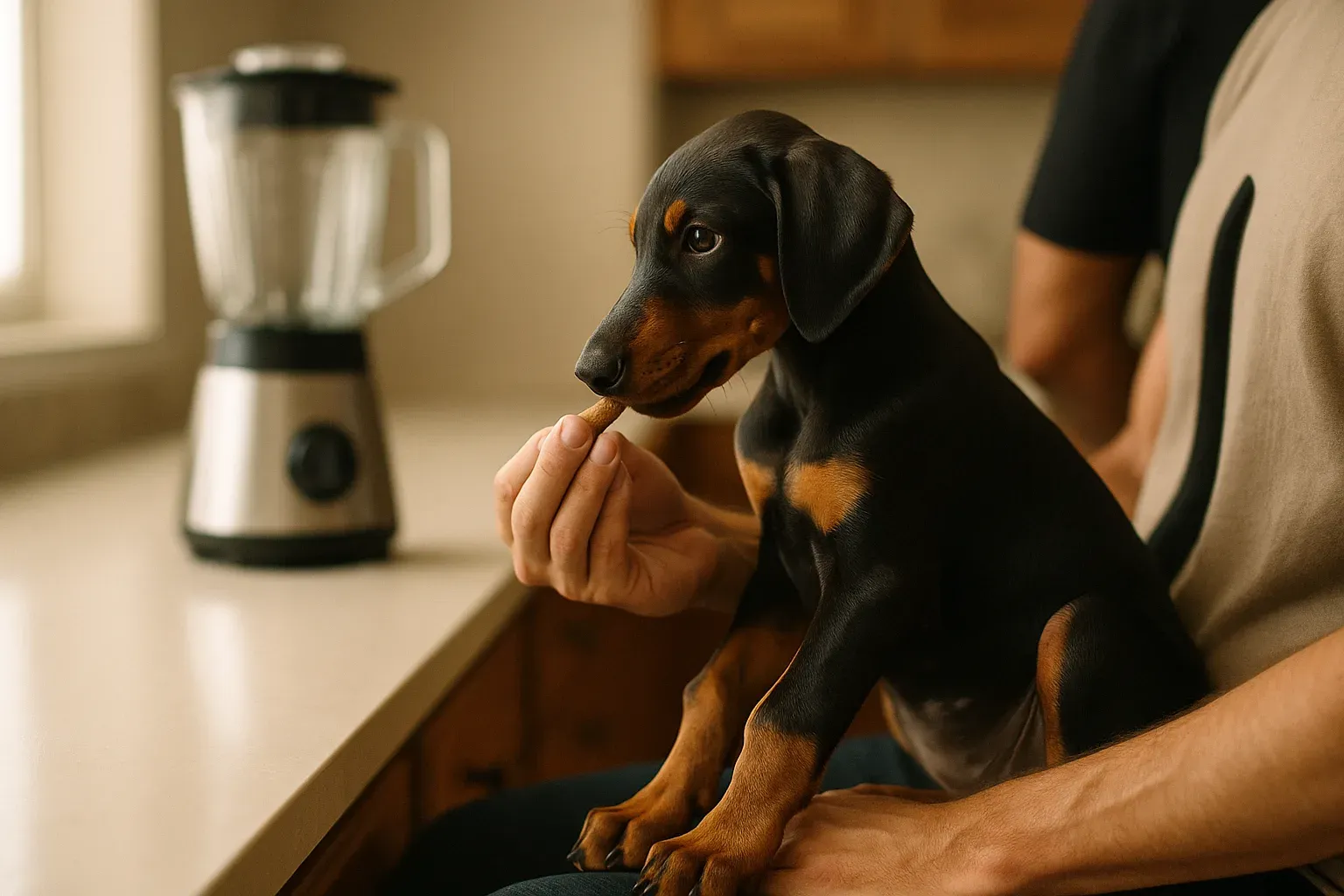
| 9th | The house and its sounds | Vacuum cleaner running at a distance, doorbell, blender, always with a treat alongside, always with a way out |
| 10th | All kinds of people | Men with a beard, a hat, an umbrella, a supervised child, an elderly person with a cane, 2 or 3 calm visitors at a time, never a full house |
| 11th | The world outside, in your arms | The car (engine running while parked, then short trips), a busy street in your arms or in a stroller, no public ground before the vaccines |
| 12th | Other dogs, with curation | Adult dogs that are vaccinated, balanced and known to you, in a clean yard, one good meeting is worth ten random ones |
Swipe the table sideways to see all the columns.
The vaccination protocol has not finished at this stage, and it does not need to be waited out: socialization and protection live together. The rule is to avoid ground where unknown dogs circulate (the street, the square, the pet shop) and to use your arms, a stroller and controlled environments. The behavioral risk of shutting the puppy away until the vaccines are done is greater and more irreversible than the sanitary risk of exposing him with judgment.
The golden rule: exposure is not immersion
The most common mistake a dedicated owner makes is excess: carrying a frightened puppy through the street market to "get him used to it". Socialization works at the puppy's pace, spontaneous curiosity, a voluntary approach, a treat, and an end before the tiredness sets in. Fear is respected, never forced: if he backed away, increase the distance until the curiosity comes back, and introduce it again another day. Five good minutes beat a whole afternoon of overload; the sign of success is the tail and the posture, not the number of stamps in the passport.
What a well used window buys
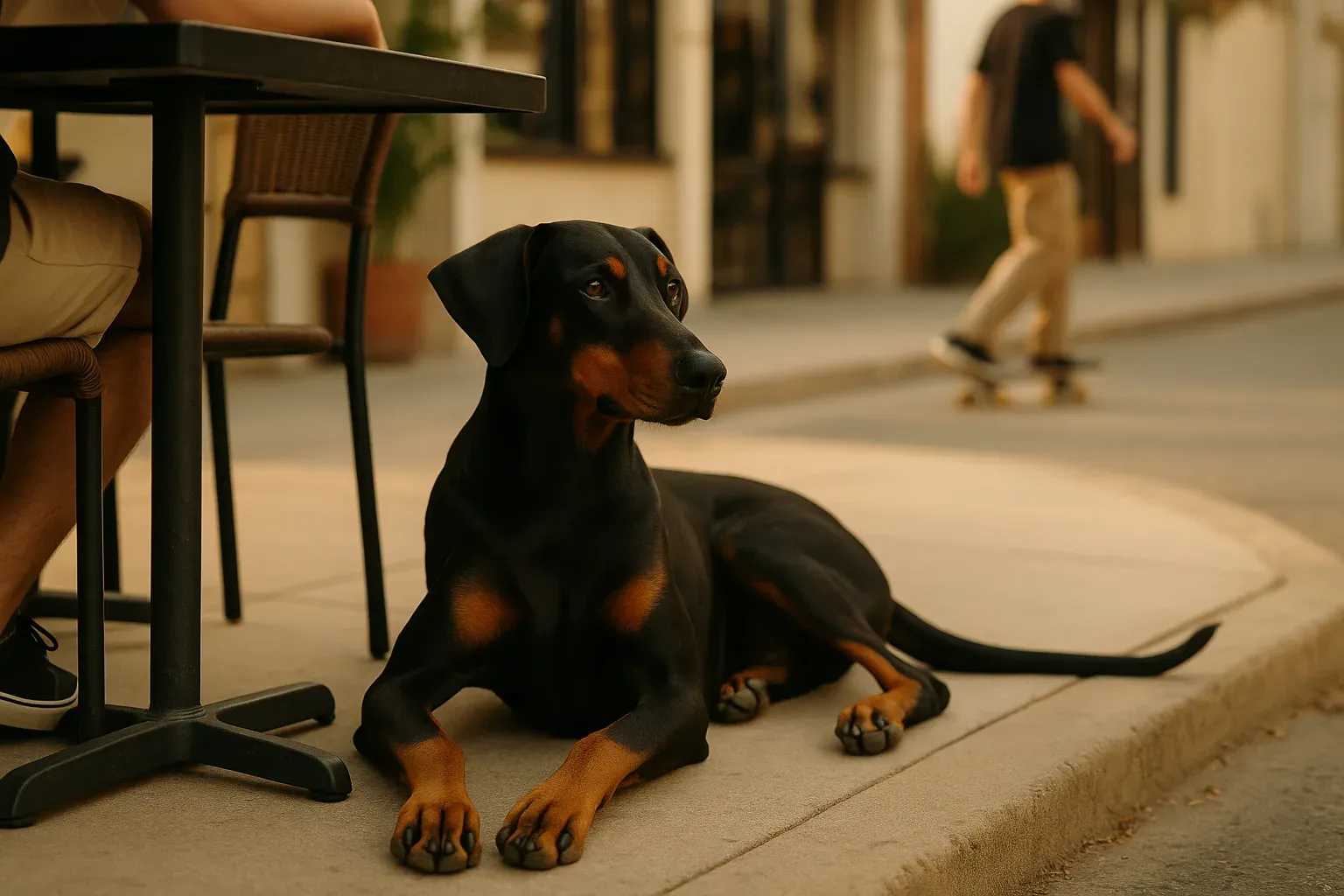
The adult Doberman who lies down in a bar, ignores a skateboard and receives visitors without a circus was not born calm: he was built between weeks 3 and 12. The reputation for being "fierce" that follows the breed is, in the vast majority of cases, a story of socialization lost, and we take that apart in is the Doberman fierce?, and the life with children we describe in the Doberman with a child depends directly on that foundation. Temperament phase by phase, from puppy to adult, is mapped out in our temperament guide.
After 12 weeks: maintenance, not recovery
The window closes, the work does not end, it changes in nature. From the fourth month onwards, the rule is to keep the world present: varied walks, regular visitors, canine encounters of quality. And that is when formal training engages: the five commands that organize life together are in our training guide, and a well socialized puppy learns them with an ease that is striking. Socialization is the foundation; obedience is the house built on top of it. If you are ever unsure about any reaction from your puppy in this phase, call the breeder. Ours answer forever.
The four mistakes that close the window early
- Shutting the puppy away until the last vaccine. It is the best intentioned mistake and the most expensive: the window does not wait for the protocol to finish. Your arms, a stroller and controlled environments exist precisely so that you can socialize safely in the meantime.
- The welcome party. Fifteen people passing the puppy from lap to lap on the first weekend is not socialization, it is overload, and overload teaches the opposite of what you want.
- Forcing the approach. Pushing the puppy towards whatever frightened him records the fear twice as strongly. The right direction is always the opposite one: distance, a treat, time.
- The random dog park. One bad encounter with an unbalanced dog in week 11 can cost months of counter-conditioning. At this stage, every canine interaction needs curation: a known dog, vaccinated and balanced.
The common thread in all four mistakes is the same: confusing quantity with quality. The window does not ask the puppy to meet the whole world, it asks that everything he does meet ends well.

About the author
Marcelo Vaz
Entrepreneur and founder of Dobs Kennel
Marcelo Vaz is an entrepreneur and the founder of Dobs Kennel, a Doberman kennel in Nísia Floresta (RN), Brazil. As a boy, he already knew which dog he wanted. That passion for the Doberman stayed with him over the years and became the kennel he now runs with the seriousness of someone who waited a long time for it. “We are not veterinarians, but we study every subject in depth and only write what is backed by science and reliable sources,” he says.
- RegistryCBKC / FCI
- Kennel nameImperio Real Norte
- WhereNísia Floresta, RN
Keep reading


Comments
Ask the breeder directly. Every comment is moderated before it appears, and your email is never published.
Be the first to comment: ask the breeder directly.