

In this article
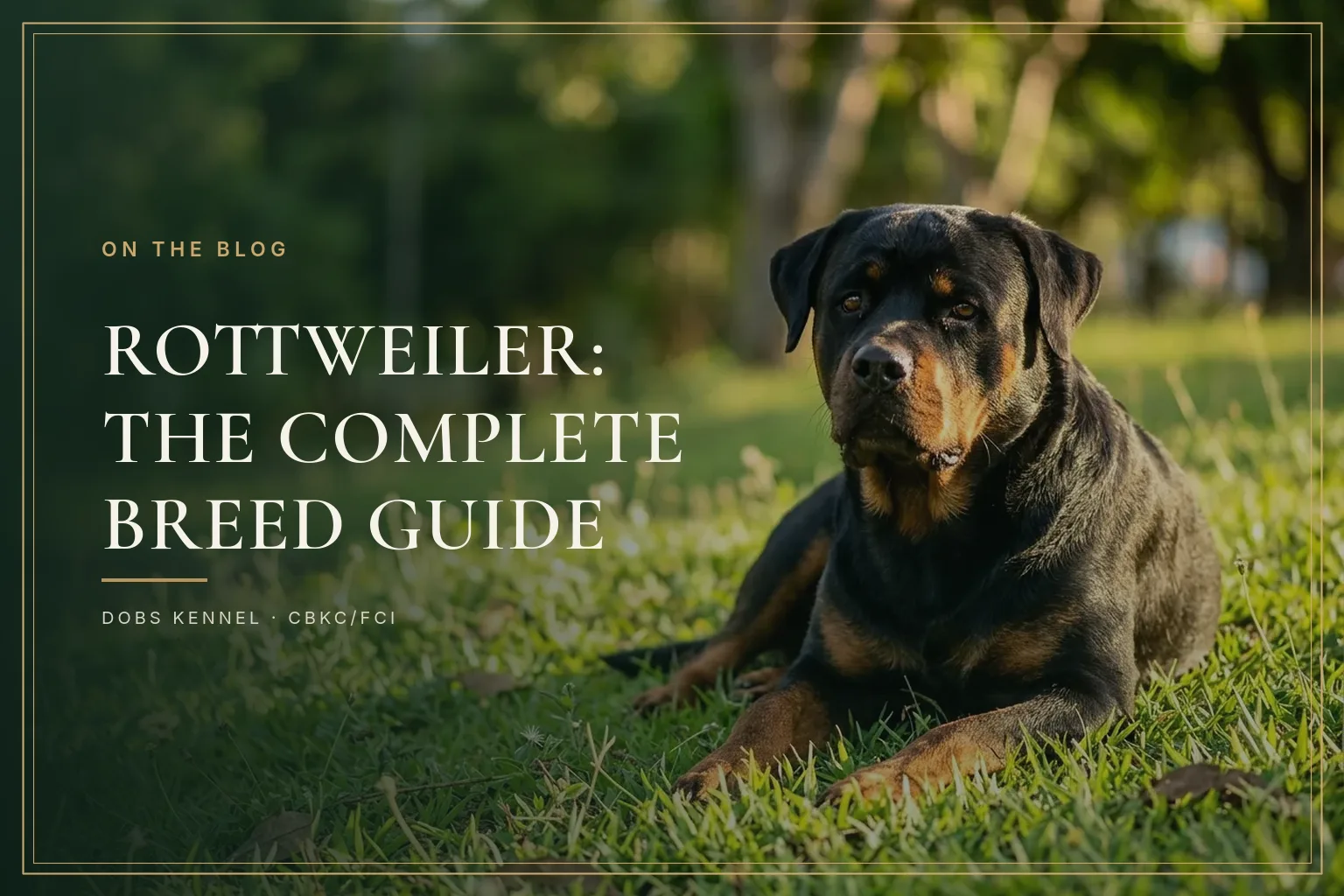
The Rottweiler is the dog that needs no introduction: his presence is already the warning. This guide was written by someone who breeds another guard breed, the Doberman, and so can talk about the Rottweiler without selling anything — with the qualities and the hard points in the same text.
Where he comes from
The breed comes from Rottweil, a city in southern Germany, where dogs of this type drove cattle and protected the butchers' money, tied around their necks on the way back. That is where the old nickname comes from, "butcher's dog". When cattle began to travel by train, at the end of the nineteenth century, the breed nearly disappeared. It was saved by police work, which recognized in it the rare combination of strength, calm and willingness to obey.
Breed data
| Trait | Male | Female |
|---|---|---|
| Height | 61 to 68 cm | 56 to 63 cm |
| Weight | 50 to 60 kg | 35 to 48 kg |
| Life expectancy | 8 to 10 years | |
| Coat | Short, double, black with clearly defined tan markings | |
| Energy | Medium — needs daily exercise, but is not tireless | |
| FCI group | Group 2, Pinscher and Schnauzer type dogs, Molossoids and Swiss cattle dogs | |
Swipe the table sideways to see all the columns.
The intact tail and what the rule says
Almost every photo of a Rottweiler in circulation shows a dog with a short tail, and many people conclude the breed is born that way. It is not. The FCI standard for the breed describes the tail in its natural state, and in Brazil Resolution 877/2008 of the Federal Council of Veterinary Medicine (art. 7, as amended by Resolution 1.595/2024) prohibits tail docking and ear cropping for aesthetic purposes, as unnecessary procedures that harm the animal's welfare. A puppy born today in a serious kennel here has an intact tail. An old image, or one from a country where cropping is still practiced, is no reference for the standard.
The question that comes right after that one is whether an intact tail is a handicap in the show ring. The current standard asks for the natural tail, so the intact dog is the dog within the standard; anyone who plans to compete should confirm the current rules directly with the organization before entering, because regulations change. At home the same choice applies that we make with the Doberman, for the same reasons, and it is explained in why we do not crop the ear.
Temperament: calm that commands respect
The balanced Rottweiler is confident and calm. He is not the dog that barks at everything; he is the dog that watches, measures and acts only when he understands he has to. That serene self-confidence is what the breed standard asks for and what good breeders select.
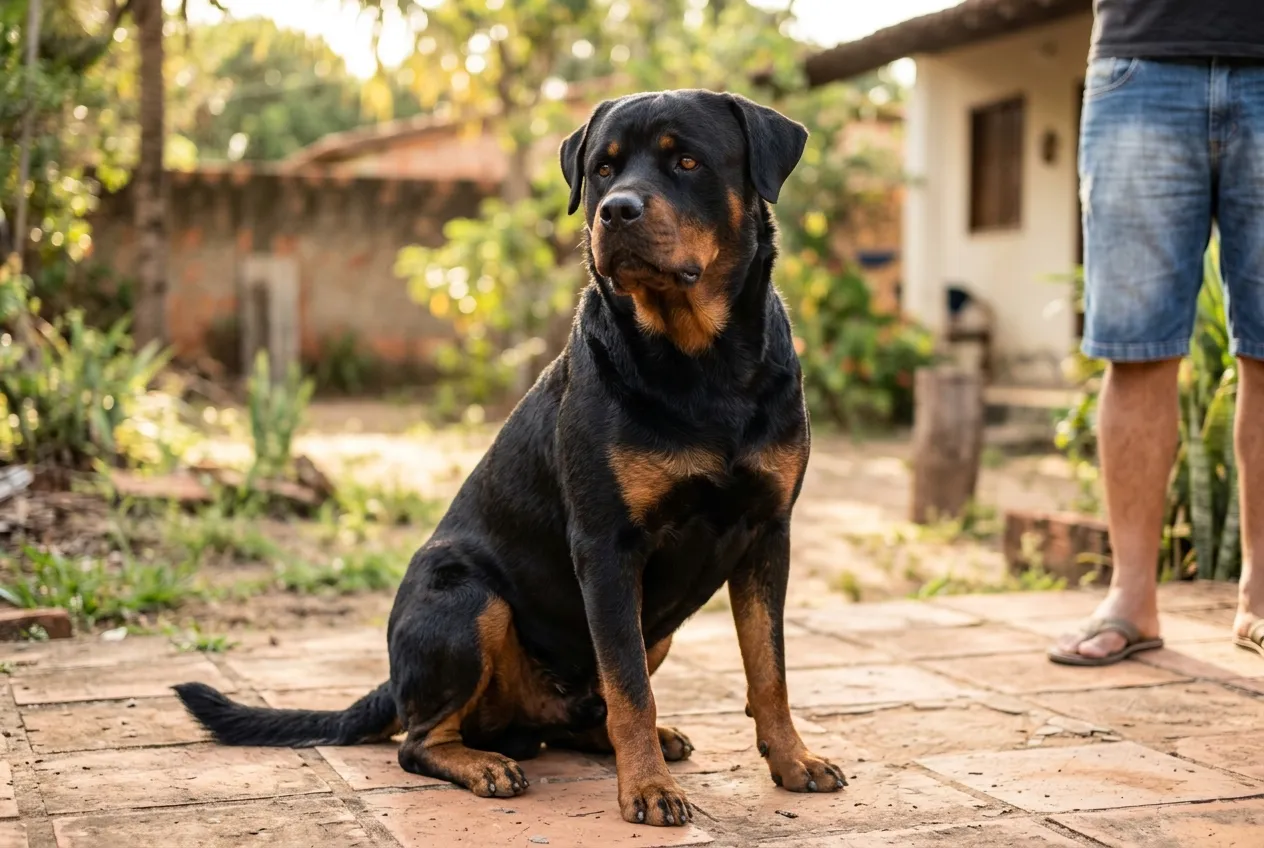
With the family he is affectionate in a clumsy way, the kind that sits on your foot thinking he is a sixty-kilo lap dog. With strangers he is reserved by nature: he accepts them when the owner does, without a fuss.
The point to watch is size combined with stubbornness. A poorly handled Rottweiler does not turn aggressive by chance, but he becomes hard to manage, and fifty kilos that are hard to manage are a real problem on the leash.
Health: what to ask the breeder
- Hip and elbow dysplasia. It is the number one concern of the breed. The parents need an official radiographic evaluation.
- Osteosarcoma. Bone cancer with an above-average incidence in large breeds, and the Rottweiler is among the most affected.
- Subaortic stenosis. A congenital heart problem that only shows up on an echocardiogram.
- Gastric torsion. A risk for any deep-chested dog. Feeding in two or three meals and avoiding exercise right afterward is the practical prevention.
A serious breeder shows these tests without you having to insist. If he does not show them, the lower price only postpones the bill, as we explained in our text on the real price of a puppy.
The routine of someone who has one
Exercise: one hour a day split between walking and mental work. He does not need to run like a Malinois, but he gains weight easily, and obesity in a large dog destroys joints.
Space: an apartment works if the routine of going out is followed religiously, although the size makes everything more complicated than with a Doberman.
Coat: weekly brushing takes care of it, with two heavier sheds a year.
Heat: a black coat and a heavy build do not go with the midday sun. In Brazil, exercise early in the morning or after six in the evening.
Rottweiler or Doberman
The comparison most requested by people looking for a guard dog. The honest summary:

| Rottweiler | Doberman | |
|---|---|---|
| Guarding style | Deterrence by presence | Fast alarm and interception |
| Energy | Medium | High |
| Reaction speed | Measures first | Reacts first, assesses along the way |
| Space needed | More | Less |
| Brazilian heat | Suffers more | Tolerates it better |
| Owner profile | Firm, with space and patience | Present, active, willing to train |
Swipe the table sideways to see all the columns.
The long version of this comparison, with routine and coexistence, is in Doberman or Rottweiler: which one fits your home. If you are still deciding among several breeds, the comparison of seven of them is in Best guard dog, and there is also the guide to the Cane Corso.
Who the Rottweiler is the right choice for
For someone who wants the mere presence of the dog to settle ninety percent of situations, has space, accepts handling a large animal with calm firmness and prefers a companion that observes to one that anticipates. If your home is busy, the space is short or you want a faster, more closely attached dog, the Doberman tends to fit better.
Frequently asked questions
Is the Rottweiler aggressive?
Not by nature. The breed standard asks for a self-confident dog with a balanced temperament. Aggression in a Rottweiler almost always comes from breeding without selection, missing socialization or wrong handling. Size only makes the consequences bigger.
Does he get along with children?
With the children of the house he is usually patient and protective. The real care is physical: sixty enthusiastic kilos knock a child over with no ill intent at all.
How much does a Rottweiler puppy cost in Brazil?
Between R$ 3,000 and R$ 7,000 at kennels with a pedigree and the parents' tests, varying by bloodline and region. Values far below that usually mean tests that were not done.
Can a Rottweiler live in an apartment?
He can, with daily outings guaranteed. But be honest about the size: maneuvering a sixty-kilo dog in an elevator and a hallway is a daily logistics exercise that not everyone wants.
We breed Dobermans, not Rottweilers. If after reading this you conclude the Rottweiler is the dog for your home, great: choose a breeder who shows the parents' hip and heart tests. And if you are undecided between the two breeds, message us on WhatsApp and we will talk with no commitment.

About the author
Marcelo Vaz
Entrepreneur and founder of Dobs Kennel
Marcelo Vaz is an entrepreneur and the founder of Dobs Kennel, a Doberman kennel in Nísia Floresta (RN), Brazil. As a boy, he already knew which dog he wanted. That passion for the Doberman stayed with him over the years and became the kennel he now runs with the seriousness of someone who waited a long time for it. “We are not veterinarians, but we study every subject in depth and only write what is backed by science and reliable sources,” he says.
- RegistryCBKC / FCI
- Kennel nameImperio Real Norte
- WhereNísia Floresta, RN
Keep reading


Comments
Ask the breeder directly. Every comment is moderated before it appears, and your email is never published.
Be the first to comment: ask the breeder directly.