


In this article
- Where he came from
- Breed profile
- Temperament: the dog that wants a task
- The lines within the breed
- Colors and coat, without the myths
- Health: what to ask before you commit
- The routine of someone who has one
- How much a German Shepherd costs in Brazil
- German Shepherd or Doberman
- Who the German Shepherd is the right choice for
- Frequently asked questions
The German Shepherd is a medium to large dog, between 55 and 65 cm tall, bred in Germany in the late 19th century for herding and later repurposed for almost every job you can ask of a dog: police work, scent detection, guide dog for the blind, search and rescue. He lives 9 to 13 years, demands daily exercise and mental work, sheds a lot, and remains the most versatile breed there is.
This guide was written by someone who breeds another guard breed, the Doberman, at the kennel we keep in Greater Natal. The advantage is that I have no German Shepherd puppies to sell, so I can talk about the hard points with the same ink I use on the good qualities.
Where he came from
The story begins in 1899, when cavalry captain Max von Stephanitz bought a dog called Hektor Linksrhein at a show, renamed him Horand von Grafrath, and registered him as the first German Shepherd. The same year he founded the breed club, the SV, which still exists today.
Von Stephanitz had a declared obsession: usefulness above beauty. When herding began to lose ground in industrialized Germany, he was the one who pushed the breed toward police and military service, and that's why the German Shepherd entered the 20th century with a job already guaranteed. The First World War carried him around the world in the soldiers' baggage.
Breed profile
| Trait | Male | Female |
|---|---|---|
| Height | 60 to 65 cm | 55 to 60 cm |
| Weight | 30 to 40 kg | 22 to 32 kg |
| Life expectancy | 9 to 13 years | |
| Coat | Double, in two recognized varieties: normal coat and long coat | |
| Energy | High, with a need for mental occupation on top of exercise | |
| Shedding | Heavy all year, with two stronger sheddings | |
| FCI group | Group 1, sheepdogs and cattle dogs, standard No. 166 | |
Swipe the table sideways to see all the columns.
Temperament: the dog that wants a task
The balanced German Shepherd is confident, attentive and willing. The trait that defines the breed isn't courage, it's the will to work together. He looks to his owner with his eyes, waiting for instruction, and that constant availability explains why he learns fast and why he goes off the rails fast when nobody gives him anything to do.
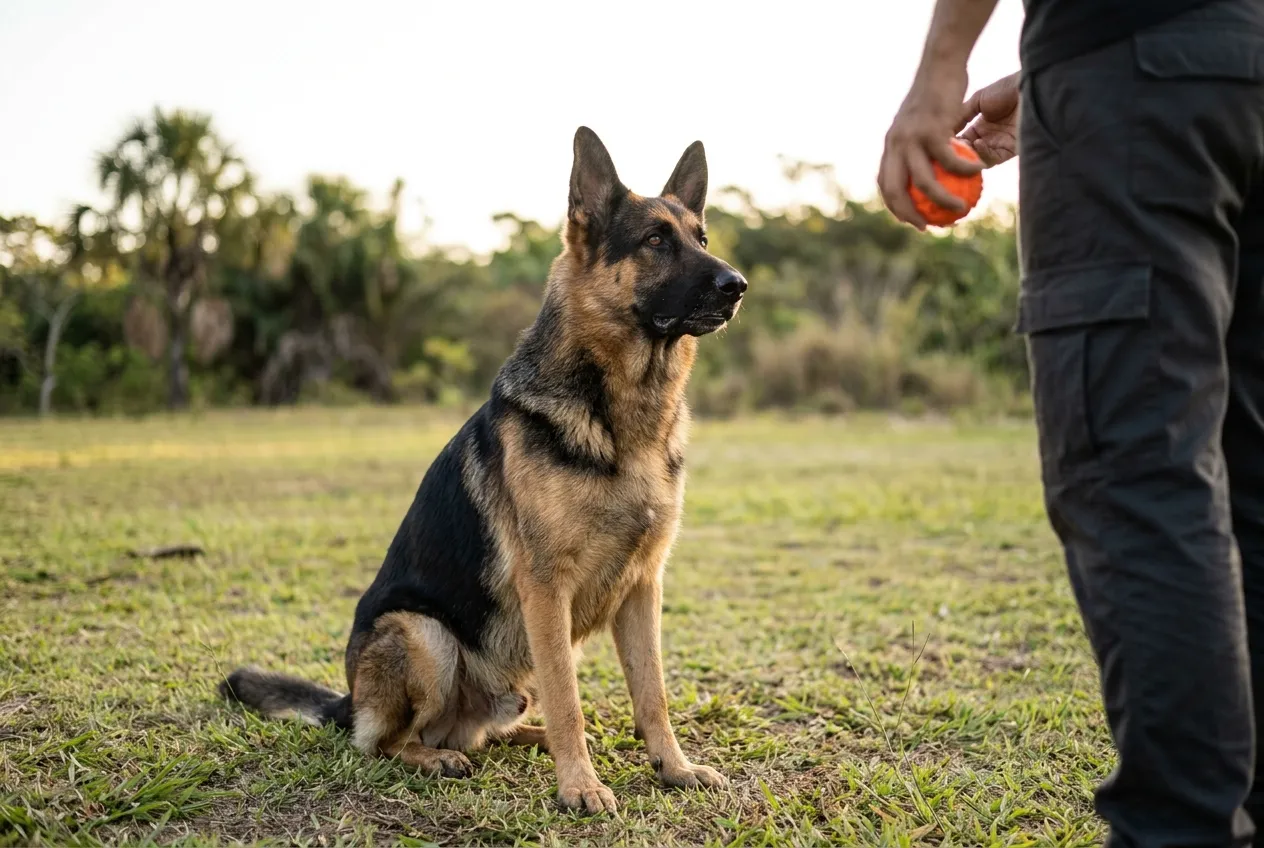
With the family he's attached to the point of becoming a shadow. With strangers he's reserved without being hostile, and the breed standard asks for exactly that. Guarding comes standard: he alerts, takes his position and waits for your read, without needing any specific training for it.
The point of concern is boredom. A German Shepherd that spends the day alone in the yard, with no function, invents one. He tends to invent compulsive barking, holes in the garden, chasing shadows and his own tail, or reactivity on the leash. It's the breed where the "problem dog" is almost always an intelligent dog without a job.
The lines within the breed
Anyone who starts researching soon finds out there's more than one German Shepherd, and the difference is big enough to change the purchase.
- German show line. The most common in Brazil. A well-marked black saddle, pronounced rear angulation, intense pigmentation. Tends to have energy that's more manageable for home life.
- German working line. Less angulated, sable and gray colors more frequent, much more drive. A dog for someone who will really train, not for someone who wants a couch companion.
- Czech and DDR line. Originates from the old border kennels of Eastern Europe. Robust structure, heavy head, firm temperament and a high stress threshold.
- American show line. Lighter, very angulated, bred with a focus on the show ring.
If the dog is going to be the family's and not the sport's, a working line can be more dog than the routine can handle. That's the costliest mistake I see people make with the breed, and it doesn't show up in the puppy: it shows up at ten months.
Colors and coat, without the myths
Black saddle
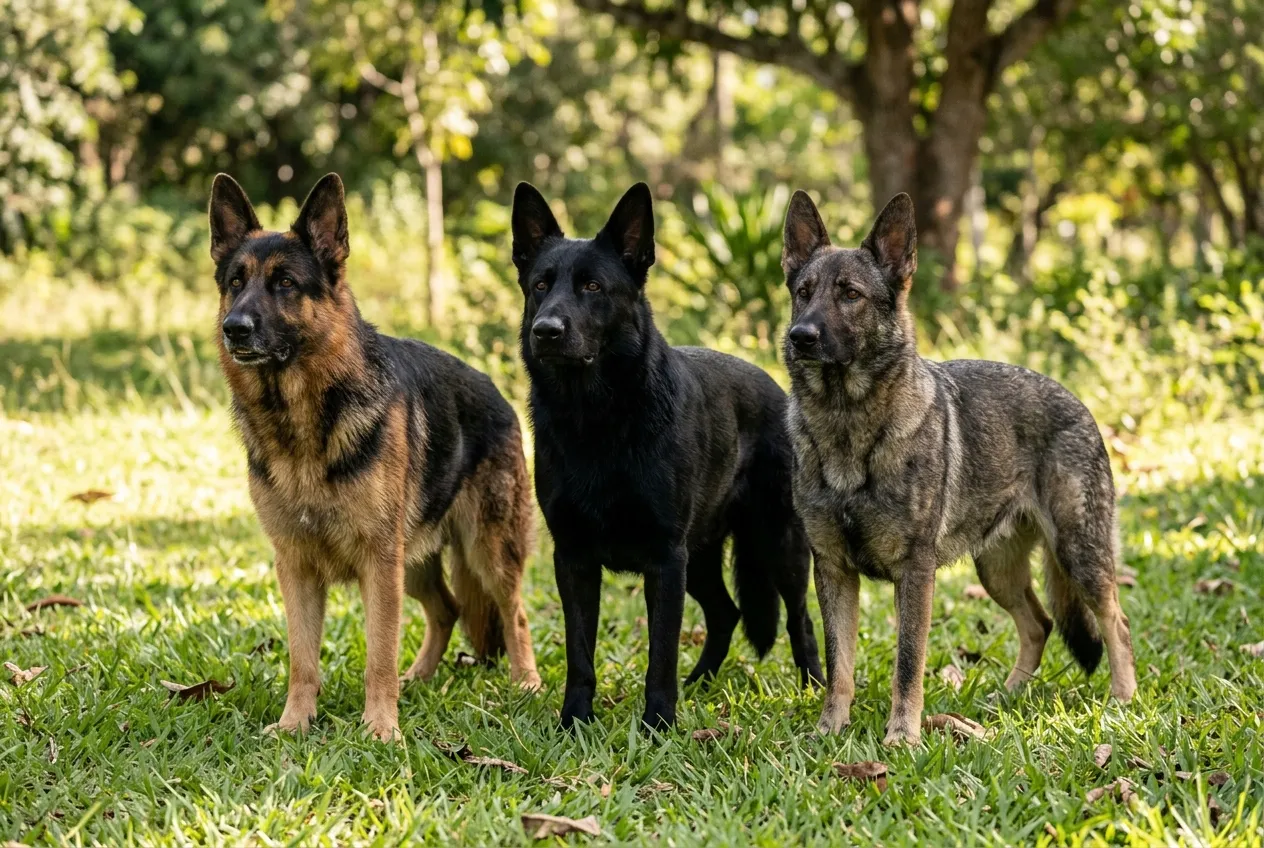
It's the popular name for the black-and-tan pattern with the dark patch covering the back like a saddle. It's the image most people have of the breed, and the most sought-after in Brazil. It doesn't indicate quality or temperament, only the distribution of pigment.
Solid black, gray and sable
All accepted by the standard. The gray, called sable or wolf, was the most common coloring in the first registered dogs. Solid black is accepted and relatively rare, which usually becomes a price argument with no technical basis.
Long coat
A variety recognized by the FCI standard as of 2010, with an undercoat. It requires more brushing and nothing else. A long-coated dog sold as "rare" or "exotic" at a premium is sales talk.
White
Here the information is usually missing. White exists in the breed, it results from a recessive gene, and it's disqualifying under the German Shepherd standard. White dogs were developed in their own line and gave rise to a separate breed, the White Swiss Shepherd, and that one is recognized, with its own standard. If someone offers you a white puppy from black-saddle parents as a "rare premium lineage," be suspicious: white is outside the breed standard, and the markup there charges for a deviation.
Health: what to ask before you commit
- Hip and elbow dysplasia. It's the breed's historic problem, made worse by decades of selection for extreme angulation. The parents need an official radiographic report, and this is the non-negotiable exam.
- Degenerative myelopathy. A progressive neurological disease of the spinal cord, with late onset, that compromises the hindquarters. There's a genetic test for the associated gene, and a breeder who works with the breed knows the status of the breeding dogs.
- Exocrine pancreatic insufficiency. The pancreas stops producing digestive enzymes and the dog loses weight while eating a lot. It has a marked breed predisposition and lifelong treatment.
- Gastric torsion. A risk for any deep-chested dog. Divided meals and no exercise right after eating is the practical prevention.
- Skin allergies and recurring ear infections, common enough to enter the monthly cost calculation.
The logic is the same one I apply to my own breed: a report in hand, not someone's word. A breeder who gets bothered by the request has already answered the question. I put together the full script for that conversation in how to recognize a serious breeder, and it works for any breed.
The routine of someone who has one
Exercise and mind. An hour a day of walking takes care of the body and doesn't take care of the dog. He needs a task: short obedience at home, a fetch toy with rules, sniffing out hidden food around the yard, training with a goal. Fifteen minutes of mental work tire more than forty on the leash.

Coat. This is the item that surprises most people who've never had the breed. The German Shepherd sheds all year round, and twice a year he sheds the undercoat in tufts. Brushing two or three times a week, a vacuum cleaner with a short life and black clothes retired. If hair in the house really bothers you, this breed will wear you down.
Heat. I write from Brazil's Northeast, so I know what I'm talking about: a double coat and midday sun don't go together. Exercise before eight in the morning or after five in the afternoon, shade available all day and water in more than one spot in the house. The breed adapts well to our climate, as long as the routine respects the schedule.
Space. An apartment is possible and harder than with the Doberman, because of the hair, the alert barking and the size of the need for occupation. A yard without walks replaces nothing: a dog alone in the yard is a bored dog with more square footage.
How much a German Shepherd costs in Brazil
At kennels with a CBKC pedigree and documented exams on the parents, a puppy usually costs between R$ 2,500 and R$ 6,000, going up with the lineage and the titles of the breeding dogs. An ad well below that range usually means an exam not done or a nonexistent pedigree, and the savings turn into an orthopedic appointment down the road. The logic of that math is the same one I detailed for my breed in why cheap ends up expensive.
The monthly cost comes close to that of any large dog: quality food, dewormer, flea prevention, annual vaccines and a reserve for the vet. Add baths and sanitary trims more often than for a short-haired dog.
German Shepherd or Doberman
| German Shepherd | Doberman | |
|---|---|---|
| Guarding style | Alerts, takes position and waits for a command | Quick alarm and interception |
| Shedding | A lot, all year | Little |
| Heat tolerance | Medium, needs schedule management | Good |
| Need for a task | Very high | High |
| Ease of training | Very high | High |
| Ideal space | A house with a yard | A house or apartment with a firm routine |
Swipe the table sideways to see all the columns.
If you're comparing several guard breeds before deciding, the full comparison of seven of them is in best guard dog. There are also the guides to the Rottweiler and the Cane Corso, written with the same criteria.

Who the German Shepherd is the right choice for
For someone who wants a dog that learns anything and insists on taking part in the day, has the willingness to give him a task throughout the ten or twelve years of his life, and doesn't mind hair. If your home is small, your time is short or hair on the couch is a real problem, the fit tends to be poor, however much you admire the breed.
Frequently asked questions
How many ribs does a German Shepherd have?
Thirteen pairs, twenty-six in total, like every domestic dog. The question shows up a lot in searches because of internet quizzes, but there's nothing particular to the breed on this point.
Is the German Shepherd aggressive?
Not by nature. The standard calls for a self-confident, balanced dog without nervousness. Aggression in the breed usually comes from three sources: breeding without temperament selection, lack of socialization and chronic boredom. All three are a human responsibility.
Does he get along with children?
He's usually excellent with the children of the house, protective and patient. The thing to watch is the herding instinct, which in some individuals shows up as pushing or nipping at the heels of a running child. It's corrected early, with supervision.
Can a German Shepherd live in an apartment?
He can, if the family guarantees a daily outing and mental occupation. Be ready for the hair and for the alert barking, which in a building earns you a talk with the neighbor.
What's the difference between a German Shepherd and a Belgian Malinois?
The Malinois is lighter, faster, with energy well above and a tolerance for boredom well below. It's a professional working dog, and most families who think they want a Malinois really want a show-line German Shepherd.
Is the black saddle better than the other colors?
No. It's the most sought-after, which sometimes raises the price, but color doesn't predict health, structure or temperament.
We breed Dobermans, not German Shepherds. If after reading this you conclude the German Shepherd is the dog for your home, great, and the one piece of advice I insist on repeating is to demand the dysplasia report for both parents. And if you're still undecided between the two breeds, talk to us and I'll help you think it through without tilting the scale my way.

About the author
Marcelo Vaz
Entrepreneur and founder of Dobs Kennel
Marcelo Vaz is an entrepreneur and the founder of Dobs Kennel, a Doberman kennel in Nísia Floresta (RN), Brazil. As a boy, he already knew which dog he wanted. That passion for the Doberman stayed with him over the years and became the kennel he now runs with the seriousness of someone who waited a long time for it. “We are not veterinarians, but we study every subject in depth and only write what is backed by science and reliable sources,” he says.
- RegistryCBKC / FCI
- Kennel nameImperio Real Norte
- WhereNísia Floresta, RN
Keep reading


Comments
Ask the breeder directly. Every comment is moderated before it appears, and your email is never published.
Be the first to comment: ask the breeder directly.