


In this article
The brown Doberman is the same breed, the same standard and the same dog as the black one — the difference is a single pigment gene, and almost everything said beyond that is a seller's myth. This article explains where the color comes from, what really changes in care, and the three sales pitches you should ignore when an "exclusive brown" shows up in front of you.
Brown catches the eye in a photo, and the internet has manufactured an aura of rarity around it. Let's take it piece by piece, starting with the genetics, which is short and settles half the doubts.
Where brown comes from: one gene, no mystery
The Doberman's base color is controlled by a gene called B, for brown. The dominant version (B) produces black pigment; the recessive one (b) produces brown, which is the same pigment assembled a different way. A brown puppy has to inherit the "b" from both its father and its mother. Two black carriers can have brown puppies; two browns bred together only produce brown.
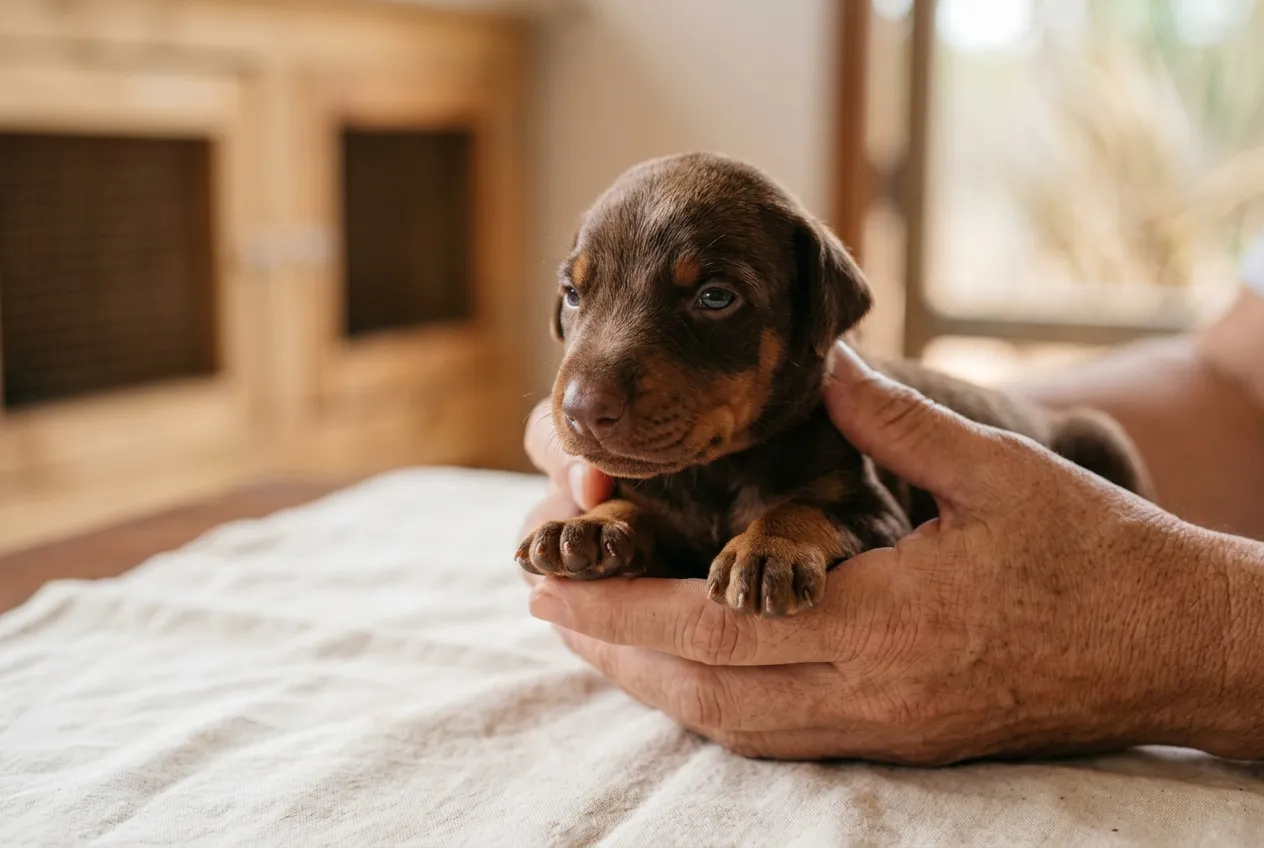
In the United States the color is called red, and you'll see that word in pedigrees and on sites from outside Brazil. It's the same brown under another name. The tan (rust) markings stay in the same places as on the black: muzzle, chest, eyebrows, paws.
A detail from the whelping room that almost never gets written down: you can tell brown from black on the day the puppies are born, without waiting for anything to "settle." Look at the nose and the paw pads. In the brown puppy they already arrive in the world in a chocolate tone; in the black one, dark. A breeder who attends the whelping knows the color makeup of the litter before the eyes open.
The full overview of the breed's colors, including the diluted ones and the ones that aren't recognized, is in our guide to Doberman colors. This article is the deep dive on brown.
What really changes in a brown Doberman
| Aspect | What changes | What does NOT change |
|---|---|---|
| Pigment | Brown nose, lips and nails; eyes from amber to brown | — |
| Temperament | — | Nothing: color doesn't predict behavior |
| Health | Skin slightly more prone to oiliness and folliculitis in some lines | Heart, dysplasia and the rest of the breed's list: identical to the black |
| Standard and showing | — | Brown and rust is a color recognized by the CBKC, FCI and AKC |
| Price at a serious kennel | — | The price follows the quality of the litter, never the coat |
Swipe the table sideways to see all the columns.
The official breed standard is FCI No. 143, the same one the CBKC adopts here, and it admits two base colors: black and brown, always with well-defined rust markings. The text goes beyond color and says where those markings have to be: above the eyes, on the muzzle, on the throat, two spots on the chest, on the limbs and under the tail. Brown and rust comes in through that front door, with the same right as black.
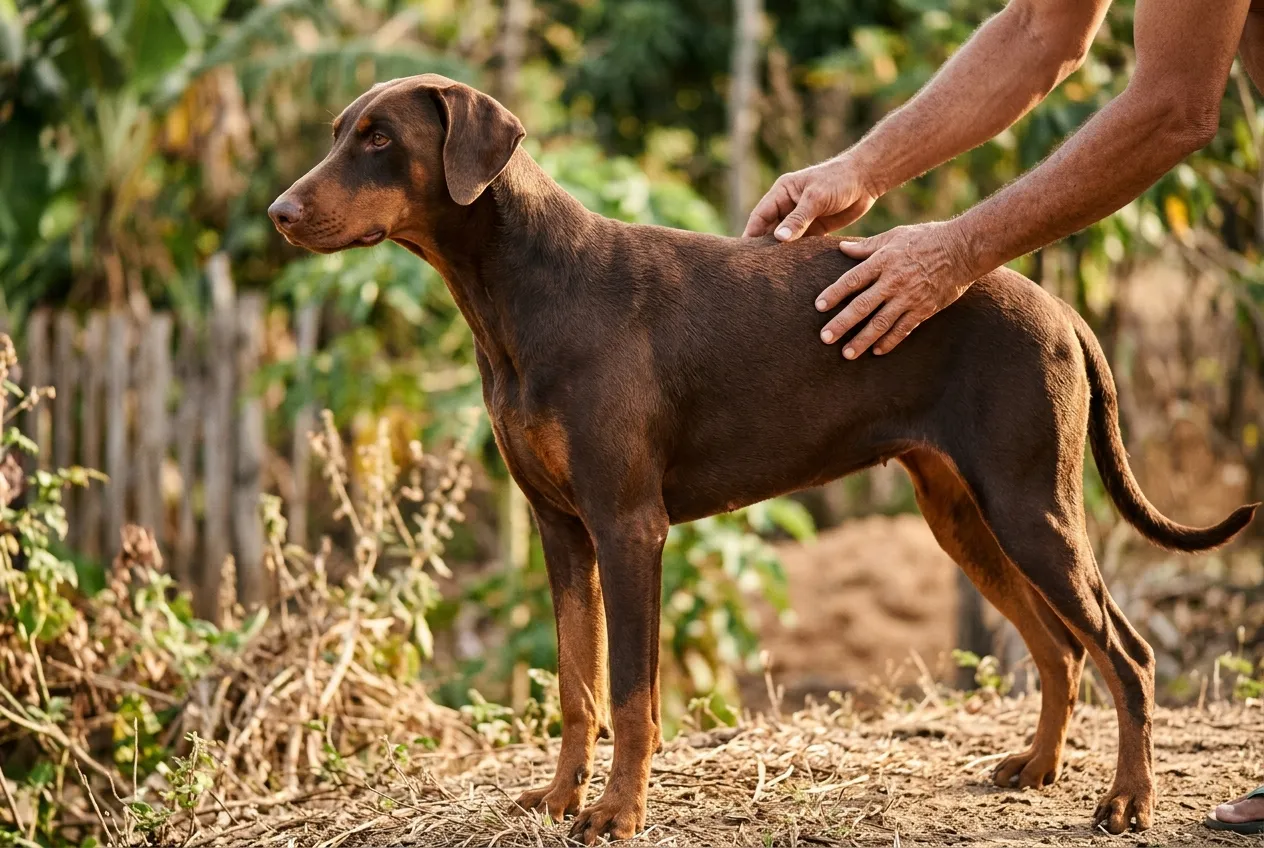
On skin: it's the only point where brown calls for a bit more attention, and it's little. Baths with a suitable product and an eye on irritations take care of it. Don't confuse it with the alopecia of the diluted colors (blue and isabella), which is another subject and another level of seriousness; the colors guide explains the difference. Real health in a Doberman is bought the same way in any color: a heart exam on the parents, dysplasia, a breeder who shows the report.
The three sales pitches to ignore
"Brown is rare, that's why it costs more." Brown is less common than black because the gene is recessive, but it isn't rare or exclusive: any kennel that breeds carriers produces it. A surcharge for color is the sign of a kennel that sells photos. The full reasoning on what makes up an honest price is in why a cheap Doberman ends up expensive.
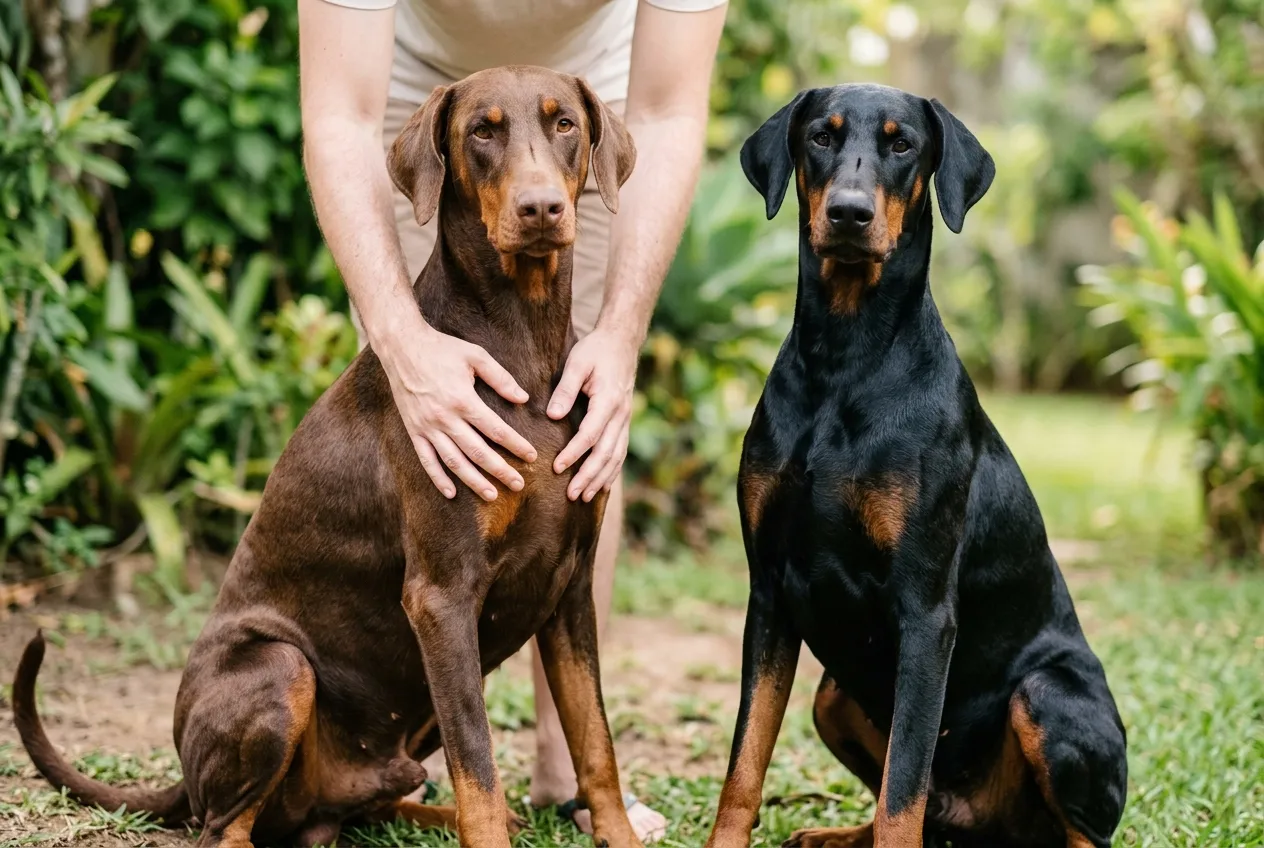
"Brown is more docile" (or "meaner," depending on the seller). Temperament comes from behavioral genetics, from socialization and from the routine the home offers. Each dog has its own, like each person. Whoever promises personality by color is inventing an attribute to close a sale.
"I have a brown with light eyes, ultra-exclusive." Eyes that are too light fall outside the standard, and in brown the amber tone is already naturally lighter than in black. "Exclusive" in a dog ad is usually a synonym for outside the standard with a rarity price, and the serious breeder checklist knocks down that act in five questions.
Brown in our lineage
We work with lines of champions from the Americas and Europe, with purity registered with the CBKC/FCI. Eros, our stud dog, is brown and rust and comes from lines of the Americas. Kira, our dam, is black and rust, with European blood documented in the pedigree (Teraline Rohan in the tree), and is a brown carrier. The genealogy of both is open at why we paired Eros and Kira.
Translating that into color, the math is short. Eros only has "b" to give, because he's brown. Kira has one "B" and one "b", and each puppy draws which of the two it gets from her. The statistical expectation for a litter from this pair is half brown and half black carriers. In a small litter the draw can easily lean to one side, and no genetics calculation guarantees the color of a specific puppy before birth.
A brown puppy here goes out with the same CBKC pedigree and the same price as the black siblings in the litter. If you ever see a price difference by color on our site, you can hold me to this paragraph in writing.
What I tell anyone who arrives set on brown: choose the puppy by the temperament that fits your home, and leave color as the tiebreaker. The puppy guide shows how we help with that reading, litter by litter.
Frequently asked questions
Is the brown Doberman rare?
No. It's less frequent than black because it's a recessive gene, but it's born in any kennel whose breeding dogs carry the "b". Real rarity in a Doberman is something else: a whole litter with heart and dysplasia exams on both parents.
Does brown have more health problems?
The breed's health list is the same in every recognized color. Brown may call for a little more care with the skin in some lines, and that's all. The serious Doberman diseases don't pick a color.
Does the brown coat fade in the sun?
It lightens, and in brown it shows more than in black, because the pigment is already lighter to begin with. A dog that spends the afternoon lying in the sun on the balcony ends up with the tips of the coat pulling toward a dusty red, and the tone comes back when he sheds his coat. If it bothers you, push his sun time to early morning and late afternoon. Here in Greater Natal I recommend that anyway, because of the heat.
Can a brown Doberman take part in dog shows?
It can: brown and rust is a standard color at the CBKC, the FCI and the AKC. What disqualifies are the colors outside the standard, like white, the subject of our colors guide.
Does brown cost more?
At a serious kennel, no. The price reflects the quality of the litter: genetics, exams, structure, follow-up. Color as a price-list item is a red flag of commerce, not of breeding.
How do I know if a black puppy carries the brown gene?
Through the genealogy (brown parents or grandparents) or through a genetic color test, which any veterinary genetics lab does today with a cheek swab. A breeder who knows his own breeding stock answers that off the top of his head.
Did you like the brown and want to know when we'll have puppies in that color? Message me. I'll put you on the list for the next litter with carriers and let you know before it goes up on the site.

About the author
Marcelo Vaz
Entrepreneur and founder of Dobs Kennel
Marcelo Vaz is an entrepreneur and the founder of Dobs Kennel, a Doberman kennel in Nísia Floresta (RN), Brazil. As a boy, he already knew which dog he wanted. That passion for the Doberman stayed with him over the years and became the kennel he now runs with the seriousness of someone who waited a long time for it. “We are not veterinarians, but we study every subject in depth and only write what is backed by science and reliable sources,” he says.
- RegistryCBKC / FCI
- Kennel nameImperio Real Norte
- WhereNísia Floresta, RN
Keep reading


Comments
Ask the breeder directly. Every comment is moderated before it appears, and your email is never published.
Be the first to comment: ask the breeder directly.