


In this article
The white Doberman exists. You can find photos of him, and even ads charging a lot for the "exclusivity." And it's exactly because he exists that this article has to be direct: we don't breed white Dobermans, and no serious breeder in the world does. The reason lies in the genetics, in the dog's health and in a line that serious breeding doesn't cross.
Where the white Doberman came from
Every white Doberman in the world descends from a single female dog: Sheba, born in the United States in 1976. She carried a recessive mutation that breaks pigment production, a type of albinism (the technical term is tyrosinase-positive albinism). Inbred matings from her fixed the gene, and that is the line still circulating today.
In the United States, the breed registry marks the descendants of that line with the letter "Z" at the start of the registration number, precisely so that any breeder can trace and avoid the gene. When the registry itself builds a tracking system for a color, the message is clear.
Science closed the case in 2014, when a study published in the journal PLOS ONE located the mutation: a partial deletion in the SLC45A2 gene, the same gene linked to forms of albinism in other species. From then on a commercial DNA test for this mutation became available, done with a cheek swab and no anesthesia at all. Any breeder can find out whether a dog carries the gene before planning a mating. After that, breeding the line became a choice.
How the gene hides in a litter
This is the part buyers rarely hear, and it's the part that explains why the gene still circulates. The mutation is recessive: a dog is only born albino if it receives the altered version from both its father and its mother. A dog that receives just one copy is a carrier, has a perfectly normal coat and eyes, and lives its whole life without ever giving a sign.
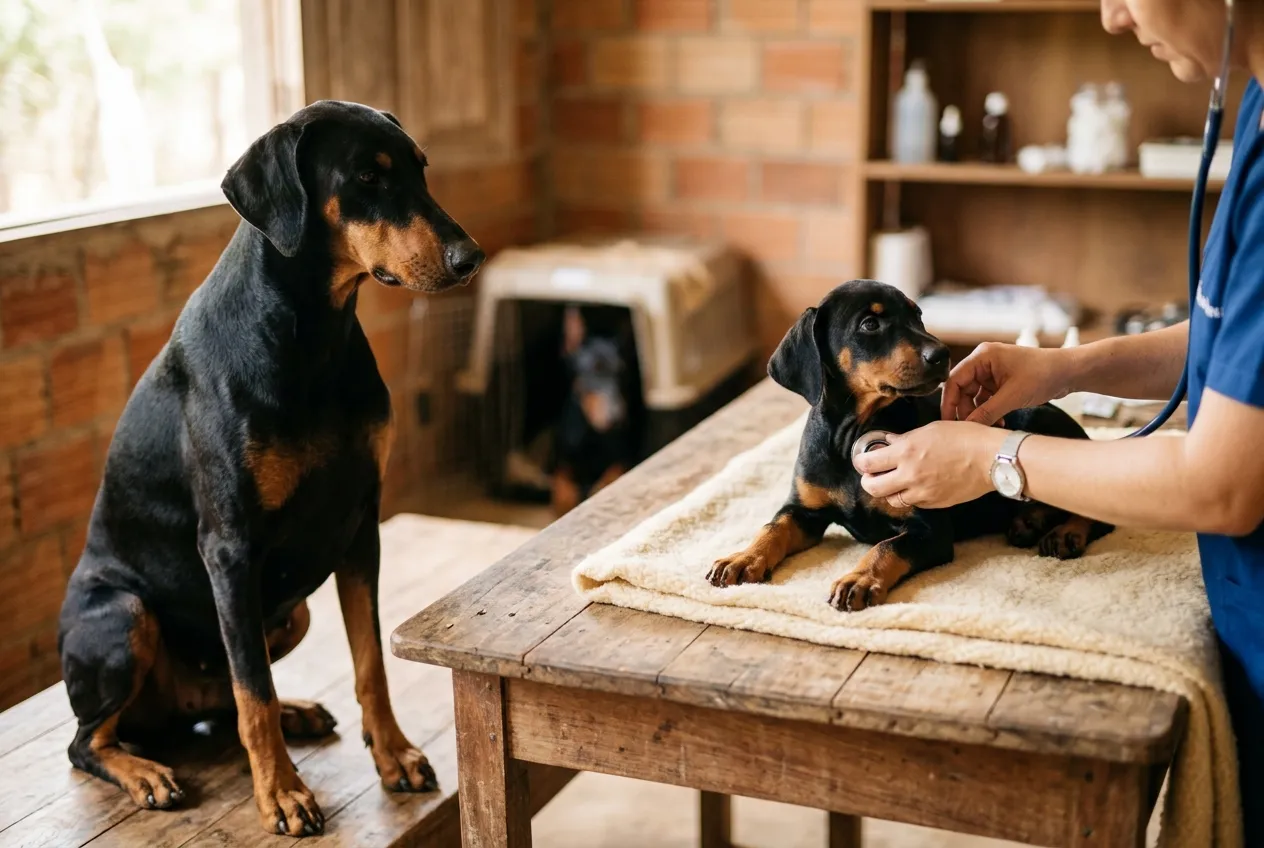
Breed two carriers and the statistical expectation for each puppy is: one in four albino, two in four carriers like the parents, one in four free of the gene. A breeder who doesn't test can spend years selling carriers without knowing it, until the day two of them meet in another kennel. That's why tracing and pedigree matter. The paperwork is the only place where this story becomes visible before the puppy is born, and it's what we explain in what the CBKC pedigree guarantees.
What the gene costs the dog
The white of the Doberman isn't a coat color, it's the absence of protection. In practice, the dog pays with:
- Photosensitivity: light eyes that suffer in daylight, which changes the dog's routine and behavior in open spaces.
- Unprotected skin: sunburn and an increased risk of skin tumors over a lifetime.
- Impaired vision: the malformation linked to albinism reduces visual acuity.
- Startle: a dog that sees poorly gets frightened by what it didn't see coming. The cause here is vision, and each dog responds in its own way. Even so, in a guard breed, being startled is a variable that serious breeding doesn't introduce on purpose.
That's why the breed standard, FCI No. 143, which the CBKC adopts here in Brazil, admits two base colors and only two: black and brown, always with well-defined rust markings. White isn't listed, never was, and there's no show judge in the world who could admit it.
The Doberman's colors, measured against the standard
| Color | Status in the standard | What the genetics say |
|---|---|---|
| Black and rust | Recognized (FCI) | The breed's classic color, no caveats |
| Brown and rust | Recognized (FCI) | One gene of difference, same health |
| Blue and isabella | Outside the FCI standard | Color dilution associated with alopecia (hair loss) |
| White / albino | Never recognized | Albinism with a real cost to health and well-being |
Swipe the table sideways to see all the columns.
As for brown, which a lot of people also think is "rare": it's a recognized, healthy color, and we explain the genetics of the brown Doberman in detail. The overview of the four colors, with the diluted ones explained separately, is in the guide to Doberman colors. The yardstick is simple: legitimate variation exists inside the standard. Outside it, the bill comes due in health.
"Rare" is a sales pitch, not a breeding argument
The white Doberman ad always follows the same script: "extremely rare specimen," "exclusive bloodline," a price above market. It's worth naming the trick: the rarity there is a genetic defect with marketing. The breeder who breeds this line is choosing, on purpose, to produce dogs that will live with skin pain and a fear of the sun, because the white puppy sells high to people who don't know the story.
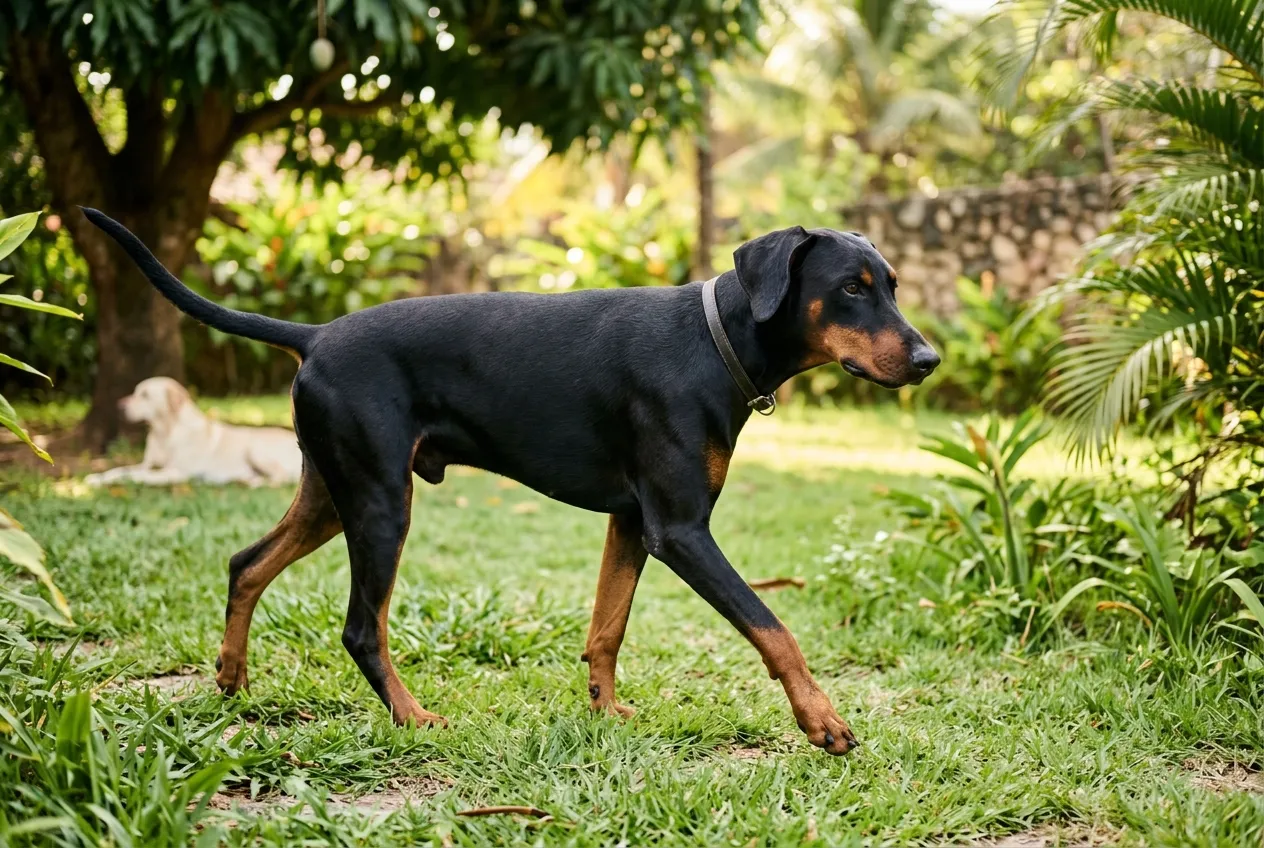
Serious breeding takes the opposite path: it tests, traces and takes the gene out of circulation. It's the same principle that guides us in choosing our breeding dogs. We work with lines of champions from the Americas and Europe, with purity registered with the CBKC/FCI, and the comparison between the breed's two lines shows what each one brings to the table.
How to recognize the ad you should avoid
- Charges more for a color the standard doesn't recognize. In serious breeding, no color inside the standard changes the price on its own.
- Calls albinism "pure white", "cream" or "white" to sound like a normal coat.
- Doesn't show the puppy's pedigree or parents, or makes up an "international registry" you can't check.
- Pushes urgency: "last of the litter," "reserve today only." Hurry is the tool of someone who doesn't want questions.
- Disappears when you ask about the DNA test for the mutation. The question costs one line on WhatsApp and separates someone who studies their own breeding stock from someone who just passes puppies along.
If the ad came from social media or a classifieds site, it's worth reading the map of where to buy a Doberman safely first, and putting the seller through the questions in the serious breeder checklist.
I already have a white Doberman. Now what?
Anyone who already has a white Doberman at home, almost always from having bought without knowing, deserves a practical answer instead of a sermon. The dog is already in your home and his life depends on how he's managed, so here is what veterinary ophthalmologists and dermatologists advise for albino dogs:
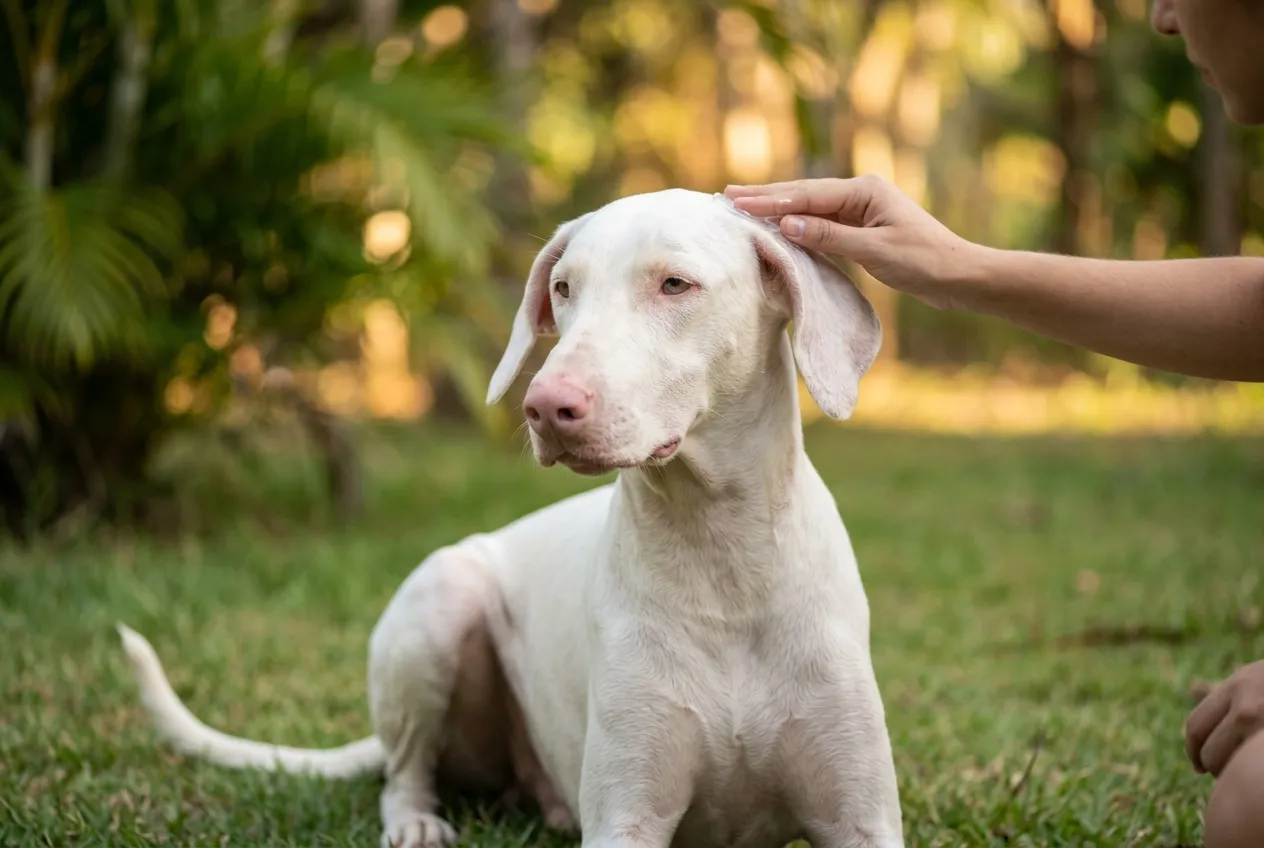
- Change when he gets sun. Walks and yard time early in the morning and late in the afternoon. Midday sun, for this dog, is risky exposure.
- Protect the thin-haired areas: nose, ear tips, belly and groin. Use a veterinary sunscreen, prescribed. Human sunscreen with zinc oxide is toxic for a dog that licks it.
- Real shade in the yard, available all day, and water in more than one spot.
- An annual skin exam and eye appointment. Any lump, scab that doesn't heal or new spot goes to the vet that week, without waiting for it to get worse.
- Speak before you touch and approach from the front. He sees poorly and gets frightened by what appears out of nowhere. The same goes for visitors and children at home.
- Spay or neuter. An albino dog shouldn't breed, and neither should a known carrier, unless the breeder knows exactly what he's doing with the test in hand.
A well-managed albino dog has a good life. What can't keep happening is someone deciding to breed one more on purpose.
Our commitment
Here at Dobs Kennel, color never comes before health. We breed black-and-rust and brown-and-rust dogs, inside the standard, with a CBKC pedigree. Our puppies are born in the whelping room and stay in a pen of their own, safe and with controllable temperature, with the mother free to come and go and nurse. They have natural ears and a full tail, and the follow-up continues after delivery. The genealogy of our breeding dogs is open at our genetics and family tree.
If you want a Doberman with the genetics working in his favor, talk to us. The WhatsApp on the site goes straight to the breeder, and questions about lineage health are welcome here.

About the author
Marcelo Vaz
Entrepreneur and founder of Dobs Kennel
Marcelo Vaz is an entrepreneur and the founder of Dobs Kennel, a Doberman kennel in Nísia Floresta (RN), Brazil. As a boy, he already knew which dog he wanted. That passion for the Doberman stayed with him over the years and became the kennel he now runs with the seriousness of someone who waited a long time for it. “We are not veterinarians, but we study every subject in depth and only write what is backed by science and reliable sources,” he says.
- RegistryCBKC / FCI
- Kennel nameImperio Real Norte
- WhereNísia Floresta, RN
Keep reading


Comments
Ask the breeder directly. Every comment is moderated before it appears, and your email is never published.
Be the first to comment: ask the breeder directly.