


In this article
The American Doberman is the Doberman selected under the AKC standard, the American Kennel Club, which maintains the breed under the name Doberman Pinscher. It is the same breed as the European Dobermann, seen through another school of selection. What changes is the average type of head, silhouette and temperament; the breed, the Brazilian pedigree and the diseases to watch for are the same.
This guide is for people who searched the term and want to understand what it means before choosing: what tends to change, what stays the same, three myths about the term and which home the American dog suits. In our home both schools live side by side, and the kennel's position gets its own section further down. If you only want the side-by-side comparison, it's in European vs American Doberman: the differences that matter.
American Doberman: what the term means
The Doberman was born in Germany, in Apolda, from the work of Karl Friedrich Louis Dobermann, in the late 19th century. The FCI maintains the breed standard under number 143, under the name Dobermann, and Germany is the country responsible for it. In the United States, the AKC wrote and maintains its own standard, under the name that stuck there, Doberman Pinscher. Germany dropped "Pinscher" from the name in 1949, and the Americans kept it.
"American Doberman", then, is how the market refers to the dog whose selection followed the AKC standard and judges over decades. Two standards written by different committees produce two types that can be told apart by eye, and that is what separates the two schools. The spelling is needlessly confusing: Dobermann with two "n"s is the German and FCI form, Doberman with one "n" is the American one, and the one we use on this blog. It doesn't say which line the dog comes from. The pedigree does.
In Brazil, an American-line Doberman born here, from registered parents, comes with the CBKC pedigree, the same as any other Doberman. If the dog comes from abroad, ask for the origin document and confirm with the CBKC how the registration works before closing the deal, because the import requirements change over time.
What tends to change in type and temperament
Everything that follows is a population tendency. Colors, ears and tail come from the standards; silhouette, head and temperament come from the description that breeders of both schools give. No dog matches the average to the letter.

- Silhouette and head. The American school tends to be leaner and more elongated, with a longer neck, more pronounced angulation and a narrower, more tapered head. The European tends to bring more bone, more mass and a wider skull.
- Accepted colors. The AKC standard accepts black, red (what we call brown), blue and fawn. The FCI standard describes only black and brown. The four colors, and the skin risk of the dilute ones, are in Doberman colors.
- Ears and tail. The AKC standard describes the ears as normally cropped and the tail as docked. It's the image that dominates American photos. In Brazil, cosmetic cropping is prohibited by the Federal Council of Veterinary Medicine, and our position is also against it.
- Temperament. The common description is of a dog more focused on the owner and more sensitive to the environment, less geared toward bite work than the European working line. The German tradition requires, to breed under the breed club, a breeding suitability test, the ZTP, which evaluates structure and behavior under stimulus. The AKC, as a registry, doesn't make breeding conditional on an equivalent test.
None of this means one school is better. Each leans toward a different use.
What doesn't change
It's the same breed. Crossing a dog from each school produces legitimate Dobermans, and breeders use that cross when they have a defined goal for structure or temperament. The pedigree, in Brazil, is the same CBKC document, and what it guarantees, along with what it doesn't guarantee, is in CBKC pedigree: what it guarantees.
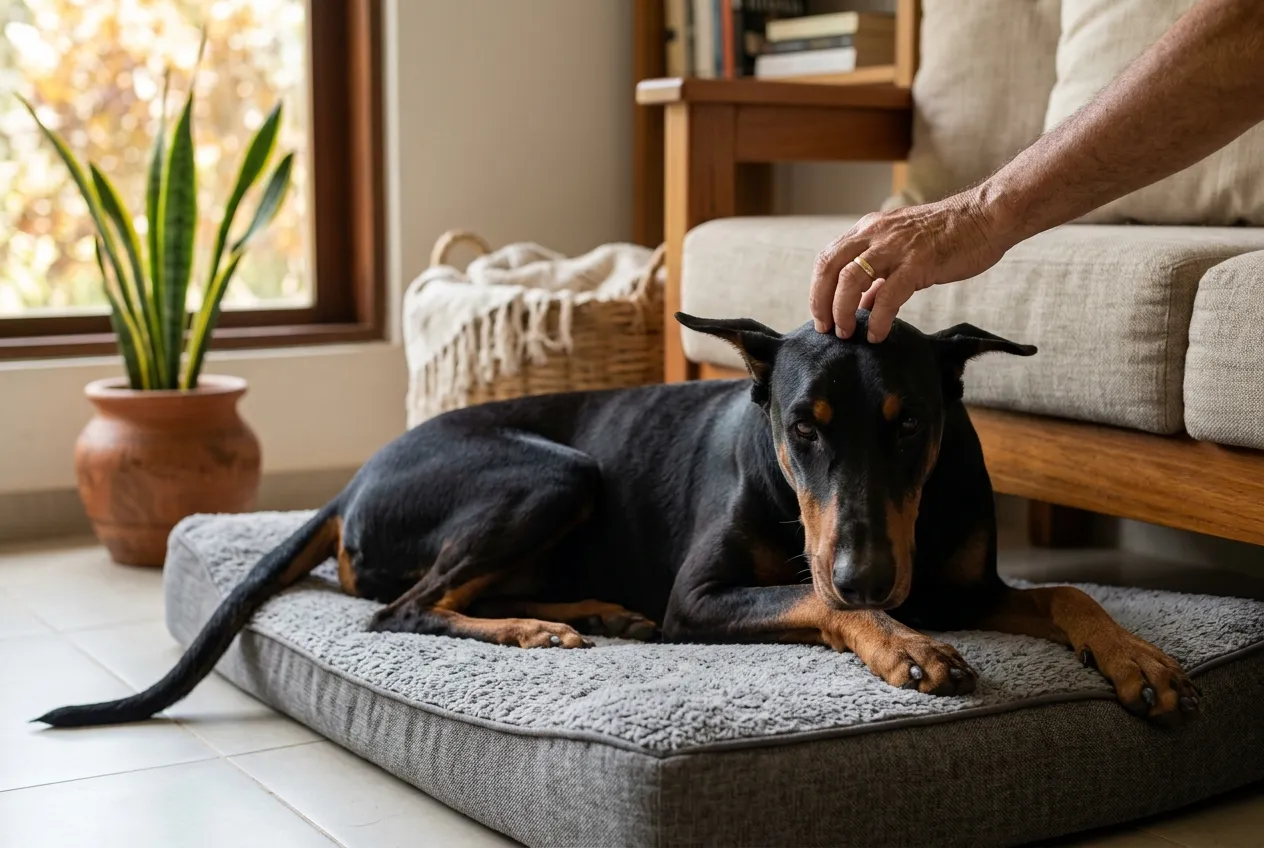
The diseases are the same too. Dilated cardiomyopathy is the breed's main heart problem, and von Willebrand disease, a clotting disorder, shows up in Dobermans of any origin. Testing the breeding dog and monitoring it throughout life weigh more than the country written on the pedigree. How to evaluate a breeding dog's heart health is in How to evaluate a Doberman's heart health.
And raising the puppy follows the same rules: socialization in the first weeks, real daily exercise, living inside the house. What each stage asks for is in Doberman temperament: what to expect from puppy to adult.
Three myths about the American Doberman
"Only the European has a real pedigree"
Pedigree is the genealogy record issued by the country's breeders' club. In Brazil, that body is the CBKC, affiliated with the FCI, and a Doberman born here from registered parents receives its pedigree, whichever the school. The real risk is elsewhere: a document from a body you can't verify. Ask for the paper, read the affixes of the parents and grandparents and check the registration. The full path is in Doberman kennel: how to recognize a serious breeder.
"The American has a long head and looks like another dog"
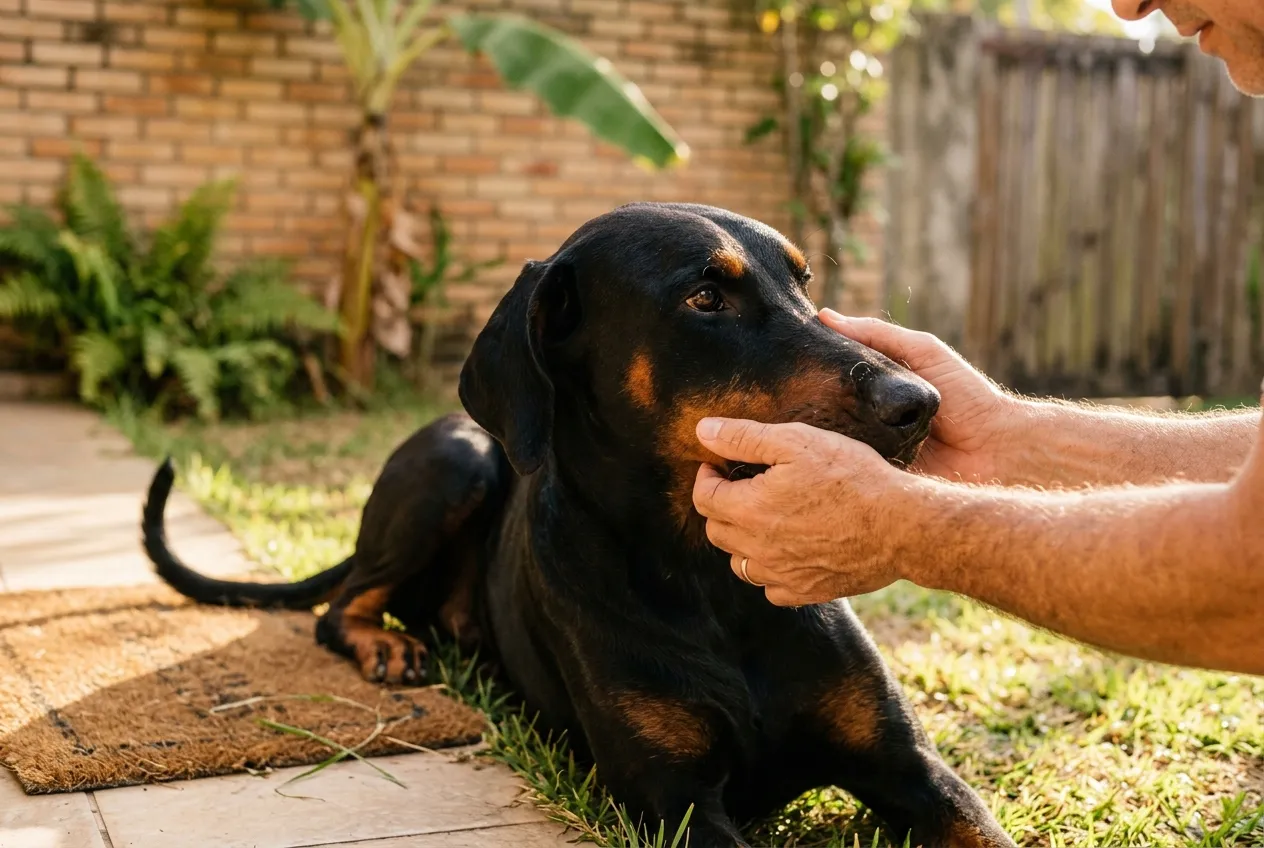
The head difference exists as a tendency among breeders of both schools, not as a rule of the standards: both describe the head as a blunt wedge, and the American tends to be narrower and more tapered. What exaggerates the impression is the photo, and the comparison guide already covers that in detail. An ear cropped to a point visually lengthens the head of any Doberman, and comparing a cropped dog with a natural-eared one is comparing two different things. Look at natural-eared dogs on both sides and the distance shrinks. Why our kennel doesn't crop is in Doberman with natural upright ears: why we don't crop.
"One of the schools is healthier"
There's an idea going around that the American line would be more fragile, and that the European would be immune. Neither has a basis that I can back up. Dilated cardiomyopathy and von Willebrand disease are in the breed as a whole, and what lowers the risk is the breeder testing the breeding dogs and discarding from breeding whatever must be discarded. Whoever promises health by line promises more than they know.
Which home the American Doberman suits
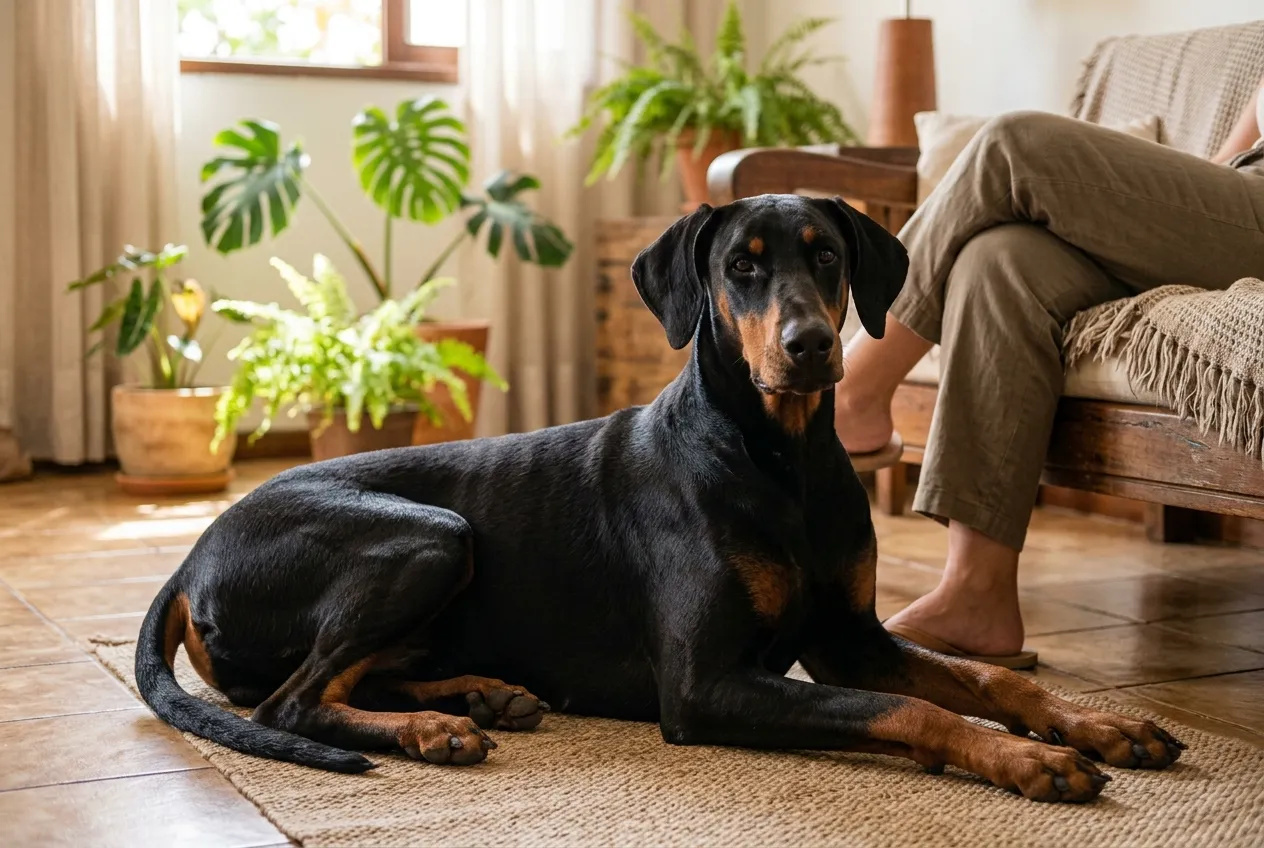
Short answer: the family that wants a companion for the house, as long as the dog comes from a breeder who tests the breeding dogs and socializes the litter. For anyone who wants to compete in protection sport, the safest path is to look for a working-line breeder.
| If you... | What to consider |
|---|---|
| Want a family companion and have never had a Doberman | The American school tends to be described as more focused on the owner, which helps someone with no experience with a guard dog. The litter's socialization and the breeder's guidance weigh more than the continent of the pedigree. |
| Have children and a busy routine | Either school works, with socialization and supervision. Read Doberman with kids: living together safely, in practice. |
| Live in an apartment | It works with real daily exercise, whichever the school. The rules are in Doberman in an apartment: does it work? |
| Want a guard dog through presence and alertness | A well-socialized Doberman already warns and commands respect. The difference between alertness and aggression is in Are Dobermans dangerous? |
| Want protection sport or guard work handled by a professional | Look for a European working-line breeder, with proof of work in the parents. That is not the focus of our breeding. |
| Plan to show in Brazil | Shows follow the CBKC and FCI standard. Talk to the breeder and the club before choosing the line. |
Swipe the table sideways to see all the columns.
The kennel's position: two schools under one roof
The term calls for some precision. Dobs Kennel doesn't breed "the American Doberman". In our home both schools live side by side. Eros, our brown and tan stud, comes from the line of the Americas, with a base in Brazil and Argentina. Kira, our black and tan breeding female, carries European blood from her family's known genealogy. The kennel's first litter was born from the union of the two, and the puppies in that litter carry both schools, without being the pure type of either.
Why bring the two together? The decision came from temperament and structure, in that order. We wanted a dog that works inside the home, with a family, without demanding from the owner the experience of someone who handles working dogs, and with enough bone and substance so the adult doesn't end up too light. Neither was chosen for its continent. What counted was the health documented across the generations, the pedigree in plain sight and the behavior we saw in each one before the mating. Then there is variability: in the documented generations of the two pedigrees, we did not identify a single common ancestor, and genetic variability is a health decision before it is an aesthetic one.
The full tree, with the champions on each side and the source for each title, is in Our genetics and family tree: why we paired Eros and Kira. The comparison between the two schools, without our opinion in the middle, is in European vs American Doberman.
This choice also defines what we don't promise. If what you want is the American show type, or the European working type with proof at the origin, look for a kennel that has that base as its specialty. The care we ask of the buyer applies to any kennel: ask for the breeding dogs' test results, meet the litter's mother and require a written contract.
Frequently asked questions
Is the American Doberman a different breed from the European?
No. It's the same breed, with the same ancestor from Apolda. What changes is the standard each school followed, the AKC's on one side and the FCI's on the other, and with it the average type of head, silhouette and temperament. Crossing the two schools produces legitimate Dobermans, as long as there are criteria and a defined goal.
Does the American Doberman have a CBKC pedigree?
It does, when it's born in Brazil from parents registered with the CBKC and the breeder registers the litter. Line describes the school of selection, and pedigree is the genealogy document. If the dog came from abroad, confirm with the CBKC how the registration works.
Is the American Doberman smaller than the European?
Both standards describe similar heights. What changes the impression in photos is volume: bone and mass on the same stature. The FCI standard gives a weight range and the AKC one doesn't; a weight range per line has no source we can cite, and that's why we don't publish any.
Is the American Doberman suitable as a guard dog?
Any well-socialized Doberman warns and commands respect through presence. Real guard work takes professional training and handling, and for protection sport the safest path is a working-line breeder. Alertness and aggression are different things, and the detail is in Are Dobermans dangerous?
Is the American Doberman calmer or more docile?
The common description is of a dog more focused on the owner, but calm depends more on exercise, socialization and handling than on the school. The Doberman is an intense breed in any line, and a bored dog invents its own occupation. The exercise question comes before the genetics question.
If after reading this you're still unsure between the two schools, talk to us and tell us what you're looking for.

About the author
Marcelo Vaz
Entrepreneur and founder of Dobs Kennel
Marcelo Vaz is an entrepreneur and the founder of Dobs Kennel, a Doberman kennel in Nísia Floresta (RN), Brazil. As a boy, he already knew which dog he wanted. That passion for the Doberman stayed with him over the years and became the kennel he now runs with the seriousness of someone who waited a long time for it. “We are not veterinarians, but we study every subject in depth and only write what is backed by science and reliable sources,” he says.
- RegistryCBKC / FCI
- Kennel nameImperio Real Norte
- WhereNísia Floresta, RN
Keep reading


Comments
Ask the breeder directly. Every comment is moderated before it appears, and your email is never published.
Be the first to comment: ask the breeder directly.