


In this article
- Fruits dogs can eat: the list
- Sugar and calories in each fruit, side by side
- Fruits dogs cannot eat
- Vegetables and other foods dogs can eat
- Foods dogs cannot eat
- How much fruit can a dog eat per day
- How to give your dog fruit, step by step
- Fruit at each stage of life
- What changes in a breed like the Doberman
- Your dog ate something forbidden: what to do
- Frequently asked questions
- Where the numbers come from
What can dogs eat? Most everyday fruits are safe: apples, bananas, mango, watermelon, melon, strawberries, pears, pineapple, oranges, peaches, kiwi and papaya, without seeds, pits or tough skin, in small pieces and within the 10% of the day's calories set aside for treats. Grapes and raisins, tamarind, avocado, cherries and star fruit stay off the list; among other foods, so do chocolate, xylitol, onion, garlic, macadamia nuts and raw bread dough. For an adult Doberman of 32 to 40 kg, a sensible portion is 110 to 130 g of watermelon or 65 to 75 g of apple, two to three times a week. The full list, the reason behind each item and the source of every number are below.
Fruits dogs can eat: the list
Every fruit in this table is a treat, never a meal. A complete dog food already gives the dog what it needs; fruit adds flavor, water and variety. The preparation guidance comes from the American Kennel Club (AKC), the U.S. kennel club, unless we name another source.
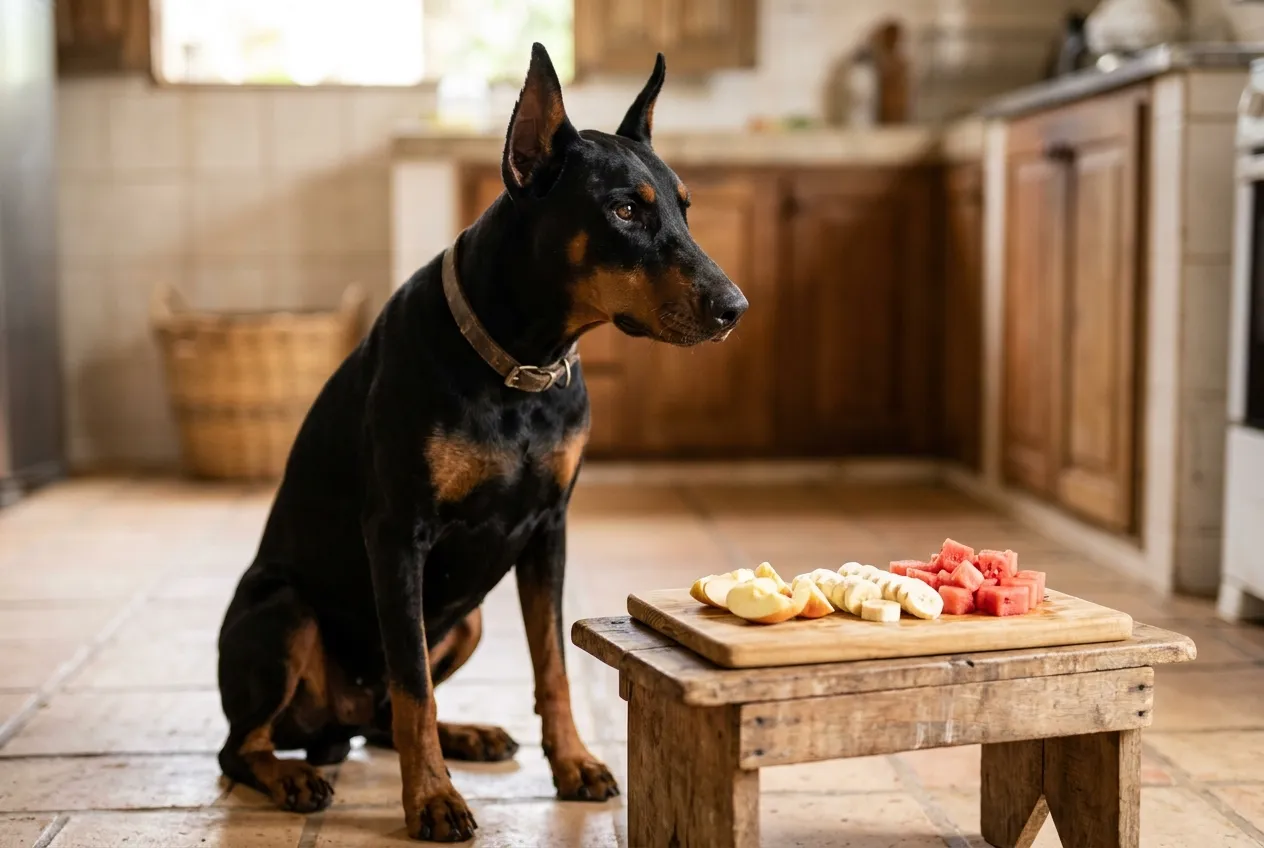
| Fruit | OK? | How to serve |
|---|---|---|
| Apple | Yes | No seeds, no core and no stem. The seeds contain a little cyanide, and the core and stem can cause choking. |
| Banana | Yes | In slices and in small amounts, because it is among the most caloric fruits on the list. |
| Mango | Yes | Ripe, peeled and pitted, in cubes. The portion by weight is in the mango guide. |
| Watermelon | Yes | Without the green rind and without the seeds, which can block the intestine. |
| Melon | Yes | Peeled, with the seeds removed. It has sugar: less for an overweight or diabetic dog. |
| Strawberry | Yes | Chopped and in moderation, because of its natural sugar. |
| Pear | Yes | No seeds and no core, which contain traces of cyanide. No canned pears in syrup. |
| Pineapple | Yes | Only the flesh, without the skin and the crown. No canned pineapple in syrup. |
| Orange | Yes | Only the segments, without peel or seeds. The peel is rough on the stomach. |
| Peach | Yes | Without the pit, which contains cyanide. No canned peaches in syrup. |
| Kiwi | Yes | Peeled, since the skin is hard to digest, and cut into pieces. Never the whole fruit. |
| Blueberry | Yes | Plain and in moderation. |
| Papaya | Yes | The ripe flesh, without skin or seeds. The AKC has no page of its own on papaya, so the general rule for the fruits in this table applies. |
| Coconut | A little | A little flesh now and then, because it is fatty. Never the shell or the husk fiber: they can block the intestine. |
Swipe the table sideways to see all the columns.
Two rules run through the whole table. Anything hard, large or slippery (a pit, a big seed, a thick rind) is a choking and obstruction risk, even when there is nothing toxic about it. And fruit in syrup, candied fruit, dried fruit with sugar or boxed juice carries added sugar, which has no place in a dog's treat.
Sugar and calories in each fruit, side by side
Fruit is, first of all, water and sugar. What changes from one to the next is how much sugar and how much energy each 100 g carries, and that decides whether it fits in a generous portion or only as a sliver. The numbers come from the food composition database of the United States Department of Agriculture, USDA FoodData Central, for raw fruit.
| Fruit (100 g, raw) | Energy | Sugars | Fiber | Vitamin C |
|---|---|---|---|---|
| Banana | 89 kcal | 12.2 g | 2.6 g | 8.7 mg |
| Kiwi | 61 kcal | 9.0 g | 3.0 g | 92.7 mg |
| Mango | 60 kcal | 13.7 g | 1.6 g | 36.4 mg |
| Pear | 57 kcal | 9.8 g | 3.1 g | 4.3 mg |
| Blueberry | 57 kcal | 10.0 g | 2.4 g | 9.7 mg |
| Apple with skin | 52 kcal | 10.4 g | 2.4 g | 4.6 mg |
| Pineapple | 50 kcal | 9.9 g | 1.4 g | 47.8 mg |
| Orange | 47 kcal | 9.4 g | 2.4 g | 53.2 mg |
| Papaya | 43 kcal | 7.8 g | 1.7 g | 60.9 mg |
| Cantaloupe melon | 34 kcal | 7.9 g | 0.9 g | 36.7 mg |
| Strawberry | 32 kcal | 4.9 g | 2.0 g | 58.8 mg |
| Watermelon | 30 kcal | 6.2 g | 0.4 g | 8.1 mg |
Swipe the table sideways to see all the columns.
For a dog that puts on weight easily, watermelon, strawberries and melon give more volume with less sugar, while bananas and mango go in smaller portions. Vitamin C stands out in several rows but carries little weight in the choice: dogs make their own vitamin C in the liver, so it is not an essential nutrient in their diet, as a piece published by the Canadian Veterinary Medical Association explains.
Coconut deserves a line of its own. Raw coconut meat has 354 kcal and 33.5 g of fat per 100 g, almost seven times the energy of apple, and that is why it appears on the list as "a little". The AKC notes that the main side effect is diarrhea and asks owners to talk to the veterinarian before offering coconut to dogs with a history of pancreatitis. Coconut water is an occasional treat, never a replacement for water.
Fruits dogs cannot eat
Five fruits stay off the list. Grapes and tamarind can lead to kidney failure. Avocado is a concern because of its pit and its fat, cherries because of the pit, and star fruit because of a substance whose level changes from one fruit to another.
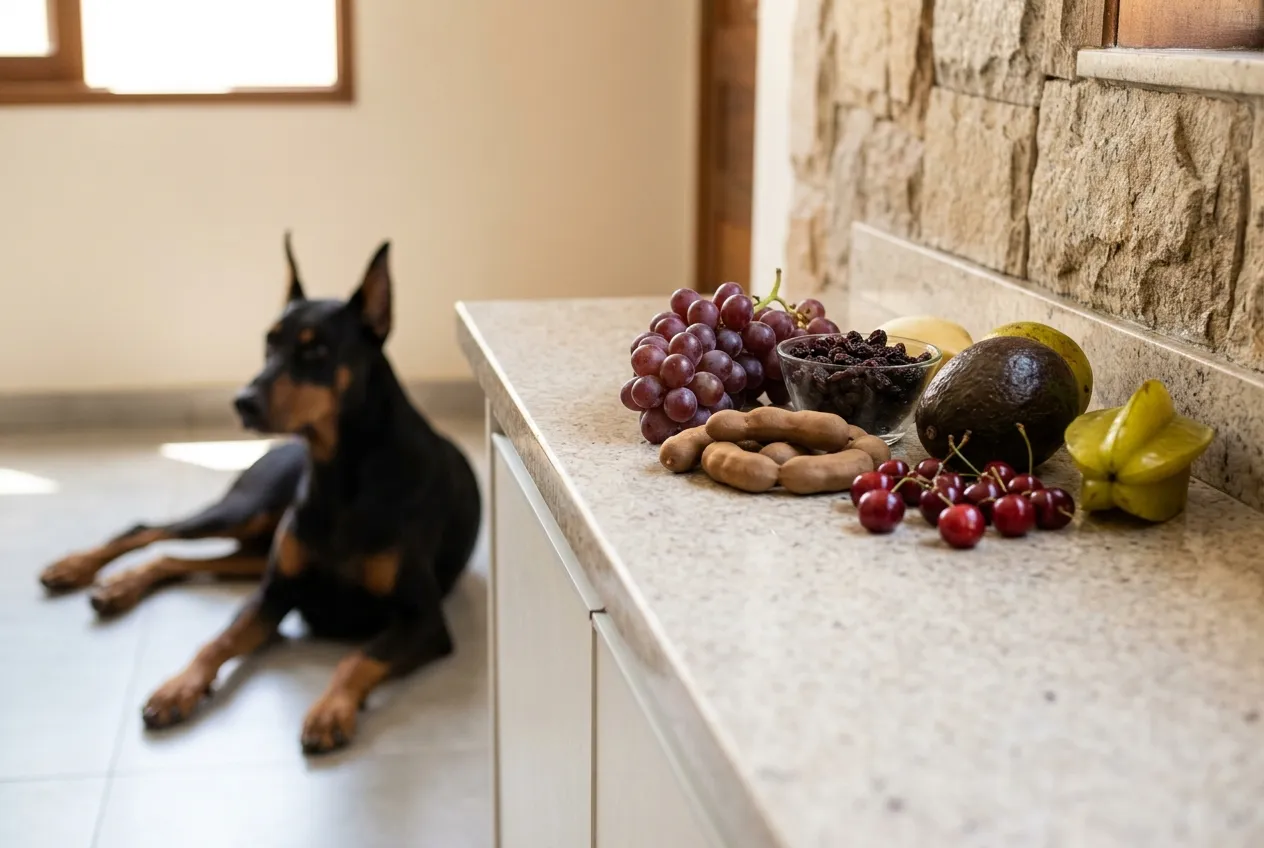
Grapes and raisins
The Merck Veterinary Manual points to tartaric acid, present in high concentration in these fruits, as the suspected substance, and dogs are poor at clearing this kind of acid through the kidneys. The manual estimates that more than one grape or raisin per 4.5 kg of body weight may contain enough acid to cause damage, with the caveat that the content varies between fruits. For a 40 kg Doberman, the math comes to about nine grapes, a handful. That number is no safety margin: the content changes from one grape to the next, the manual names no safe dose, and any grape or raisin eaten is already a reason to call the veterinarian.
Most poisoned dogs vomit or have diarrhea 6 to 12 hours after eating, and kidney failure shows up 24 to 72 hours after ingestion. This applies to fresh grapes and to raisins, including those hidden in Christmas panettone and in holiday farofa, a Brazilian toasted cassava flour side dish.
Tamarind
Tamarind sits in the same Merck chapter, which records cases of kidney failure in dogs after eating the fruit; tartaric acid is the common suspect. In Brazil it shows up as frozen pulp, juice, candy and sweets. It stays off the list, along with grapes.
Avocado
The AKC recommends against it. Merck notes that dogs seem more resistant to persin, the avocado toxin, than birds and livestock, and points to another problem: a whole pit can cause an obstruction in the stomach or intestine. The flesh is fatty too: 14.7 g of fat and 160 kcal per 100 g, according to the USDA, against 0.2 g of fat and 52 kcal in apple. Guacamole, which usually contains onion, is ruled out twice over.
Cherries
The AKC advises against them: the plant contains cyanide and the pit is dangerous, so the guidance includes keeping the dog away from fruit that has fallen to the ground. Peaches, which are on the "yes" list, have the same problem with the pit. The flesh is fine, and the pit goes in the trash.
Star fruit
Sour star fruit has soluble oxalate in a dangerous concentration, according to Pet Poison Helpline, a U.S. animal poison control service; the sweet kind has little and does not poison an animal with healthy kidneys. Since there is no way to tell at home which of the two is in the fruit bowl, we prefer to leave star fruit out. In people, it is forbidden for anyone with chronic kidney disease, as a 2015 review published in the Jornal Brasileiro de Nefrologia, the Brazilian journal of nephrology, sums up.
Vegetables and other foods dogs can eat
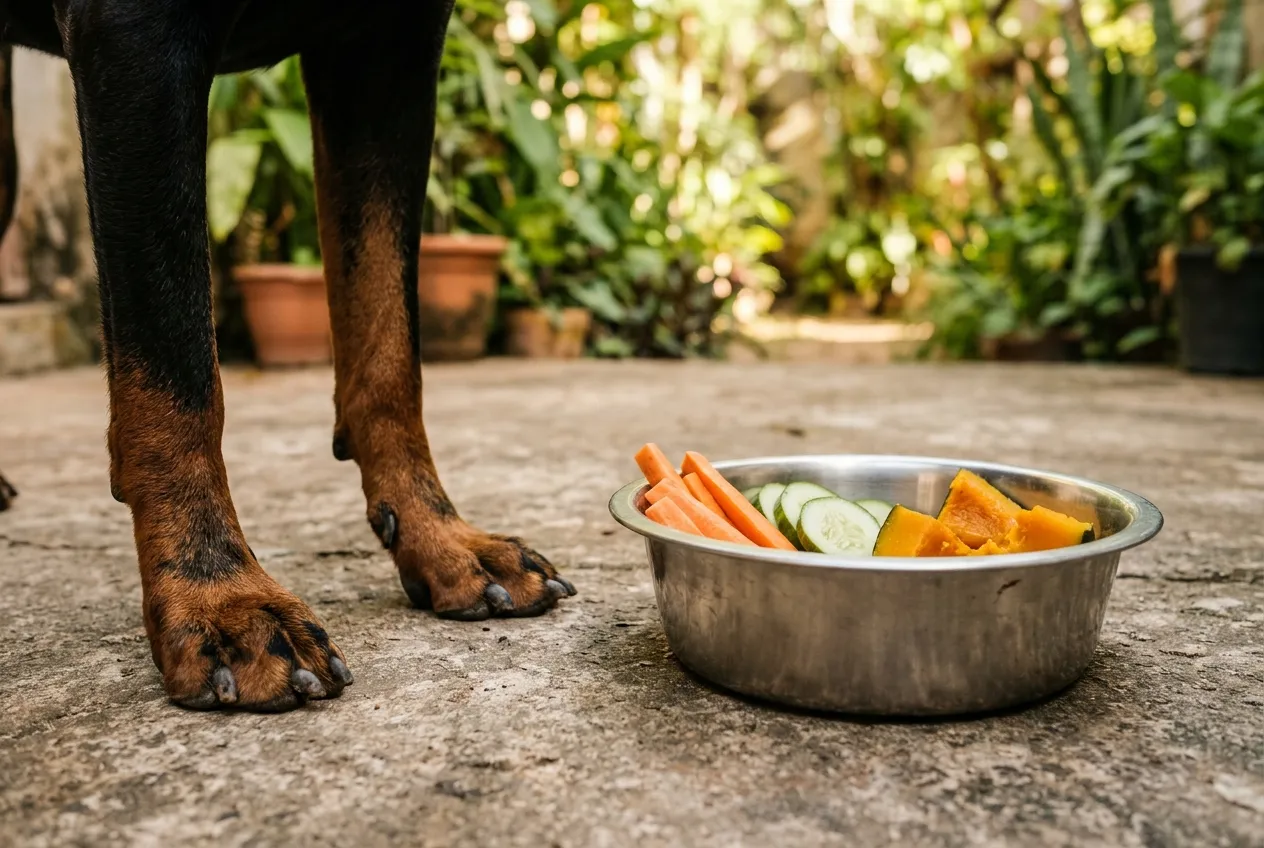
Beyond fruit, the list of allowed foods is long, with one condition that applies to all of them: no salt, no oil, no butter and no seasoning. The guidance comes from the AKC, and every food counts as a treat, within the same 10% of the day.
| Food | OK? | How to serve |
|---|---|---|
| Carrot | Yes | Raw or cooked, in sticks or rounds. Low in calories, with plenty of fiber and beta-carotene. |
| Cucumber | Yes | Almost all water and few calories, good for an overweight dog. |
| Pumpkin | Yes | Cooked and plain, with no sugar or seasoning. |
| Sweet potato | A little | Cooked and peeled, a small piece now and then. Never raw. The AKC added a note to its sweet potato page: recent research suggests sweet potato may not be suitable for a dog's diet, because of the FDA alert about cardiomyopathy in dogs eating diets based on potatoes and legumes. For a Doberman, talk to the veterinarian first. |
| Potato | A little | Cooked until soft enough to mash, unseasoned and in small amounts. Never raw or green: it contains solanine. |
| Broccoli | A little | Preferably cooked. The tough stalk can get stuck in the esophagus. |
| Green beans and peas | Yes | Fresh or frozen, unsalted. Avoid canned ones with added sodium. |
| Corn | Kernels only | Loose kernels, now and then. Never the cob: it causes choking and can block the intestine. |
| Popcorn | Plain only | Popped without oil, salt or butter, in small amounts. Leave out the kernels that did not pop. |
| Tomato | Ripe only | The red one, now and then. Leaves, stems and green tomatoes contain solanine and tomatine. Sauce and ketchup usually contain garlic and onion. |
| Cheese | A little | One small cube, as a reward. Choose low-fat kinds, such as mozzarella and cottage cheese. Never cheese with herbs, garlic or onion. |
| Egg | Yes | Cooked and unseasoned. The portion by weight is in the egg guide. |
Swipe the table sideways to see all the columns.
Seasoned people food stays out for a reason that comes up just below: garlic and onion go into almost every sauté, sauce and ready-made seasoning.
Foods dogs cannot eat
These call for more care because the effect goes beyond the stomach. The numbers come from the Merck Veterinary Manual, in chapters written by a veterinarian from the poison control center of the ASPCA, the American Society for the Prevention of Cruelty to Animals.
Chocolate
Chocolate contains theobromine and caffeine, the methylxanthines. According to Merck, mild signs (vomiting, diarrhea, excessive thirst) can appear from 20 mg per kilo of body weight; effects on the heart, from 40 to 50 mg/kg; seizures, from 60 mg/kg. The darker the chocolate, the more concentrated: milk chocolate has about 2.3 mg of methylxanthines per gram, semisweet 5.3 to 5.6 mg, and cocoa powder 28.5 mg.
| Dog (first signs, 20 mg/kg) | Milk chocolate | Semisweet | Cocoa powder |
|---|---|---|---|
| 5 kg | 43 g | 18 to 19 g | 3.5 g |
| 10 kg | 87 g | 36 to 38 g | 7 g |
| 20 kg | 174 g | 71 to 75 g | 14 g |
| Doberman, 40 kg | 348 g | 143 to 151 g | 28 g |
Swipe the table sideways to see all the columns.
Use the table only to give the veterinarian a sense of how big the problem is: below these numbers a dog can also get sick, and the call is just as necessary. Signs usually appear 6 to 12 hours after eating and, in severe cases, can last up to 72 hours.
Xylitol
Xylitol is the sweetener in many sugar-free products: chewing gum, candy, mints, bakery goods, toothpaste and some peanut butters. In dogs it triggers a strong release of insulin, and blood sugar plunges 10 to 60 minutes later, according to the FDA, the U.S. Food and Drug Administration. Merck links doses above about 100 mg per kilo to hypoglycemia and above 500 mg/kg to severe liver damage. Peanut butter only goes in after you check the label.
Onion, garlic, scallions and leeks
Plants of the genus Allium damage red blood cells and can cause anemia. Merck records signs in dogs that ate 15 to 30 g of raw onion per kilo of body weight, and garlic is 3 to 5 times more toxic than onion. Cooking does not remove the risk, and the anemia usually appears 3 to 5 days later. Concentrated forms are the biggest worry: dehydrated onion, garlic or onion powder and packet onion soup. That is why seasoned leftovers do not go into the dog's bowl.
Macadamia nuts
Merck records signs from 2.4 g of macadamia nuts per kilo: weakness, lethargy, vomiting, a wobbly gait, tremors and high body temperature, within 12 hours. For a 10 kg dog, that is about 24 g. Most dogs recover in 12 to 48 hours without specific treatment, which does not make the call to the veterinarian any less necessary.
Raw bread dough
Dough made with yeast keeps rising inside the stomach, which swells, and the yeast produces alcohol, which passes into the blood. Merck describes effects ranging from a wobbly gait to coma and seizures, and notes that the dough can set off gastric dilatation and volvulus, the twisted stomach known as bloat, in dogs of predisposed breeds. The risk is raw dough left to rise in the kitchen.
How much fruit can a dog eat per day
The rule that organizes everything is the calorie rule. The nutrition guidelines of the AAHA, the American Animal Hospital Association, recommend that treats and any food outside the complete diet add up to no more than 10% of the day's energy. Fruit, eggs, training treats and any other extra share that same space.
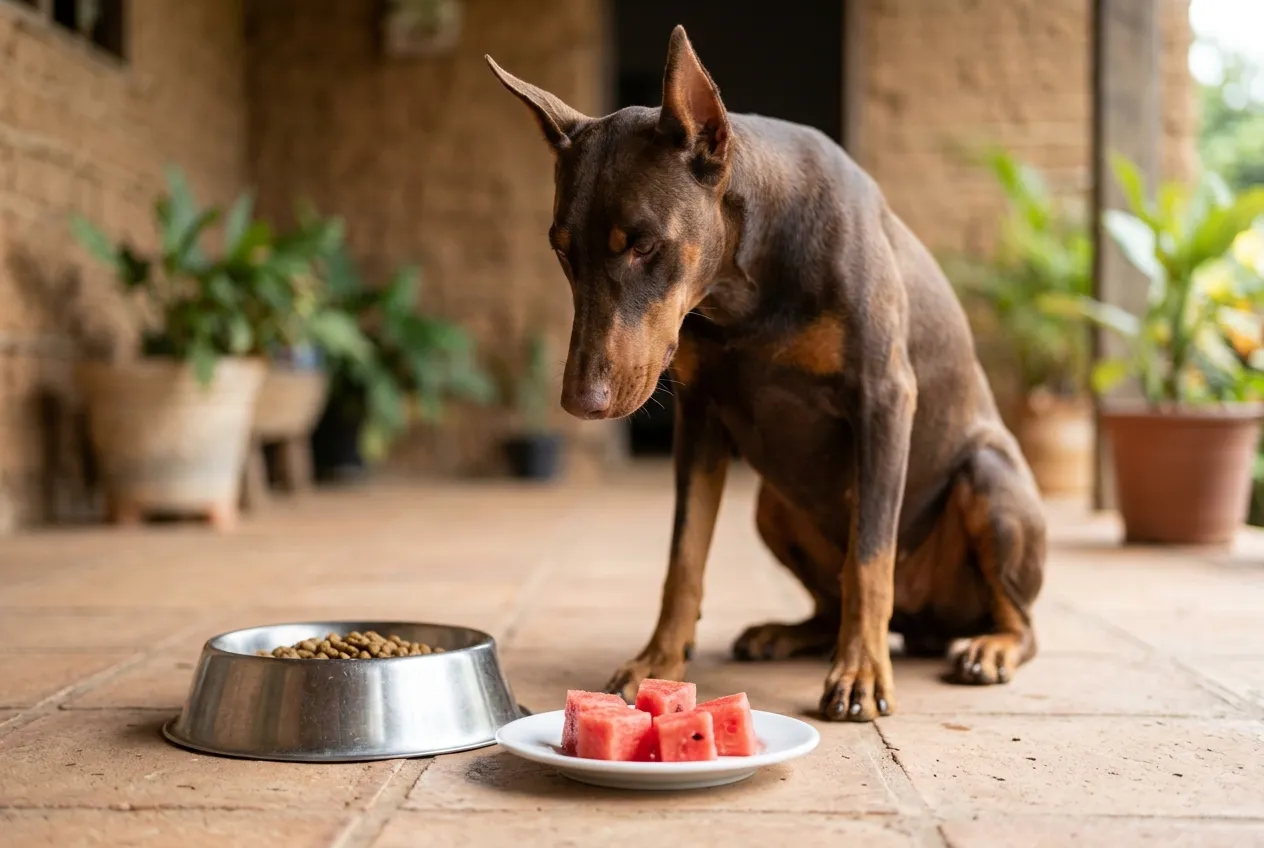
Daily energy comes from the resting energy formula (70 multiplied by body weight in kg raised to the power of 0.75), multiplied by the maintenance factor from the same guidelines: 1.4 to 1.6 for a neutered adult and 1.6 to 1.8 for an intact one. The neutered dog sits at the low end, and the tendency to gain weight after surgery is covered in the article on neutering a dog. The Doberman rows are highlighted because it is the breed we raise; the math is the same for any dog.
| Adult dog | Energy per day (neutered to intact) | Ceiling for extras (10%) | Watermelon portion | Apple portion | Banana portion |
|---|---|---|---|---|---|
| 5 kg | 330 to 420 kcal | 33 to 42 kcal | 25 g | 15 g | 10 g |
| 10 kg | 550 to 710 kcal | 55 to 71 kcal | 45 g | 25 g | 15 g |
| 20 kg | 930 to 1,190 kcal | 93 to 119 kcal | 75 g | 45 g | 25 g |
| Doberman female, 32 kg | 1,320 to 1,700 kcal | 132 to 170 kcal | 110 g | 65 g | 35 g |
| Doberman male, 40 kg | 1,560 to 2,000 kcal | 156 to 200 kcal | 130 g | 75 g | 45 g |
| 60 kg | 2,110 to 2,720 kcal | 211 to 272 kcal | 175 g | 100 g | 60 g |
Swipe the table sideways to see all the columns.
The portion is set at about a quarter of the neutered dog's ceiling, for two reasons: fruit is sweet, and the rest of the space stays free for training treats, which serve as the reward in Doberman training. Two to three times a week is a good pace. To check the math: 130 g of watermelon has 39 kcal, less than 3% of what a 40 kg neutered male Doberman burns in a day. After four to six weeks, the body gives the answer: ribs easy to feel under a thin layer of fat and a waist visible from above.
How to give your dog fruit, step by step
The preparation is the same for almost every fruit on the list, and the greatest care goes into what comes off before the fruit reaches the bowl.
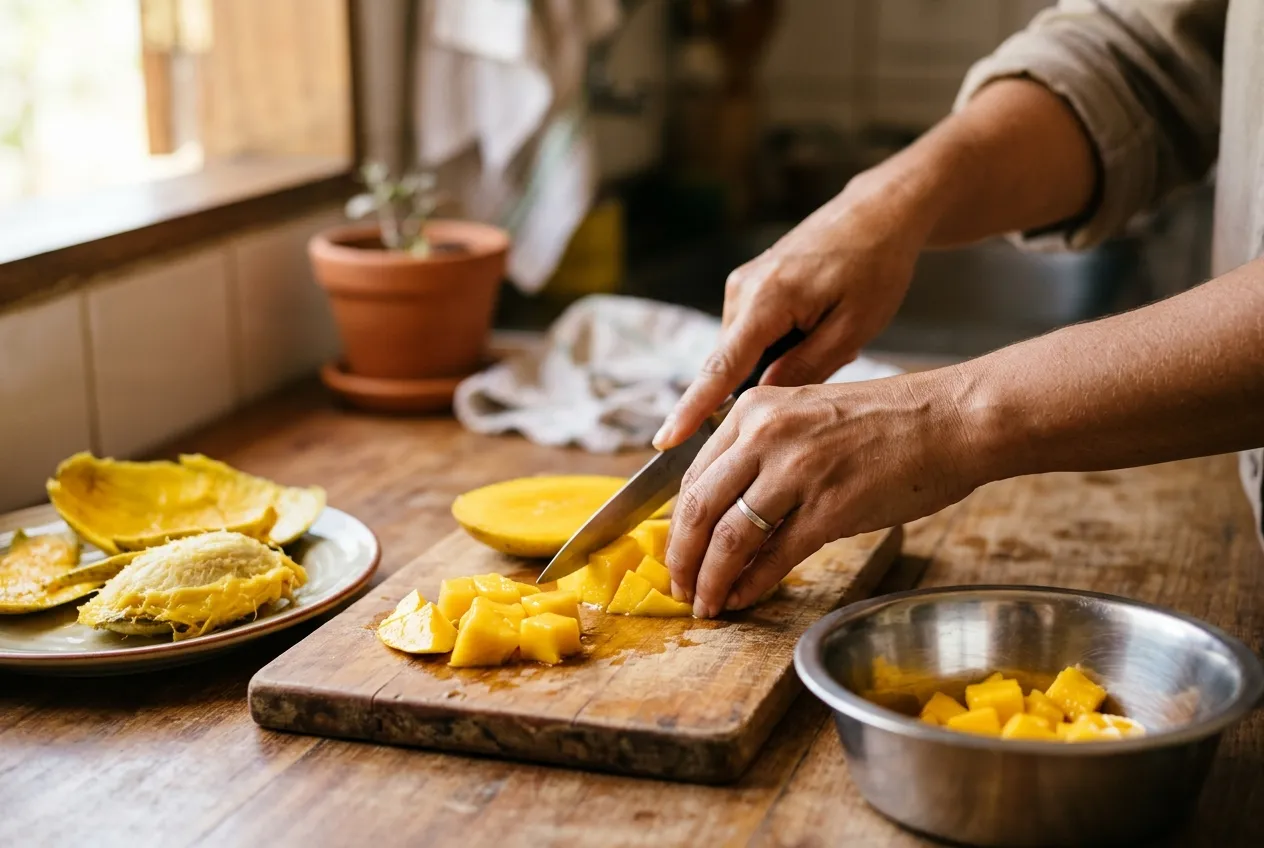
- Choose ripe fruit, wash it and remove tough skin, seeds, core and pit.
- Cut it into bite-sized cubes: about 2 cm for medium and large dogs, smaller for small dogs and puppies.
- Offer one new fruit at a time, starting with one or two pieces.
- Watch the stools over the next 24 hours. Diarrhea or gas means the portion was too big or that this fruit does not agree with your dog.
- Count the fruit within the day's 10% and take the equivalent off the other treats.
- In hot weather, freeze the cubes or mash the fruit inside a stuffable toy; the portion counts the same.
- Throw rinds, pits and cobs into a trash can the dog cannot reach.
Fruit at each stage of life
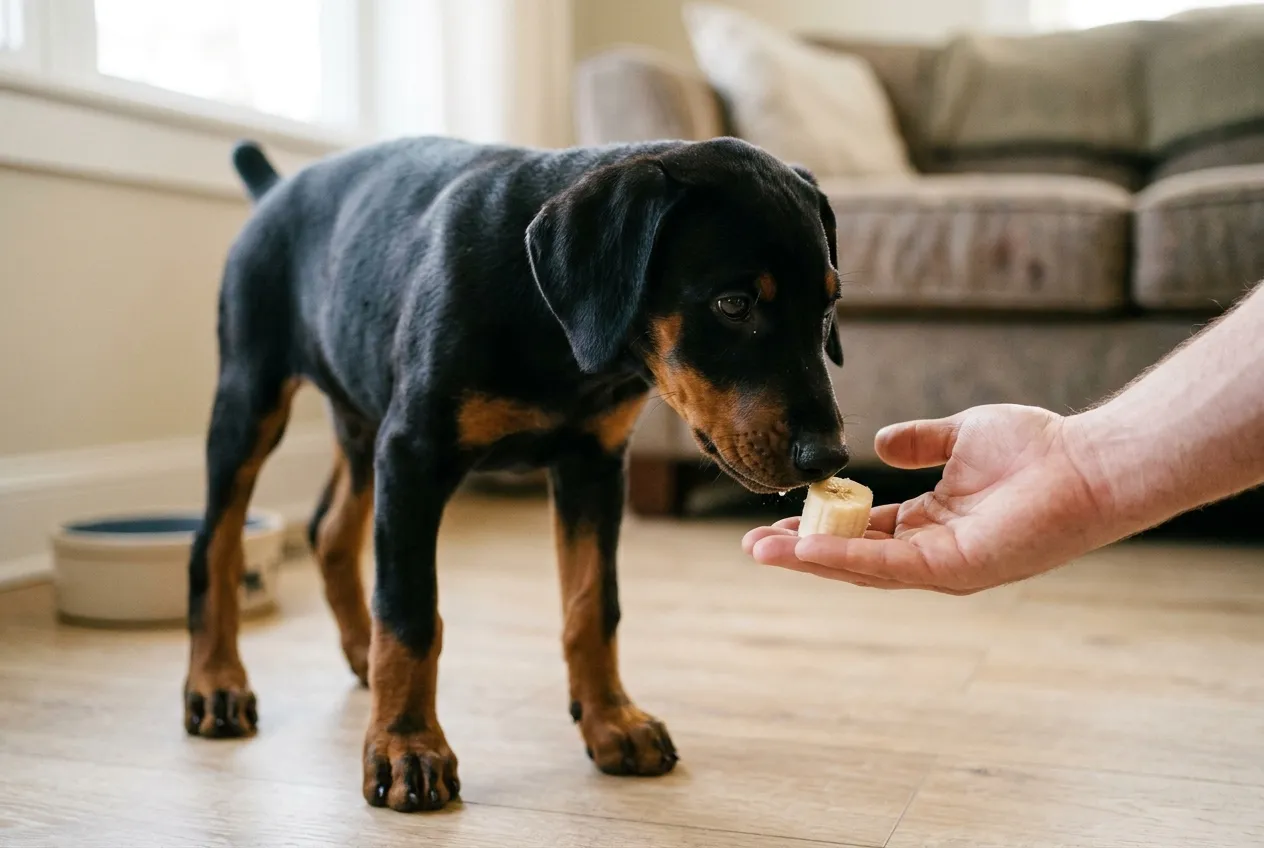
Puppy
In a comment on our Instagram, @doobskennel, someone asked from what age a puppy can have a boiled egg. For fruit, the criterion that matters is adaptation: the puppy already eating its growth food well in the new home, with firm stools. From then on, a small piece once or twice a week. A large-breed puppy needs to grow at the right pace, and what keeps calcium, phosphorus and energy in the right measure is the growth food, as we explain in nutrition for large-breed puppies. For eggs, the answer by age is in the egg guide.
Young and adult dogs
From the sixth month on, fruit works as a training reward in small pieces, since it is soft and smells good. For adults the weight table applies, rotating fruits so you do not rely only on the sweetest one.
Senior
According to the European nutrition guidelines from FEDIAF, dogs over 7 years old may need 10% to 15% less energy than between 3 and 7 years of age. The fruit portion shrinks in the same proportion, and soft fruits such as watermelon, papaya and mashed banana help dogs with worn teeth. What goes into the bowl at each stage is in feeding the Doberman at each life stage.
What changes in a breed like the Doberman
We breed Dobermans registered with the CBKC, Brazil's national kennel club, and the math in this article applies to the breed just as it does to any dog. In the Doberman, the chest, the size and the weight call for extra attention.
Deep chest and stomach
The Doberman has a deep chest, and the Merck Manual lists a deep chest among the risk factors for gastric dilatation and volvulus, an emergency that requires immediate care. For dogs at risk, the manual recommends several small meals instead of one large one, and less exercise before and after eating. With fruit, that means a small portion, well away from running. It is also why raw bread dough is such a concern in a dog with this kind of chest. The risk factors for bloat are in how long a Doberman lives.
Size and pits
A big dog swallows whole what a small one cannot: mango, peach and avocado pits, a piece of corn cob. In a home with a Doberman, the pit goes into a closed trash can as soon as the fruit is cut. The mango guide describes a case series of three adult dogs that needed surgery because of a swallowed pit.
Weight and heart
The Doberman is built to be lean, and too much sweet fruit is the shortest road to extra kilos. There is no evidence that fruit protects or harms the heart. What changes the outcome of cardiomyopathy in the breed is screening with an echocardiogram and a Holter monitor, which catches the disease before symptoms appear, as we describe in how to assess a Doberman's heart health.
Your dog ate something forbidden: what to do
- Call the veterinarian right away, even if the dog seems fine. With grapes, Merck recommends early decontamination even for a dog that shows no signs yet; with xylitol, blood sugar can drop within 10 minutes.
- Do not induce vomiting on your own. Leave that decision and the procedure to the veterinarian; a pit or a cob can get stuck on the way back up.
- Have on hand the dog's weight, what it ate, how much and at what time. Keep the packaging: the label shows the type of chocolate and whether the product contains xylitol.
- Watch for vomiting, diarrhea, lethargy, tremors, a wobbly gait and pale gums, and tell the veterinarian what you saw and when.
Retching without bringing anything up, drooling, restlessness and a swelling belly in a deep-chested dog are signs of a twisted stomach, according to Merck, and require immediate care, whether or not forbidden food is part of the story.
Frequently asked questions
Can dogs eat mango?
Yes, ripe, peeled and pitted, in cubes. The pit is the real danger, because it can lodge in the intestine. The portion by weight is in the mango guide.
Can dogs eat apples?
Yes, without seeds, core or stem. One or two slices are enough; a whole apple, with about 19 g of sugar, is too much, according to the AKC.
Can dogs eat watermelon?
Yes, without the green rind and without the seeds. It is among the fruits with the least sugar: 6.2 g per 100 g.
Can dogs eat bananas?
Yes, in slices and in small amounts. Bananas have 89 kcal per 100 g, the most caloric fruit in the table.
Can dogs eat strawberries?
Yes, chopped and in moderation. They have 4.9 g of sugar per 100 g, the lowest in the table.
Can dogs eat avocado?
Better not. The pit can block the stomach or intestine, and the flesh has 14.7 g of fat per 100 g. The AKC recommends against it.
Can dogs eat grapes?
No, and no raisins either. They can cause kidney failure, and Merck estimates risk from more than one grape per 4.5 kg of body weight, with no known safe dose. If your dog ate any amount, call the veterinarian right away.
Can dogs eat pineapple?
Yes, only the flesh, without skin or crown. No pineapple in syrup.
Can dogs eat tomatoes?
Ripe ones, now and then. No leaves, stems or green tomatoes. Ready-made sauce and ketchup are out too, because they usually contain garlic and onion.
Can dogs eat melon?
Yes, peeled and with the seeds removed, in moderation for an overweight or diabetic dog.
Can dogs eat popcorn?
Only popped without oil, salt or butter, in small amounts and without the unpopped kernels.
Can dogs eat oranges?
Yes, only the segments, without peel or seeds.
Can dogs eat papaya?
The ripe flesh, without skin or seeds, in a small portion, under the general rule for safe fruits.
Can dogs eat guava paste?
Better not. Guava paste, goiabada in Brazil, is a guava sweet made with a lot of sugar, and added sugar stays out of a dog's treats.
Can dogs eat coconut?
A little flesh, now and then. Coconut has 33.5 g of fat per 100 g. Never the shell or the fiber.
Can dogs eat sweet potatoes?
Yes, but only a little: cooked and peeled, a small piece now and then. Never raw. The AKC added a note to its sweet potato page: recent research suggests sweet potato may not be suitable for a dog's diet, because of the FDA alert about cardiomyopathy in dogs eating diets based on potatoes and legumes. For a Doberman, talk to the veterinarian first.
Can dogs eat beans?
Not regular home-cooked beans, because they almost always contain garlic and onion. If you want to offer beans, cook them in plain water with no salt or seasoning and give only a small amount.
Can dogs eat chocolate?
No. The first signs appear from 20 mg of methylxanthines per kilo; for a 10 kg dog, that comes to 36 to 38 g of semisweet chocolate.
Can dogs eat onions?
No, and no garlic, scallions or leeks either. They damage red blood cells and can cause anemia, even cooked or powdered.
At what age can a puppy eat fruit?
The guidelines set no fixed month. The sign is a puppy settled on its growth food, with firm stools; from then on, a small piece once or twice a week.
Can fruit replace dog food?
No. The complete food is the meal, and fruit is a treat, within 10% of the day's calories.
Can Dobermans eat fruit?
Yes, like any healthy dog: 110 to 130 g of watermelon or 65 to 75 g of apple at a time, two to three times a week, for an adult of 32 to 40 kg, away from intense exercise.
Where the numbers come from
This article gathers reference information and does not replace a visit to your dog's veterinarian, who knows its test results, weight and history. The sources:
- Composition of the fruits, coconut and avocado: USDA FoodData Central, records 169910 (mango), 173944 (banana), 171688 (apple with skin), 169926 (papaya), 167765 (watermelon), 167762 (strawberry), 169118 (pear), 169092 (cantaloupe melon), 169124 (pineapple), 171711 (blueberry), 169097 (orange), 168153 (kiwi), 170169 (coconut meat) and 171705 (avocado).
- Fruits and vegetables dogs can and cannot eat: American Kennel Club, Fruits and Vegetables Dogs Can and Can't Eat, updated in August 2026, and the pages on apples, kiwi, coconut, tomatoes, potatoes, sweet potatoes, corn, popcorn and cheese.
- Grapes, raisins and tamarind: Merck Veterinary Manual, Grape, Raisin, and Tamarind Toxicosis in Dogs, reviewed in September 2024.
- Chocolate: Merck Veterinary Manual, Chocolate Toxicosis in Animals.
- Xylitol: Merck Veterinary Manual, Xylitol Toxicosis in Dogs, and FDA, Paws Off Xylitol; It's Dangerous for Dogs.
- Onion and garlic: Merck Veterinary Manual, Garlic and Onion (Allium spp) Toxicosis in Animals.
- Macadamia nuts: Merck Veterinary Manual, Macadamia Nut Toxicosis in Dogs.
- Raw bread dough: Merck Veterinary Manual, Bread Dough Toxicosis in Animals.
- Avocado: Merck Veterinary Manual, Avocado (Persea spp) Toxicosis in Animals.
- Bloat: Merck Veterinary Manual, Gastric Dilation and Volvulus in Small Animals, reviewed in August 2025.
- Star fruit: Pet Poison Helpline, star fruit page, accessed in October 2026; and de Oliveira ES, de Aguiar AS. Why eating star fruit is prohibited for patients with chronic kidney disease? Jornal Brasileiro de Nefrologia, vol. 37, no. 2, pp. 241 to 247, 2015.
- Vitamin C in dogs: Matthew Kornya, Vitamin C in Veterinary Medicine, Canadian Veterinary Medical Association website.
- The 10% rule and energy factors: 2021 AAHA Nutrition and Weight Management Guidelines.
- Energy for senior dogs and body condition: FEDIAF Nutritional Guidelines, October 2021 edition.

About the author
Marcelo Vaz
Entrepreneur and founder of Dobs Kennel
Marcelo Vaz is an entrepreneur and the founder of Dobs Kennel, a Doberman kennel in Nísia Floresta (RN), Brazil. As a boy, he already knew which dog he wanted. That passion for the Doberman stayed with him over the years and became the kennel he now runs with the seriousness of someone who waited a long time for it. “We are not veterinarians, but we study every subject in depth and only write what is backed by science and reliable sources,” he says.
- RegistryCBKC / FCI
- Kennel nameImperio Real Norte
- WhereNísia Floresta, RN
Keep reading


Comments
Ask the breeder directly. Every comment is moderated before it appears, and your email is never published.
Be the first to comment: ask the breeder directly.