

In this article
- What is the American Bully?
- American Bully vs Pit Bull: what is the difference?
- What are the American Bully sizes?
- Is the American Bully aggressive?
- Is the American Bully banned in Brazil? What the law says
- Where does the Doberman fit in this comparison?
- Frequently asked questions about the American Bully
- Where the numbers come from
The American Bully is a breed developed in the United States from the American Pit Bull Terrier and selected as a companion dog: it is wider and more heavily muscled than the Pit Bull and, in the Pocket and Standard varieties, also shorter. The Pit Bull kept the athletic body of a working terrier. Both share the same root, and that is where the confusion comes from. In Brazil, the Confederação Brasileira de Cinofilia (CBKC), the national kennel club, registers them as separate breeds, and neither one is recognized by the Fédération Cynologique Internationale (FCI).
Here at Dobs Kennel we breed Dobermans, not Bullies or Pit Bulls. We wrote this guide because the three breeds end up in the same conversation about large dogs and guard dogs, and because the law of at least one Brazilian state puts the Doberman on the same list as the Pit Bull. Below you will find what each one is, how to tell them apart, what the rules say and where the Doberman fits in the comparison.
What is the American Bully?
The American Bully is a breed developed in the United States from the American Pit Bull Terrier. According to the history section of the United Kennel Club (UKC) standard, other bull-type breeds such as the American Bulldog went into the crosses to reach the look breeders were after: a broad head, a deep chest, heavy bone and plenty of muscle on a compact body.
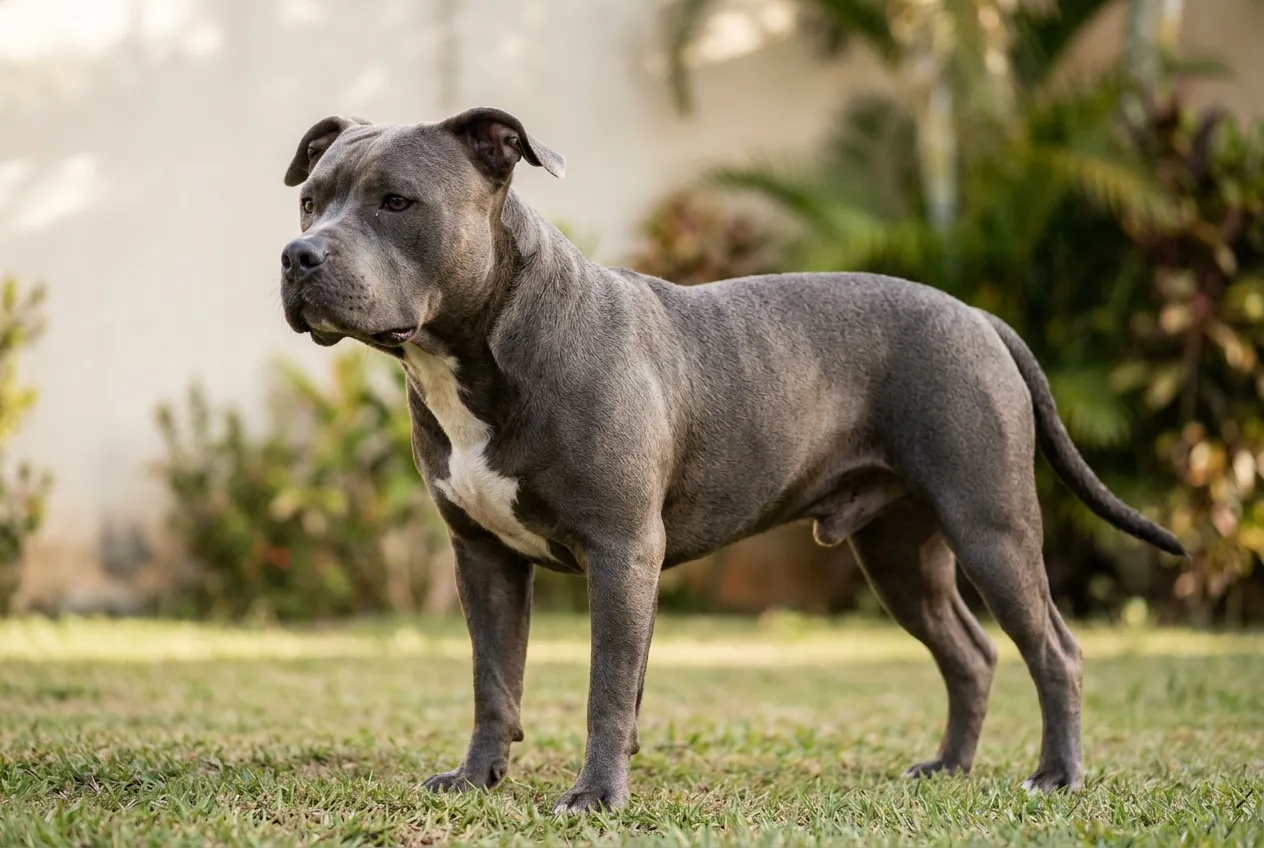
Before any major club took it on, the breed had its own registry, the American Bully Kennel Club (ABKC). The UKC recognized the American Bully on July 15, 2013 and placed it in the Companion Dog Group. The American Kennel Club (AKC), the other major American registry, does not have the American Bully on its list of breeds, and it does not list the American Pit Bull Terrier either.
In Brazil, the CBKC registers the American Bully in group 11, the group for breeds recognized only by the confederation. The American Pit Bull Terrier is in the same group. In practice, a Bully can have a pedigree issued here, but it cannot compete for the FCI international championship certificate, because the federation does not recognize the breed. If you are comparing puppies of any breed, knowing what a CBKC pedigree guarantees saves you a lot of headaches.
American Bully vs Pit Bull: what is the difference?
The difference lies in what each one was selected for. The American Pit Bull Terrier is much older as a registered breed: the UKC standard tells how the club's founder, C. Z. Bennett, gave registration number 1 to his own dog, Bennett's Ring, in 1898. It is a bull-type terrier, athletic and moderate in weight for its height. The American Bully took that base and was pushed in another direction: a wider chest and head, heavier bone and far more muscle mass. Under the UKC standard, the leg keeps the Pit Bull's proportion, but the dog as a whole looks lower because of its width.
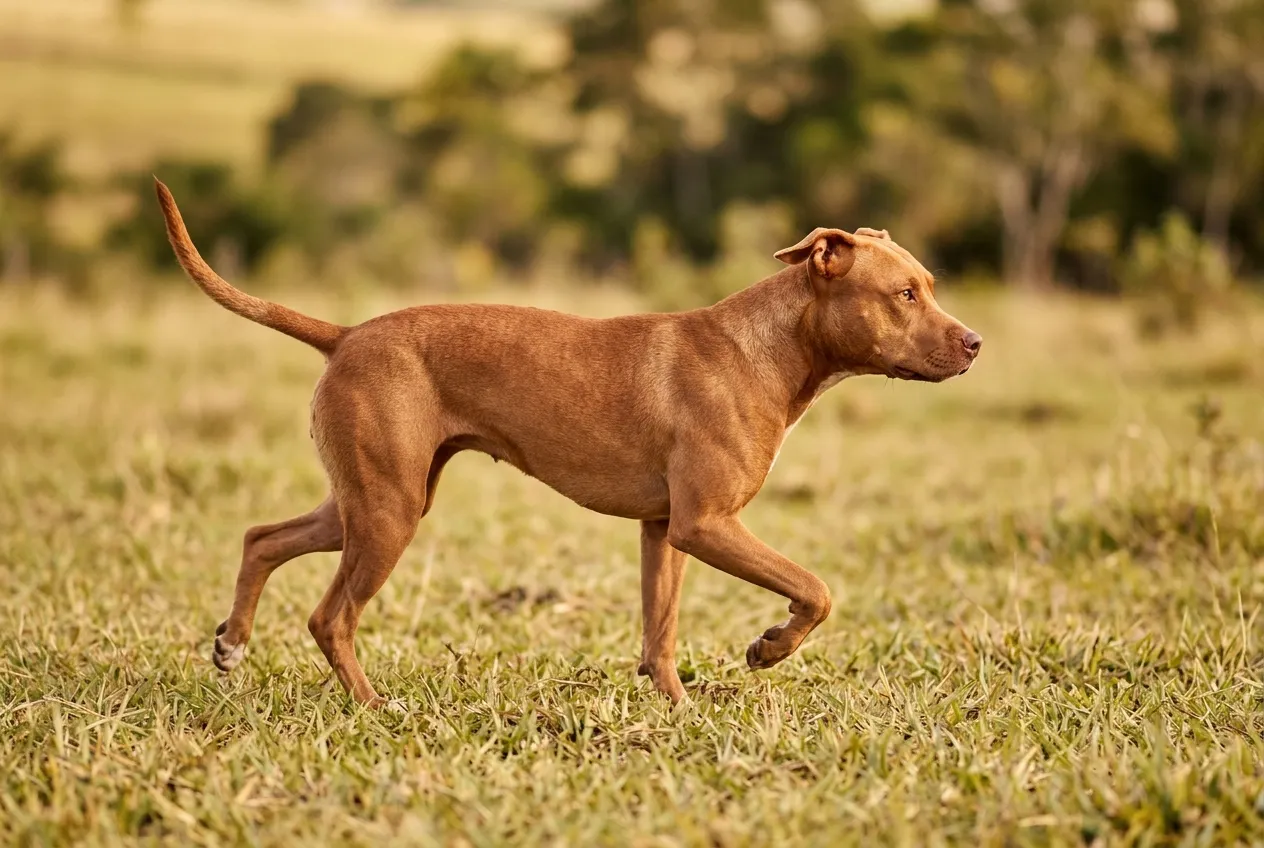
In everyday speech, "pit bull" has become a popular name for many bull-type dogs, mixes included. The official name of the breed is American Pit Bull Terrier. There is also a third relative, the American Staffordshire Terrier (the AmStaff), which comes from the same root and is the only one of these American breeds accepted by the FCI. The table puts the three together and sets the Doberman beside them for scale:
| Breed | Recognized by the FCI? | CBKC group | Reference height, males | Reference height, females | Body |
|---|---|---|---|---|---|
| American Bully (Standard variety) | No | 11 | 43 to 51 cm (UKC) | 41 to 48 cm (UKC) | Compact, wide, heavily muscled |
| American Pit Bull Terrier | No | 11 | about 46 to 53 cm (UKC) | about 43 to 51 cm (UKC) | Athletic, lighter for its height |
| American Staffordshire Terrier | Yes, standard 286 | 3 | 46 to 48 cm (FCI) | 43 to 46 cm (FCI) | Muscular, halfway between the other two |
| Doberman | Yes, standard 143 | 2 | 68 to 72 cm (FCI) | 63 to 68 cm (FCI) | Tall, with an almost square outline |
Swipe the table sideways to see all the columns.
On the street, the safest way to tell them apart is proportion. The Pit Bull has an athlete's silhouette, leaner and less wide. The Bully looks shorter than it really is, because its chest and head are broad. Even so, trained eyes get it wrong: a study published in The Veterinary Journal in 2015 asked staff at four Florida shelters to classify 120 dogs by appearance. Adding up the staff's guesses, 62 dogs were labeled pit bull type; the DNA test found that ancestry in only 25.
What are the American Bully sizes?
The UKC standard in force since January 1, 2025 divides the breed into varieties by height at the withers, the highest point between the shoulder blades. Converted from inches to centimeters, the ranges look like this:
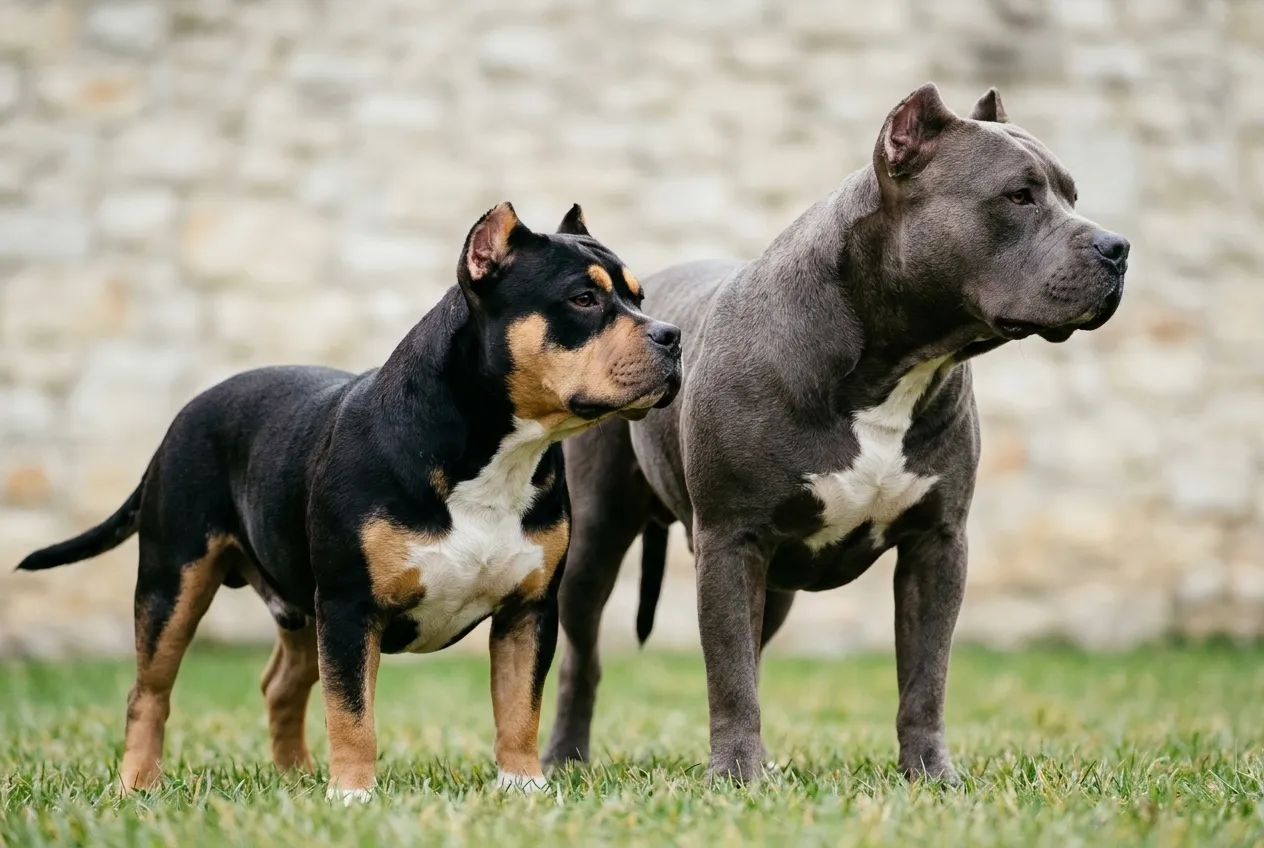
- Pocket: males 36 to 43 cm, females 33 to 41 cm.
- Standard: males 43 to 51 cm, females 41 to 48 cm.
- Classic: the same height as the Standard, with a lighter frame and less mass.
- XL: males 51 to 58 cm, females 48 to 56 cm.
Names like "micro" or "exotic" show up in puppy ads, but they are not among the varieties in the UKC standard. The standard itself carries a warning that says a lot about the breed: quality should never be sacrificed for size and mass, and exaggerations that harm health and movement should be avoided. When an ad sells a puppy on its extreme size, be suspicious.
For comparison with the Doberman: an XL Bully at the top of the UKC's ideal range, 58 cm, still falls short of where the FCI range for a Doberman female begins, 63 cm. These are dogs on different scales.
Is the American Bully aggressive?
Breed on its own predicts little about an adult dog. Temperament depends on the genetics the dog got from its parents, on socialization in the first weeks and on how the family handles it. The shelter study points to a problem that comes before all of that: if not even shelter staff can identify the breed by appearance, breed-based bite statistics that rely on visual identification are on shaky ground.
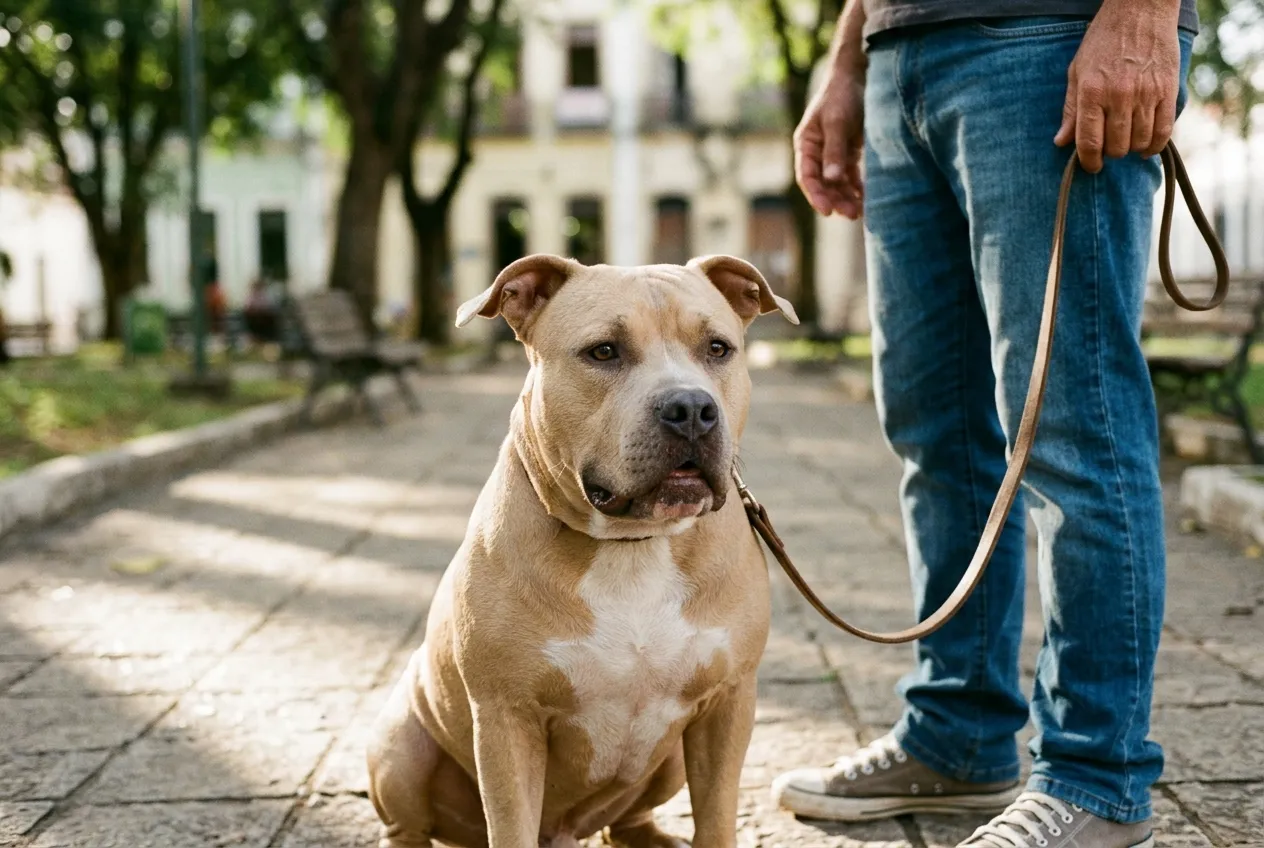
Much of this is in the hands of whoever breeds and whoever buys: parents with a balanced temperament, a puppy well socialized in the first 12 weeks and, in adult life, exercise and clear limits at home.
There is one point specific to the Bully: a lot of muscle mass for its height. That kind of strength calls for a firm leash and obedience training from early on, whatever the dog's nature. The same reasoning applies to any large breed, ours included, and it is what we discuss in Is the Doberman aggressive? The truth from someone who breeds them.
Is the American Bully banned in Brazil? What the law says
As of this article's review, in October 2026, there is no federal law banning the American Bully in Brazil. The rules that exist are state or municipal, and they change from place to place. Two states deserve attention:
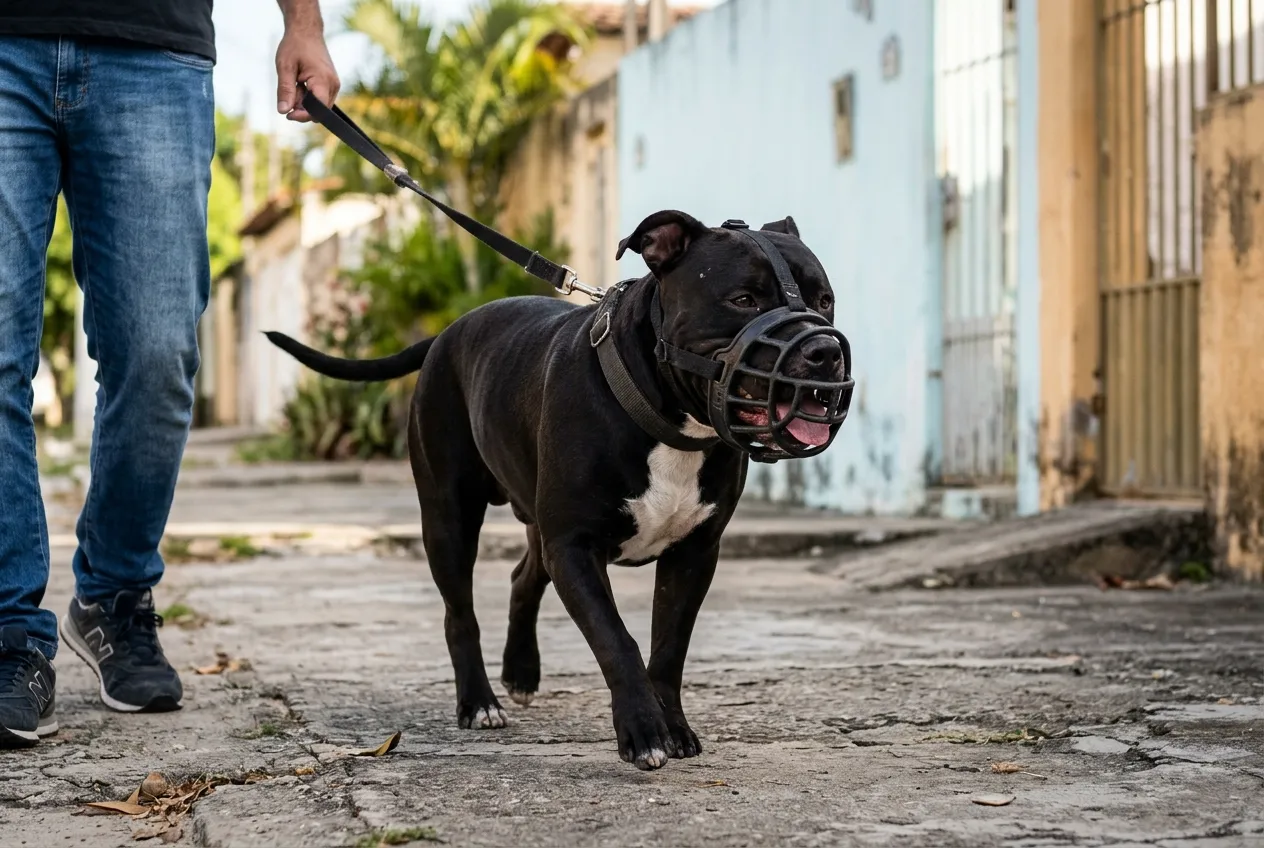
- Santa Catarina. State Decree No. 1.047 of July 9, 2025 regulated state Law No. 14.204/2007 and named the American Bully explicitly, along with the American Pit Bull Terrier, the American Staffordshire Terrier, the Staffordshire Bull Terrier and variations such as Pocket and Micro. The decree banned breeding and selling these dogs, required neutering from six months of age and allowed them in public only on a leash, with a muzzle and an adult handler. On June 17, 2026, ruling on a mandado de segurança (a Brazilian writ against an act of a public authority), the Special Body of the Santa Catarina Court of Justice found the ban on breeding and selling pit bulls unconstitutional, because it disproportionately restricted professional freedom and the free exercise of economic activity. The ruling applies to that case and guides the court's future judgments, but it does not repeal the law or the decree, which stay in force until Brazil's Supreme Federal Court (STF) decides ADI 7.850, a direct action of unconstitutionality. The rules for taking these dogs out in public, with leash and muzzle, still apply.
- Minas Gerais. State Law No. 16.301/2006, as amended by Law No. 25.165/2025, governs the raising of pit bulls, dobermanns, rottweilers, fila brasileiros and dogs of similar size, strength and behavior, as well as their mixes. It bans breeding pit bulls and bringing them into the state, and it requires a muzzle, a collar and a handler over 18, on public roads and in transport, for every breed on the list. The Doberman is on it.
Outside Brazil, the most cited case is the United Kingdom. Since February 1, 2024, owning an XL Bully in England and Wales without a Certificate of Exemption is a criminal offense, according to UK government guidance. The rule targets the XL type, not the smaller varieties.
Before bringing home a dog of any of these breeds, check the law in your state and in your city. Building and condo rules count too. And if neutering comes into the decision, whether the law requires it or you choose it, it is worth reading what changes when you neuter a dog.
Where does the Doberman fit in this comparison?
The Doberman comes from another family. A German breed in FCI group 2, the group of pinschers, schnauzers and molossers, it is named after Friedrich Louis Dobermann, who developed it in the 19th century. It is much taller than the three related American breeds: FCI standard 143 calls for males of 68 to 72 cm and 40 to 45 kg, and females of 63 to 68 cm and 32 to 35 kg. The same standard lists its uses as companion, protection and working dog, and describes a friendly dog, deeply attached to its family, with a medium threshold of irritation.
If you came to the Bully looking for a guard dog, the math changes. The Doberman was selected for protection and work; the Bully, for companionship. We compare the Doberman with other guard breeds in which is the best guard dog and, side by side with a molosser, in Doberman or Rottweiler.
This question has already reached us on WhatsApp: "Is your Doberman European or American style?" That "American" is a type within the Doberman breed and has nothing to do with the American Bully. We explain that type in American Doberman: what it is, what changes and what does not. Our kennel, in Nísia Floresta, in the Greater Natal area of Rio Grande do Norte, works with champion bloodlines from the Americas and Europe: Eros, our brown stud with Registro Geral (general registration) at the CBKC, comes from the Akido San and Black Shadow lines, and Kira, our black dam who carries brown, brings in the Russian Teraline bloodline.
Our puppies leave registered with the CBKC, which is affiliated with the FCI, under the kennel affix Imperio Real Norte. And they leave just as they were born, with ears and tail intact: cosmetic ear cropping and tail docking are banned in Brazil by the resolutions of the Federal Council of Veterinary Medicine (CFMV), and that applies equally to the Bully, the Pit Bull and the Doberman.
Frequently asked questions about the American Bully
Is the American Bully a Pit Bull?
No. The American Bully descends from the American Pit Bull Terrier, but it has its own standard, with a different build and different proportions. The UKC recognized the breed in 2013, and the CBKC registers it separately from the Pit Bull, in group 11.
Is an American Bully and Rottweiler cross a breed?
No. Crossing an American Bully with a Rottweiler produces a mixed-breed dog, with no standard and no way to get a CBKC pedigree, since the CBKC only registers a litter when sire and dam are of the same breed and registered. The adult's size and temperament are unpredictable, because each puppy may take more after one side than the other.
Is the American Bully XL banned?
In the United Kingdom, yes: since February 1, 2024, owning an XL Bully without a Certificate of Exemption is a criminal offense in England and Wales. In Brazil there is no national ban. In Santa Catarina, the 2025 decree covers the American Bully of any variety. In 2026, in a specific case, the state's Court of Justice found the ban on breeding and selling unconstitutional, but the rule stays in force until the STF decides ADI 7.850.
What food should you give an American Bully?
A complete and balanced food for the dog's size and life stage, chosen with the veterinarian who looks after the animal. Because the breed carries so much muscle, extra weight is easy to miss: keep track of the body condition score, in which the ribs should be easy to feel under a thin layer of fat, and adjust the amount with your vet.
Does the American Doberman have anything to do with the American Bully?
Nothing. "American Doberman" is the name of a type within the Doberman breed. The American Bully is another breed, of a different size and a different origin within the United States.
Where the numbers come from
- Origin, recognition on July 15, 2013, companion group, varieties and heights of the American Bully: United Kennel Club standard, version in force since January 1, 2025, with inches converted to centimeters.
- Registration number 1 of the American Pit Bull Terrier (Bennett's Ring, 1898) and the breed's reference height: United Kennel Club standard for the American Pit Bull Terrier.
- CBKC group 11 for the American Bully and the American Pit Bull Terrier: list of breeds by group of the Confederação Brasileira de Cinofilia, checked in October 2026.
- Bull-type breeds accepted by the FCI: FCI group 3 nomenclature. Height of the American Staffordshire Terrier: FCI standard 286. The breed at the AKC: American Staffordshire Terrier page.
- Height, weight, proportions, use and temperament of the Doberman: FCI standard 143.
- Visual identification of pit bull type dogs (120 dogs; 62 labeled by staff, 25 identified by DNA): Olson and colleagues, The Veterinary Journal, 2015, abstract on PubMed.
- Santa Catarina: State Decree No. 1.047/2025, published in the State Official Gazette (Diário Oficial do Estado) on July 9, 2025; state Law No. 14.204/2007; Case Law Bulletin (Informativo da Jurisprudência) No. 165 of the Santa Catarina Court of Justice, July 23, 2026.
- Minas Gerais: State Law No. 16.301/2006, consolidated text with Law No. 25.165/2025, on the website of the Legislative Assembly of Minas Gerais.
- United Kingdom: UK government guidance on the XL Bully ban in England and Wales.
- Ear cropping and tail docking: CFMV Resolution No. 877/2008 and CFMV Resolution No. 1.027/2013.

About the author
Marcelo Vaz
Entrepreneur and founder of Dobs Kennel
Marcelo Vaz is an entrepreneur and the founder of Dobs Kennel, a Doberman kennel in Nísia Floresta (RN), Brazil. As a boy, he already knew which dog he wanted. That passion for the Doberman stayed with him over the years and became the kennel he now runs with the seriousness of someone who waited a long time for it. “We are not veterinarians, but we study every subject in depth and only write what is backed by science and reliable sources,” he says.
- RegistryCBKC / FCI
- Kennel nameImperio Real Norte
- WhereNísia Floresta, RN
Keep reading


Comments
Ask the breeder directly. Every comment is moderated before it appears, and your email is never published.
Be the first to comment: ask the breeder directly.