
In this article
The best guard dog for a family with children isn't the fiercest one on the block: it's the dog with a high threshold, attached to the group and easy to handle, and by that yardstick the Doberman, the Boxer and the German Shepherd come out ahead of most. The long answer depends on the age of the children, the space in the house and your own experience with dogs, and that's the answer this article delivers.
Two warnings before I start. First: I breed Dobermans, so read my list knowing where it comes from. The general comparison of the 7 guarding breeds shows the full yardstick, without the children filter. Second: there is no dog that replaces an adult keeping watch. Any breeder promising a "nanny with teeth" is selling a fantasy.
What "family guarding" really asks for
Family guarding is a different job from property guarding, and confusing the two is mistake number one for buyers. A warehouse needs a territorial dog that acts on its own. Your home needs the opposite: a dog that warns a lot and decides little, that fires the alert when something breaks the pattern and waits for your reaction instead of taking the lead.
That's why the criteria that matter in a house with children are about living together, not about combat. The dog will spend 99% of his life being family and 1% being an alarm. Choose by the routine, and the alarm comes along with it.
The five criteria I used
Tolerance threshold. A child steps on a paw, pulls an ear, shrieks a few inches from the muzzle. A family dog needs a long fuse and, when he's bothered, he needs to prefer walking away to answering back.
Attachment to the group. A family guardian protects the people, not the yard. Breeds that operate alone, far from the owner, serve that role worse.
Handling. The more physical power there is, the more the difference between the right dog and a problem comes down to daily training. Some breeds forgive a first time owner; others don't.
Compatible energy. A bored guard dog invents work for himself, and the invented work is usually destruction or noise. The exercise bill has to fit the family's real week, not the ideal one.
Size versus a small child. This isn't aggression, it's physics: 40 excited kilos knock over a 15 kilo body with no bad intention at all.
The list, with the caveats spelled out
| Breed | With children | Alert | Handling demanded | The honest caveat |
|---|---|---|---|---|
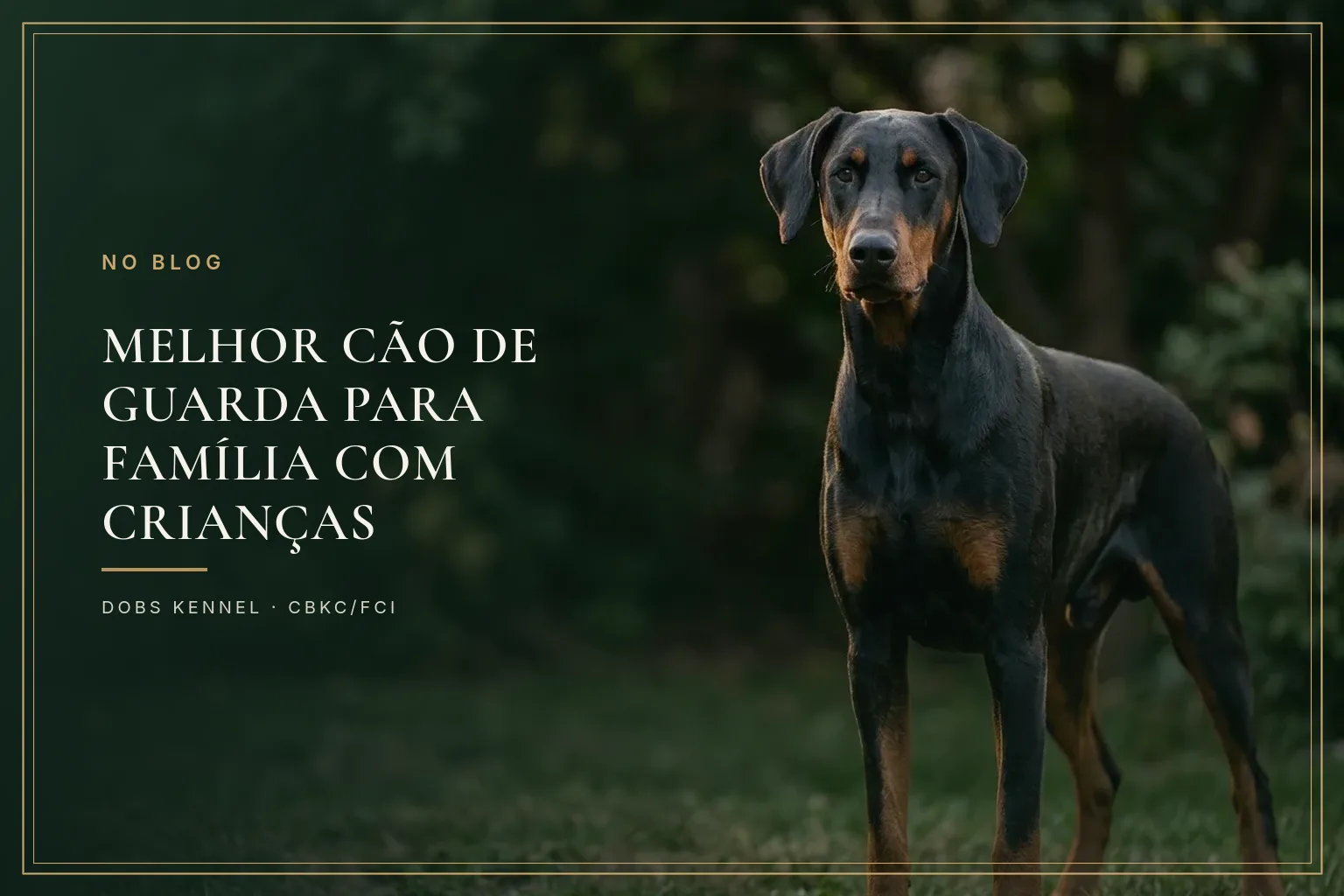
| Doberman (American type) | Excellent with his own family | Very high | Medium: he wants to get it right for the owner | Intense and glued to you; needs real daily exercise, see the temperament guide |
| Boxer | A historical benchmark with children | High | Low to medium | A 30 kilo clown until he turns 3: knocks a small child over while playing |
| German Shepherd | Very good, strong herding instinct | Very high | Medium: he needs a task | Sheds all year round and suffers in hot weather, the complete guide covers it |
| Rottweiler | Good with the family, reserved with visitors | High, and quieter about it | High: that power calls for experience | I don't recommend him as a first dog with a small child at home, see the breed guide and the head to head |
| Cane Corso | Devoted, but territorial | High, acts silently | Very high | A dog for an experienced owner; with children visiting often, managing him is serious work, see the complete guide |
Arraste a tabela para o lado para ver todas as colunas.
If your house has a lot of people coming through it, birthday parties, your children's friends in and out, weigh that more than any other line in the table. The more territorial guarding breeds read the commotion of visiting children worse than they read their own family's chaos.
The rules that hold for any breed
The breed sets the raw material; these four rules set the result. They are not optional in any scenario.
Supervision always. A dog and a small child in the same room call for an adult present. No exception for breed, size or history. Our article on a Doberman and a child living together safely goes down to the detail, and the principle serves for all of them.
Socialization in the first weeks. A balanced guardian is built between the 3rd and the 12th week of life, when the puppy learns what counts as normal in the world. That window doesn't come back: ask any breeder what he does during it.
The dog has a corner of his own. Bed, bowl and rest where a child can't reach. Half of household incidents start with a child approaching a dog that was eating or sleeping.
The child gets educated too. No riding, no pulling, no chasing, no touching the bowl. A well chosen guard dog tolerates all of that; the house that works is the one that doesn't test the tolerance every day.
Fine tuning for your house
A baby or a child up to about 5: put threshold and predictability ahead of an imposing look. The Boxer and the American type Doberman are the ones I would put in the living room. Leave the Rottweiler and the Corso for when there's experience already banked.
Older children and teenagers: the range opens up. The dog can take part in the exercise, and breeds that ask more of the handler come into play if an adult takes the training on as a real hobby.
An apartment: guarding works through the alert, not through territory. The Doberman adapts with serious exercise, I've written about that, and so does the Boxer. The German Shepherd suffers more in a small space and in the heat.
A big yard and a full routine: careful with the sum that looks easy. A yard doesn't exercise a dog; people do. A guard dog left alone in the yard all day becomes the noisy neighbor, not the guardian.
Frequently asked questions
Does a guard dog live well with a newborn baby?
He does, with a gradual introduction and constant supervision. What changes the safety isn't the breed, it's the management: smells before contact, the dog's own space preserved and no meeting without an adult during the first year.
Do I have to train the dog for him to guard?
No. The alert is instinct in the breeds on this list: nobody needs to teach barking at strange movement. What you train is the rest, obedience, calm with visitors, a civilized walk. Attack training in a family dog is a risk no house with a child should buy.
Male or female for a house with children?
Females tend to mature earlier and to read the household with more subtlety; males stay bigger and playful for longer. The variation between individuals is greater than the average between the sexes: describe your house to the breeder and ask for the puppy with the right temperament, not the one with the right sex.
Is a big dog dangerous for a small child?
The number one risk of size is the physical accident, not the bite: being knocked over during play, a tail at face height. Choose a build that matches the age of the children and teach the dog to move calmly indoors from puppyhood.
Is a mixed breed no good for guarding?
Plenty of them warn very well, and the alert is 80% of family guarding. What you lose is predictability: without knowing the genetics, adult temperament and size are a gamble. With a child at home, predictability is exactly what I pay to have.
Torn between two breeds and want a frank opinion about your routine? Get in touch. I've already sent a family off to look for a Boxer instead of my puppy, and I'd do it again: the right dog in the right house is the only marketing that lasts.

Written by
Marcelo Vaz — breeder at Dobs Kennel
CBKC/FCI registered kennel in Natal, Brazil. Champion American and European bloodlines, proven health, and lifelong support for every family. Meet the kennel →