


In this article
- Can dogs eat bananas? The short answer
- What is inside a banana
- Are bananas bad for dogs? What is real
- Can dogs eat banana peels?
- Prata, nanica, maçã or plantain: which bananas a dog can eat
- How to give a dog banana
- How much banana can a dog eat: the math by weight
- Banana at every life stage
- What changes in a breed like the Doberman
- When not to give banana, or only after talking to the vet
- Dried banana, chips, candy, oatmeal and peanut butter: what about banana products?
- Frequently asked questions
- Where the numbers come from
Yes, dogs can eat bananas: ripe, peeled, sliced or mashed, as a treat that fits inside the 10% of daily calories set aside for extras. For an adult Doberman of 32 to 45 kg, a sensible portion is 35 to 60 grams, a third to half of a medium banana, two or three times a week; for smaller dogs the portion shrinks in proportion to body weight, as the table further down shows. Bananas carry more calories than apple, mango and watermelon, so the portion is smaller. The peel stays out: it is not poisonous, but it is hard to digest and can block the intestine.
Can dogs eat bananas? The short answer
- Yes, the flesh of a ripe banana, raw or mashed.
- Take the peel off first. The American Kennel Club, the AKC, says it is not toxic but is hard to digest and can cause discomfort and, in some cases, an intestinal blockage.
- Serve it in slices, cubes or mashed, sized for the dog.
- All of the day's extras added together stay at or below 10% of calories. Banana shares that room with training treats and any other fruit.
- Puppy settled on its food: a little mashed banana, once or twice a week. Adult: the portion in the table, two to three times a week. Senior: a slightly smaller portion than the adult's, with an eye on weight.
- Fried banana, banana chips, banana candy, cake and chocolate-covered banana stay off the menu.
These rules apply to a healthy dog at the right weight eating a complete and balanced food. Diabetes, obesity, a diagnosed illness, long-term medication or a prescription diet change the math, and in those cases the call belongs to the dog's own vet.
What is inside a banana
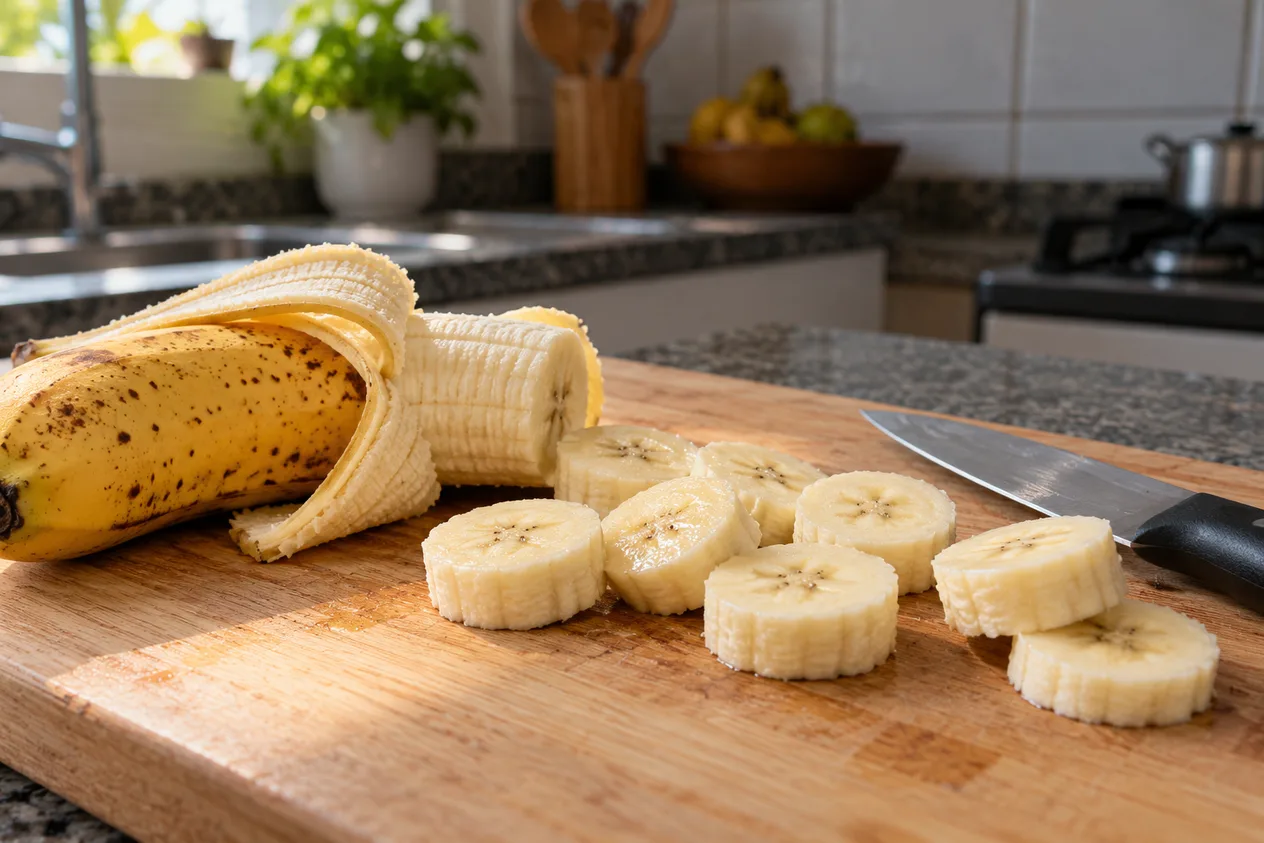
A banana holds much less water than an apple: 74.9 g per 100 g, against 85.6 g, according to the food composition database of the United States Department of Agriculture, the USDA. That leaves more room for carbohydrate, 22.8 g, of which 12.2 g is fruit sugar and 5.4 g is starch. Protein and fat barely show up.
| Nutrient | 100 g raw banana | 1 medium banana (118 g of flesh) |
|---|---|---|
| Energy | 89 kcal | 105 kcal |
| Water | 74.9 g | 88.4 g |
| Carbohydrate | 22.8 g | 26.9 g |
| Sugars | 12.2 g | 14.4 g |
| Starch | 5.4 g | 6.3 g |
| Fiber | 2.6 g | 3.1 g |
| Protein | 1.1 g | 1.3 g |
| Fat | 0.3 g | 0.4 g |
| Potassium | 358 mg | 422 mg |
| Magnesium | 27 mg | 32 mg |
| Vitamin B6 | 0.37 mg | 0.43 mg |
| Vitamin C | 8.7 mg | 10.3 mg |
| Copper | 0.078 mg | 0.092 mg |
Swipe the table sideways to see all the columns.
The medium banana is the USDA's measure for a fruit 18 to 20 cm long, with 118 g of flesh once peeled.
Next to mango, apple and watermelon, the banana stands out in two numbers. It has 89 kcal per 100 g, almost three times as much as watermelon, and 358 mg of potassium, more than three times the apple's and double the mango's.
| Fruit (100 g, raw) | Energy | Sugars | Fiber | Potassium |
|---|---|---|---|---|
| Banana | 89 kcal | 12.2 g | 2.6 g | 358 mg |
| Mango | 60 kcal | 13.7 g | 1.6 g | 168 mg |
| Apple with skin | 52 kcal | 10.4 g | 2.4 g | 107 mg |
| Watermelon | 30 kcal | 6.2 g | 0.4 g | 112 mg |
Swipe the table sideways to see all the columns.
Banana sugar sits close to mango's; what weighs more is the starch, which adds calories without showing up on the sugar line. That is why, gram for gram, it is the fruit in the table that fills the day's quota of extras fastest. With mango the main worry is something else, the pit, as we explain in our guide to mango for dogs.
Are bananas bad for dogs? What is real
In the right portion, they are not. What the fruit actually offers:
- A treat with almost no fat. That is 0.3 g per 100 g, and the AKC points to bananas as an alternative to fatty or salty treats.
- Potassium, magnesium and vitamin B6, which the AKC lists among the fruit's nutrients. A dog on a complete food already gets these in the right amounts, so banana comes in for the taste, not as a supplement.
- Fiber, 2.6 g per 100 g. According to the AKC, it can help the digestive tract.
- Soft texture. Mashed, it fills a toy, tops the kibble and suits an older dog with worn teeth.
The harm comes from too much. A banana has 12.2 g of sugar per 100 g, and a whole medium fruit adds up to 105 kcal and 14.4 g of sugar. The AKC advises feeding it in moderation and not as an everyday treat, because the fruit adds calories and, in quantity, can upset the gut. The bigger risk sits outside the flesh: in the peel, which can cause a blockage, and in the fried or sweetened products covered further down.
Can dogs eat banana peels?
They should not. The peel is not on the list of foods toxic to dogs, and the problem is mechanical: the AKC explains that it is hard to digest, can cause stomach upset and, in some cases, an intestinal blockage. A whole peel, gulped down by a big dog in a hurry, is a wad of tough fiber that can lodge in the stomach or the intestine.
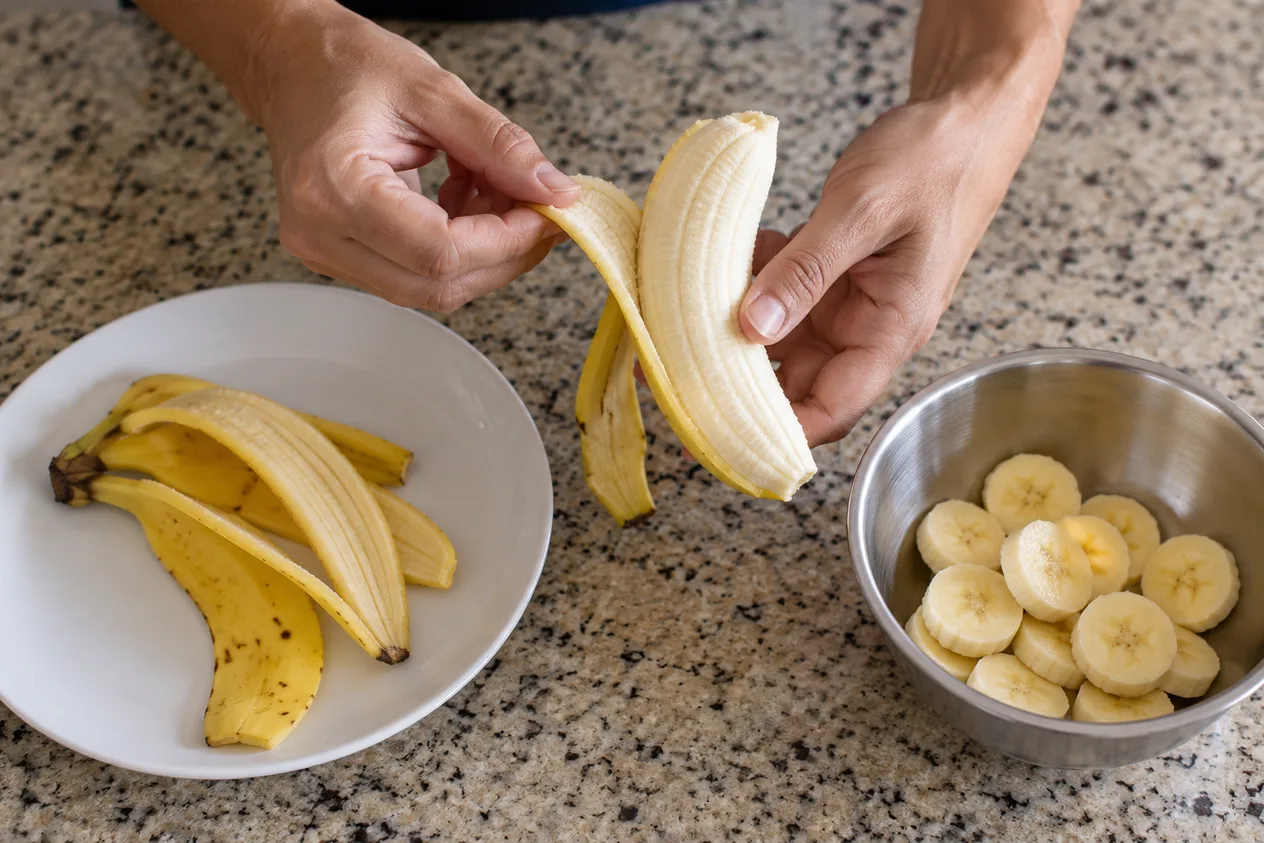
Peel the banana before serving and throw the peel in a lidded bin, out of reach of a curious nose.
My dog ate a banana peel: what to do
- If the dog is choking, retching, coughing nonstop or struggling to breathe, it is an emergency: go to the nearest vet.
- Do not make the dog vomit on your own. That is the vet's decision, once they know what the dog ate and how much.
- Call your vet and give the dog's weight, how much peel it ate and how long ago.
- Watch closely over the next few days. Lethargy, loss of appetite and vomiting are the most common signs of an intestinal blockage in dogs, according to the Merck Veterinary Manual, which also lists diarrhea and a painful or swollen belly. Any one of them calls for a vet visit, all the more in a deep-chested dog like the Doberman.
Prata, nanica, maçã or plantain: which bananas a dog can eat
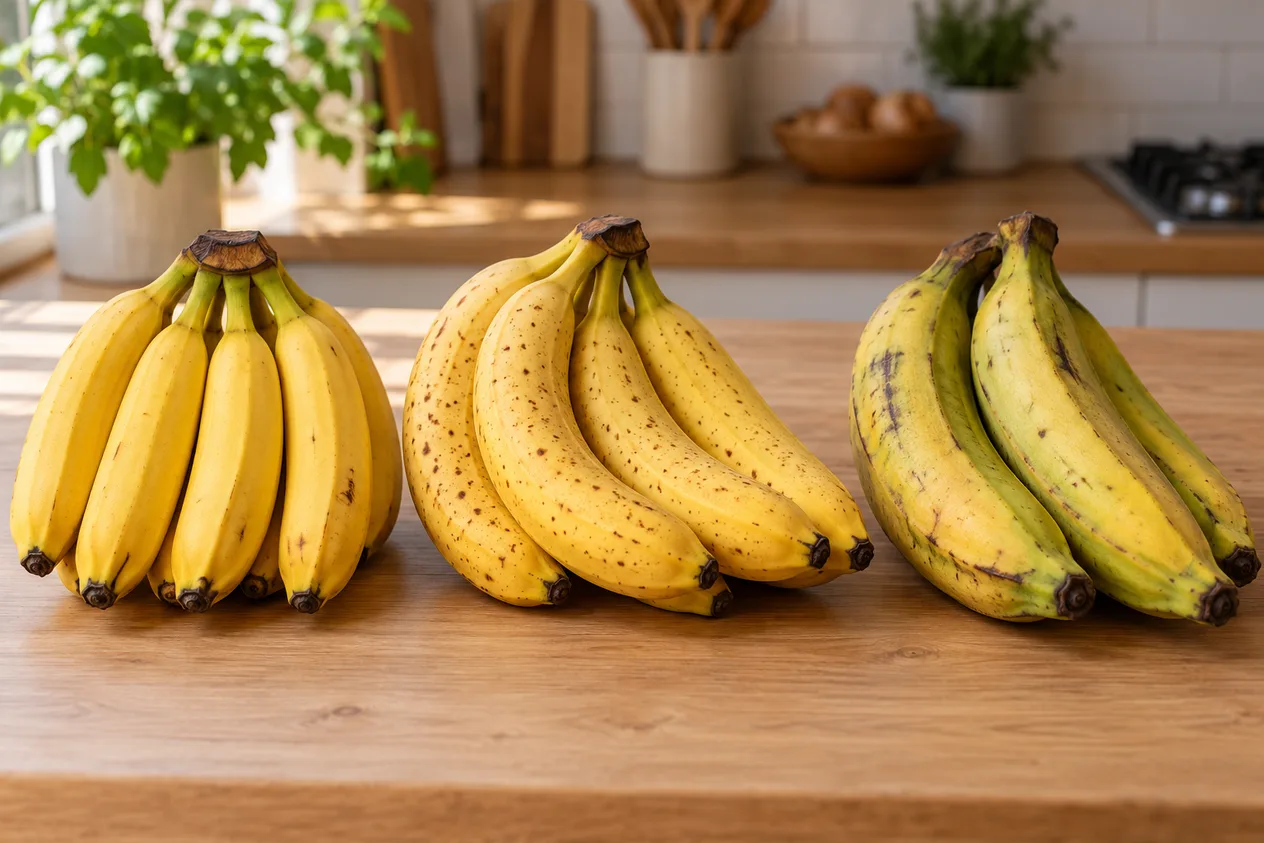
Every eating banana sold in Brazil can go in the bowl, under the same rules. What changes from one to the next is the calorie count, and the Brazilian Food Composition Table, known as TACO, from the University of Campinas (Unicamp), measured each raw variety. For readers outside Brazil: prata is a firm, slightly tart banana, nanica is the Cavendish type found in most supermarkets, maçã is a small "apple banana", ouro is a tiny, very sweet finger banana, and banana-da-terra is the cooking plantain.
| Raw banana (100 g) | Energy | Carbohydrate | Fiber | Potassium |
|---|---|---|---|---|
| Pacova | 78 kcal | 20.3 g | 2.0 g | 267 mg |
| Maçã | 87 kcal | 22.3 g | 2.6 g | 264 mg |
| Nanica | 92 kcal | 23.8 g | 1.9 g | 376 mg |
| Prata | 98 kcal | 26.0 g | 2.0 g | 358 mg |
| Ouro | 112 kcal | 29.3 g | 2.0 g | 355 mg |
| Plantain (da terra) | 128 kcal | 33.7 g | 1.5 g | 328 mg |
Swipe the table sideways to see all the columns.
Between the maçã and the prata, the gap is 11 kcal per 100 g. In a Doberman's 50 g portion, that comes to less than 6 kcal, next to nothing. The nanica sits in the middle, and the ouro is the most caloric of the ones eaten raw.
Plantain
Plantain is a cooking fruit. Raw, it has 128 kcal per 100 g according to TACO, and the USDA measures 12 g of starch in raw plantain, more than double that of a regular banana. For a dog, serve it only boiled or baked, with no salt, sugar or oil, which is how the AKC says to serve any human food. Baked, it loses water and gets denser: it reaches 155 kcal per 100 g, according to the USDA, so the portion drops to a little over half of the regular banana portion. Fried, no, for the reason given in the section on banana products.
Ripe or overripe
As it ripens, a banana loses starch. In the USDA's most recent analyses, a ripe banana had 3.7 g of starch per 100 g and an overripe one 0.4 g, with the same sugar in both: 15.8 g per 100 g, more than the classic record used in the tables in this article. Choose a ripe, firm banana with a yellow peel. The overripe one, softer, works mashed, and any moldy part goes in the trash.
How to give a dog banana
The best banana for your dog is the one you would eat yourself: ripe, firm, with no rotten or moldy spots.
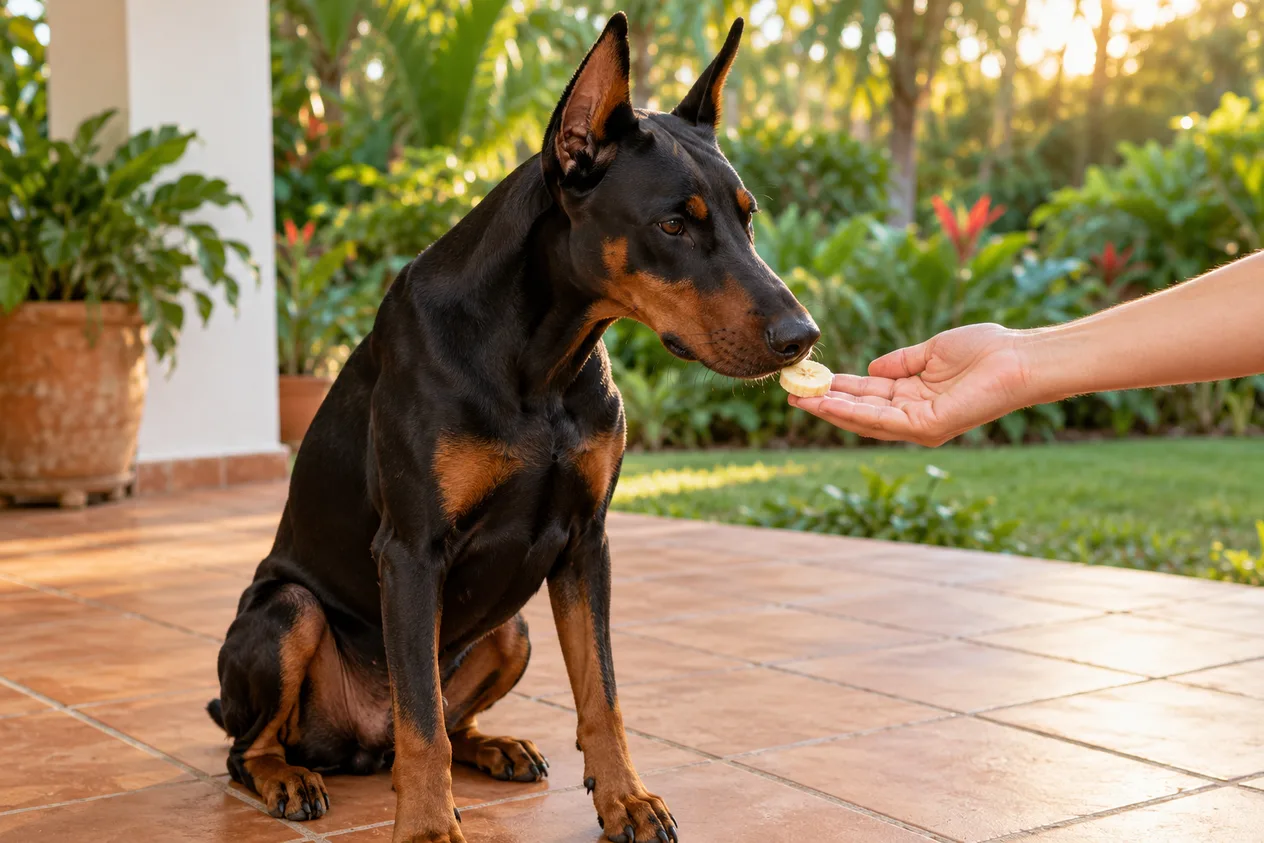
- Peel it and throw the peel in a bin the dog cannot reach.
- Cut it into slices about 1 cm thick for a big dog that chews, or into small cubes for a small dog, a puppy or a dog that gulps.
- Offer it plain, from your hand, as a reward, or mashed on top of the kibble for variety.
- Mashed, it can also fill a rubber toy, with the portion counted.
- In hot weather, freeze the slices. The AKC suggests frozen banana as a cooling treat, in pieces sized so they will not cause choking.
- Plantain only boiled or baked with no seasoning, and cooled before serving.
The first time, start with one or two slices and check the stool over the next 24 hours. Loose stool or gas means the portion was too big or that this particular dog does not get along with the fruit.
How much banana can a dog eat: the math by weight
The rule that ties everything together is the calorie one. The nutrition guidelines of the AAHA, the American Animal Hospital Association, recommend that treats and any food outside the complete diet add up to no more than 10% of the day's energy. Banana, training treats, eggs and any other food outside the kibble all go into that same count.
Daily energy comes from the standard resting energy formula, 70 times body weight in kg raised to the power of 0.75, multiplied by the factor from the same guidelines: 1.4 to 1.6 for a neutered adult and 1.6 to 1.8 for an intact adult. The neutered dog sits at the low end, and the tendency to gain weight after surgery is covered in our article on neutering a dog. The Doberman rows are highlighted because it is the breed we raise, at the weights in the official FCI standard: about 32 to 35 kg for a female and 40 to 45 kg for a male. The math is the same for any dog; only the weight changes.
| Adult dog | Energy per day (neutered to intact) | Cap on extras (10%) | Cap in banana | Sensible portion |
|---|---|---|---|---|
| 5 kg | 330 to 420 kcal | 33 to 42 kcal | 35 to 45 g | 10 g (1 slice), 2 to 3 times a week |
| 10 kg | 550 to 710 kcal | 55 to 71 kcal | 60 to 80 g | 15 to 20 g (2 slices), 2 to 3 times a week |
| 20 kg | 930 to 1,190 kcal | 93 to 119 kcal | 105 to 135 g | 25 to 35 g (3 to 4 slices), 2 to 3 times a week |
| Doberman female, 32 kg | 1,320 to 1,700 kcal | 132 to 170 kcal | 150 to 190 g | 35 to 45 g (4 to 6 slices), 2 to 3 times a week |
| Doberman male, 40 kg | 1,560 to 2,000 kcal | 156 to 200 kcal | 175 to 225 g | 45 to 55 g (5 to 7 slices), 2 to 3 times a week |
| Doberman male, 45 kg | 1,700 to 2,190 kcal | 170 to 219 kcal | 190 to 245 g | 50 to 60 g (6 to 7 slices), 2 to 3 times a week |
| 60 kg | 2,110 to 2,720 kcal | 211 to 272 kcal | 235 to 305 g | 60 to 75 g (7 to 9 slices), 2 to 3 times a week |
Swipe the table sideways to see all the columns.
The last two columns do different jobs. The cap is the limit for all of the day's extras combined, and no dog needs to reach it with banana. The sensible portion is about a quarter of the cap, leaving room for training treats and other fruit. For a sedentary dog or one that gains weight easily, the cap drops, and so does the portion.
The table uses the USDA banana's 89 kcal. If yours is a prata, at 98 kcal, cut the portion by a tenth; if it is an ouro, at 112 kcal, cut it by a fifth.
To measure without a scale: a medium banana, with 118 g of flesh, yields about 15 slices 1 cm thick, and each slice weighs about 8 g. And to check the math: 45 g of banana has about 40 kcal and 5.5 g of sugar. A neutered 40 kg male Doberman burns around 1,670 kcal a day, and that portion is 2.4% of it. The body confirms the math after four to six weeks: ribs easy to feel and a waist visible from above.
Banana at every life stage
Puppy
A puppy can eat banana once it has settled on its growth food in the new home and its stool is firm. At first, mashed or in tiny cubes, once or twice a week, in an amount that fits on the tip of a teaspoon.
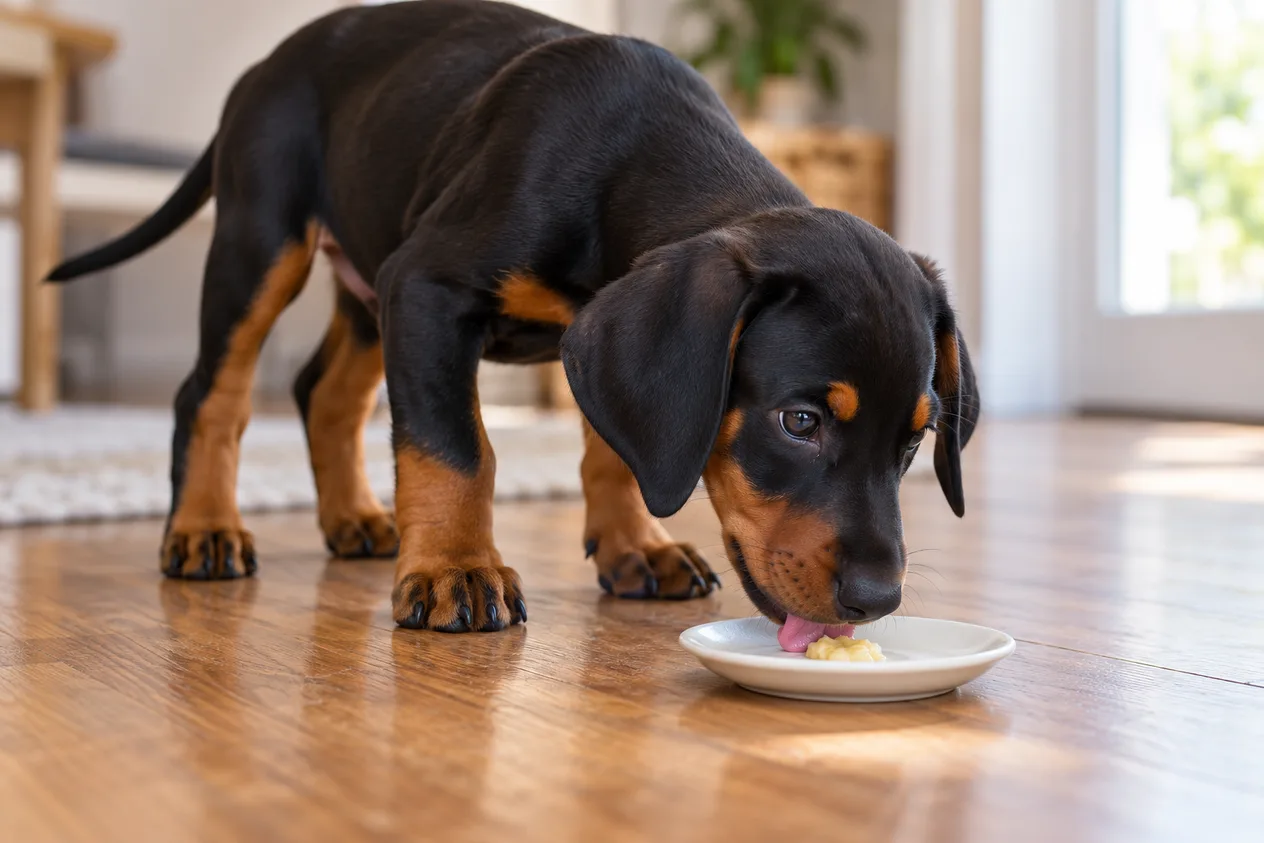
A large-breed puppy needs to grow at the right pace, and the growth food is what supplies calcium, phosphorus and energy in the right measure; banana is only a little treat. The details are in nutrition for large-breed puppies.
Young dog, 6 to 18 months
In the chew-everything phase, mashed banana inside a rubber toy, put in the freezer, makes a treat that lasts longer. Training treats count toward the same 10%, and basic commands with rewards are covered in Doberman training.
Adult
The portion in the table, two to three times a week, rotating with other fruit and with training treats. For what goes in the bowl at each age, see feeding a Doberman at every life stage.
Senior
A dog over seven uses less energy, and the European nutrition guidelines from FEDIAF recommend 10% to 15% fewer calories than between the ages of three and seven. Banana is still fine, in a slightly smaller portion, and mashed it is one of the easiest fruits for a dog with worn teeth. Watch the weight: in an older dog, every extra kilo weighs on the joints and the heart.
What changes in a breed like the Doberman
The math holds for any dog. In the Doberman, three points need attention, and in none of them does banana play the role of treatment.

Weight and stomach
The Merck Veterinary Manual lists a deep, narrow chest, a single daily meal and fast eating among the risk factors for gastric torsion (bloat), and recommends limiting exercise before and after meals in at-risk dogs. The Doberman has that chest. Give banana in pieces, away from running and rough play, and never a full bowl at once. The breed's bloat risk factors are covered in how long a Doberman lives.
Liver and copper
The Doberman is among the breeds in which the Merck Manual records chronic copper buildup in the liver, and managing it means restricting copper in the diet, a topic we cover in the article on eggs in a dog's diet. Banana does not weigh on that count: it has 0.078 mg of copper per 100 g, less than mango, and a 50 g portion adds up to 0.04 mg.
Heart and potassium
The breed is predisposed to dilated cardiomyopathy, and banana neither protects nor harms a healthy heart. The concern is the Doberman already being treated for a heart condition. ACE inhibitors are among the drugs used for heart failure in dogs, and the Merck Manual notes that enalapril is approved in the United States for heart failure caused by dilated cardiomyopathy, among other causes. The same manual warns that giving these drugs together with spironolactone, a potassium-sparing diuretic, can raise blood potassium, and recommends monitoring that value. Banana has more potassium than the other fruits in this article's table: 358 mg per 100 g. For a dog on these drugs, the fruit only goes in after you agree on it with the vet who monitors the bloodwork. Screening for the disease before symptoms appear, with an echocardiogram and Holter monitoring, is covered in how to assess a Doberman's heart health.
When not to give banana, or only after talking to the vet
- Diabetic dog: fruit only with the approval of whoever manages the insulin, because control depends on consistent meals and calories. Banana has 12.2 g of sugar per 100 g, more than apple and almost double watermelon.
- Obese dog or dog on a weight-loss diet: if banana goes in, it takes the place of another treat rather than adding to it, and in a smaller portion than the table's.
- Heart or kidney medication, or a blood test with potassium out of range: check first, for the reason in the section above.
- Prescription diet for kidney, liver, gut or allergy: nothing goes in without checking.
- Diarrhea or vomiting right now: wait for the gut to settle. Banana is not medicine, and diarrhea lasting more than a day calls for the vet.
- Dog that swallows without chewing: give it mashed or in small cubes, never the whole fruit.
Dried banana, chips, candy, oatmeal and peanut butter: what about banana products?
The more a banana is processed, the more it concentrates sugar or picks up fat. The USDA numbers per 100 g:
| Product (100 g) | Energy | Sugars | Fat |
|---|---|---|---|
| Raw banana | 89 kcal | 12.2 g | 0.3 g |
| Dehydrated banana, dried or powder | 346 kcal | 47.3 g | 1.8 g |
| Banana chips, fried | 519 kcal | 35.3 g | 33.6 g |
Swipe the table sideways to see all the columns.
- Dried and dehydrated banana: drying concentrates the sugar. The USDA's dried banana, at 3% water, has almost four times the calories of fresh banana by weight; soft dried banana keeps more water and comes in a little lower, but it is still many times more caloric. If you use it, only the kind with no added sugar, in tiny slivers, counted in the day's quota.
- Banana chips and fried banana: no. Banana chips have 33.6 g of fat per 100 g, about 65 g of fat per 1,000 kcal, more than three times the 20 g limit the Merck Manual gives for the diet used to treat pancreatitis. The same manual points to dietary indiscretion, when a dog eats something that is not part of its diet, as a common risk factor for the disease.
- Banana candy bars (the Brazilian doce de banana): per TACO, 280 kcal and 75.7 g of carbohydrate per 100 g, three times the calories of raw banana. Keep it out.
- Banana cake and chocolate-covered banana: out. Besides the sugar, chocolate contains theobromine and caffeine, toxic to dogs according to the Merck Manual, and raisins, which some cakes include, can damage the kidneys. The same manual flags risk from more than one grape or raisin per 4.5 kg of body weight and notes that the toxic content varies from fruit to fruit, so there is no safe amount: if your dog ate some, call the vet. Diet or sugar-free cakes and sweets may contain xylitol, which the FDA, the US Food and Drug Administration, identifies as dangerous for dogs.
- Banana with oatmeal: fine, if the oats are cooked in water, with no salt, sugar or butter, as the AKC advises; it recommends against instant and flavored oatmeal, which may contain xylitol. Both together fit in the same quota of extras.
- Banana with peanut butter: fine, in small amounts, with peanut butter that has no salt and no xylitol. The FDA lists some peanut butters among products that may contain xylitol, also called birch sugar, so read the label. Peanut butter is fatty, and the AKC notes that too much leads to obesity and pancreatitis.
- Banana milkshake or smoothie with milk: better not. The AKC notes that dogs are sensitive to milk and digest lactose poorly.
Frequently asked questions
Can dogs eat bananas every day?
It is not ideal. The AKC recommends bananas in moderation and not as an everyday treat. Two to three times a week is a good frequency and leaves room for other fruit and training treats.
Can puppies eat bananas? From what age?
Yes, once they have settled on their growth food and their stool is normal, as a little mashed banana, once or twice a week. The puppy food stays the foundation.
Can dogs eat banana peels?
They should not. The peel is not toxic, but it is hard to digest and can cause an intestinal blockage, according to the AKC. If your dog ate one, follow the steps in the peel section and watch for lethargy, loss of appetite and vomiting over the next few days.
Are bananas bad for dogs?
In the right portion, no. Too much adds sugar and calories and can upset the gut. The real troublemakers are the peel, fried banana, banana chips and banana sweets.
How much banana can I give my dog?
A sensible portion is 10 g for a 5 kg dog, 25 to 35 g for a 20 kg dog and 45 to 55 g for a 40 kg male Doberman, two to three times a week. The table above covers every weight.
Can dogs eat prata or nanica bananas?
Yes, both. Prata has 98 kcal per 100 g and nanica 92 kcal, per TACO. The difference is small; with prata, cut the table's portion by a tenth.
Can dogs eat plantains?
Yes, boiled or baked, with no salt, sugar or oil. Baked, plantain has 155 kcal per 100 g, so the portion drops to a little over half of the regular banana portion. Fried, no.
Can dogs eat apple bananas (banana-maçã)?
Yes. It is one of the least caloric bananas in TACO, at 87 kcal per 100 g, and follows the same rules on peel and portion.
Do bananas constipate dogs? Can I give banana for diarrhea?
Do not use the fruit as medicine. In excess, it can actually loosen the stool. With diarrhea, wait for things to settle before offering any extra, and see the vet if it lasts more than a day or comes with vomiting, blood or lethargy.
Can dogs eat banana with oatmeal?
Yes, with oats cooked in water, without sugar, salt or butter, and never instant or flavored oatmeal. Both together go into the same daily quota of extras.
Can dogs eat frozen bananas?
Yes. Frozen in slices, it becomes a cooling treat for hot days, suggested by the AKC itself. Cut it to a size the dog cannot swallow whole.
Can diabetic dogs eat bananas?
Only with the approval of the vet who manages the insulin. Banana has 12.2 g of sugar per 100 g, and diabetes control depends on consistent meals.
Can Dobermans eat bananas?
Yes, like any healthy dog: peeled, 35 to 60 g two to three times a week for an adult of 32 to 45 kg, away from intense exercise and with weight under control. A Doberman on heart medication only eats banana after you agree on it with the vet.
Where the numbers come from
This article gathers reference nutrition information and does not replace a consultation with your dog's veterinarian, who knows its tests, weight and history. The sources:
- Composition of banana and the compared fruits: USDA FoodData Central, records 173944 (raw banana), 169910 (mango), 171688 (apple with skin) and 167765 (watermelon).
- Ripe and overripe banana: USDA FoodData Central, records 1105314 and 1105073.
- Raw and baked plantain: USDA FoodData Central, records 169130 and 169131.
- Banana products: USDA FoodData Central, records 173945 (dehydrated banana) and 168849 (banana chips).
- Brazilian varieties and banana candy bars: Tabela Brasileira de Composição de Alimentos (TACO, the Brazilian Food Composition Table), 4th revised and expanded edition, Center for Food Studies and Research at Unicamp (NEPA), 2011, table 1, pages 36 and 37.
- Peel, nutrients cited, moderation and frozen banana: American Kennel Club, "Can Dogs Eat Bananas?", updated September 2026.
- Human food served without salt, sugar and fat: American Kennel Club, "Which Human Foods Can Dogs Eat?".
- Oatmeal and milk: American Kennel Club, "Can Dogs Eat Oatmeal?". Peanut butter: American Kennel Club, "Can Dogs Eat Peanut Butter?".
- Signs of intestinal blockage: Merck Veterinary Manual, "Disorders of the Stomach and Intestines in Dogs".
- Risk factors for gastric torsion: Merck Veterinary Manual, "Gastric Dilation and Volvulus in Small Animals".
- Copper in the Doberman liver: Merck Veterinary Manual, "Copper Toxicosis in Animals", revised April 2026.
- ACE inhibitors, spironolactone and potassium: Merck Veterinary Manual, "Angiotensin-converting Enzyme Inhibitors for Use in Animals".
- Fat and pancreatitis: Merck Veterinary Manual, "Pancreatitis in Dogs and Cats".
- Chocolate and raisins: Merck Veterinary Manual, "Food Hazards".
- Xylitol: FDA, "Paws Off Xylitol; It's Dangerous for Dogs".
- The 10% rule and energy factors: 2021 AAHA Nutrition and Weight Management Guidelines.
- Energy for senior dogs: FEDIAF Nutritional Guidelines, October 2021 edition, section 7.2.3.3.
- Doberman weight: FCI standard No. 143, Dobermann, dated December 17, 2015.

About the author
Marcelo Vaz
Entrepreneur and founder of Dobs Kennel
Marcelo Vaz is an entrepreneur and the founder of Dobs Kennel, a Doberman kennel in Nísia Floresta (RN), Brazil. As a boy, he already knew which dog he wanted. That passion for the Doberman stayed with him over the years and became the kennel he now runs with the seriousness of someone who waited a long time for it. “We are not veterinarians, but we study every subject in depth and only write what is backed by science and reliable sources,” he says.
- RegistryCBKC / FCI
- Kennel nameImperio Real Norte
- WhereNísia Floresta, RN
Keep reading


Comments
Ask the breeder directly. Every comment is moderated before it appears, and your email is never published.
Be the first to comment: ask the breeder directly.