

In this article
Sex and color don't change what's essential about a Doberman: they change details. Sex weighs on size and on a few traits of daily life together; color is almost purely aesthetic, despite the reputation it carries. People who choose a puppy by leading with "male or female, black or brown" tend to regret it, because what really makes the difference sits with the parents and with socialization. Even so, those two choices do exist, and it's worth understanding what each one actually means before you reserve.
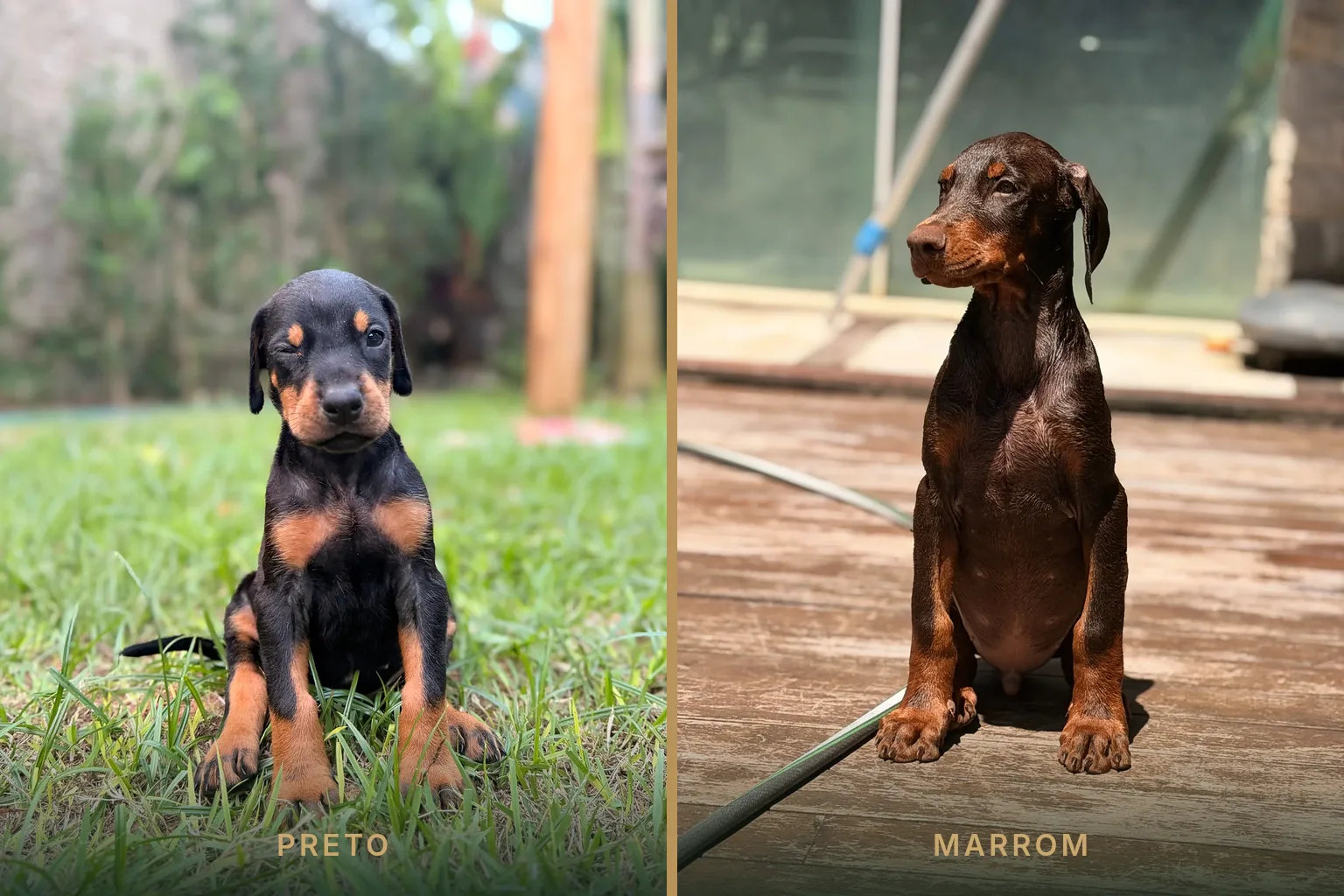
Here at Dobs Kennel, in Natal, the latest litter from Eros and Kira gave us males and females, blacks and browns, in the same group. We watched all nine grow up side by side. What you're about to read comes from that observation, not from a table off the internet.
Male or female: the differences that actually show up
The most predictable difference is size. The male is bigger, taller at the withers and broader in the head; the female stays more compact and lighter. If what you want is maximum physical presence for guarding, the male delivers that through his silhouette alone. If space is tighter, or you'd rather have a dog that's a little easier to handle day to day, the female helps.
To give you a sense of what that means on the scale, an adult male within the standard usually sits around 68 to 72 cm at the withers and 40 to 45 kg, while the female runs around 63 to 68 cm and 32 to 35 kg. It doesn't look like much on paper, but when you're holding the lead with an excited dog, or getting him settled in the car, those extra kilos are real. Anyone without much strength in the arm feels the difference.
On temperament, the difference is subtler than people claim. The female tends to be more attached to the family, the dog who follows you from room to room. The male is usually more outgoing and more territorial, and with other adult males there can be friction. None of that is law: inside our own litter there was a female bolder than any male, and a male gentler than any female.
One practical point people forget: an unspayed female comes into season twice a year, and that needs managing. An intact male can get restless when there's a female in season nearby. These are things you handle with information, but it's better to know beforehand.
Black or brown: what changes, and the myth that won't die
On color, the truth disappoints anyone looking for drama: black and rust and brown and rust are the same breed and follow the same standard. Color doesn't decide temperament: each dog has his own, like each person. What changes is the look. The black has a striking contrast and is the better known of the two. The brown, the chocolate one, is softer, less common, and turns heads for exactly that reason.
There is one real detail: brown coat fades more in strong sun, so a dog who spends the day exposed tends to lighten over time. The black holds up better. It's the kind of thing only someone living with them closely notices.
Now the myth. Every so often someone tells us that "the brown one is dopier and the black one is fiercer". We've heard it from clients more than once. Genetics says the opposite: the gene that determines coat color has no relationship to the genes behind behavior. In our litter with both colors, the variation in personality between siblings of the same color was greater than any difference between black and brown. Color doesn't pick temperament.
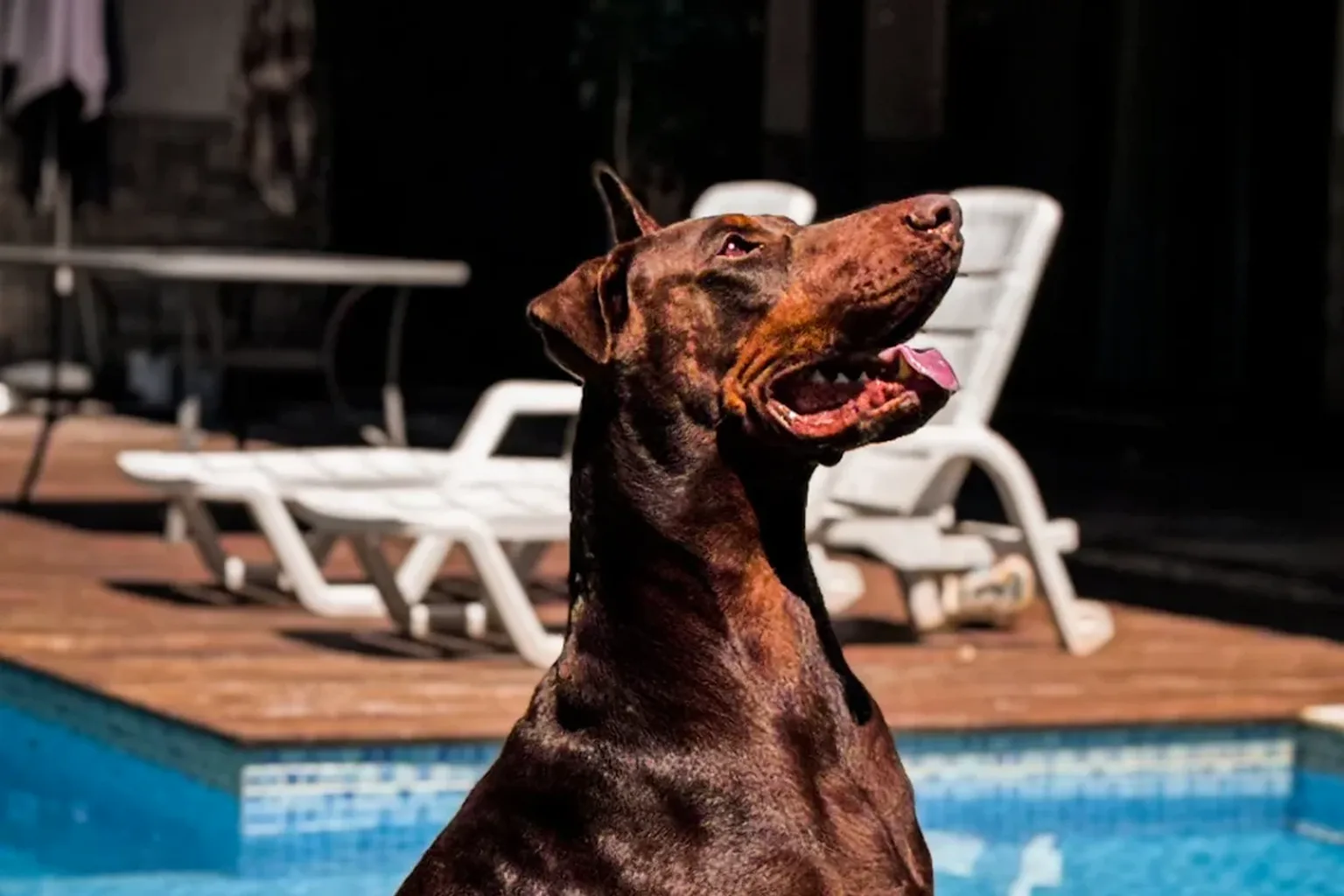
If your curiosity goes past black and brown, through blue, isabella and the colors that shouldn't exist at all, we go into that, along with the health side of it, in the colors of the Doberman and in what changes in the brown Doberman.
The decision table: what weighs for each household
There's no universally "right" choice. There's the one that fits your routine. Use this as a starting point, never as a closed rule:
| If in your home... | Tends to suit |
|---|---|
| An adult male already lives there | Female, it reduces friction between males |
| An adult female already lives there | Male, the same logic in reverse |
| You want maximum physical presence | Male |
| You'd rather have a dog that's easier to handle | Female |
| It's your first time with the breed | What decides is the parents' temperament, not the sex |
| You want the classic high-contrast look | Black and rust |
| You want something more understated and uncommon | Brown and rust |
| The dog will spend a lot of time in the sun | Black holds its color better |
Arraste a tabela para o lado para ver todas as colunas.
"And the ears and tail, do they come cropped and docked?"
That question arrives almost every week, and the answer is no. Our puppies leave with natural ears and a full tail. Ear cropping and tail docking for aesthetic reasons are prohibited in Brazil under the CFMV resolution, and we agree with that position. A Doberman with natural ears is the same dog, with the same guarding instinct and the same presence. If that part weighs on your choice, it's worth reading first why we don't crop the ears.
What weighs more than sex and color
After following every litter closely, our conviction is simple: the parents and the first weeks decide the dog you're going to have far more than the label of male, female, black or brown. A puppy from parents with stable temperament and tested health, well socialized through 12 weeks, becomes a balanced adult whatever the color of his coat.
So when a client gets stuck on the color question, we hand back other questions. Do the parents have health testing? Was the puppy raised indoors, in the middle of the household? Is there a contract and support after delivery? That's where the difference you'll feel for ten years lives. We talk about it in the Doberman's temperament from puppy to adult and in socialization in the first 12 weeks.
Quick questions
Is a female easier to train than a male? Not as a rule of sex. What makes training easier is the dog's temperament and the owner's consistency. An attached female learns fast; a focused male does too. See the five commands that change daily life.
Is the brown Doberman rarer? Does it cost more? Brown is less common than black, but here color on its own doesn't change the price. What forms the value is the whole package: pedigree, the parents' health, sex and availability.
Which color shows less mess indoors? The Doberman's coat is short in both colors and sheds little. Brown hides light dust better; black hides the hair of dark dogs. In practice, near enough the same.
Once the choice is settled, the next step is all here: the puppy guide from reservation to 12 months. And if the question is still between breeds, Doberman or Rottweiler helps close the picture.

Written by
Marcelo Vaz — breeder at Dobs Kennel
CBKC/FCI registered kennel in Natal, Brazil. Champion American and European bloodlines, proven health, and lifelong support for every family. Meet the kennel →