
In this article
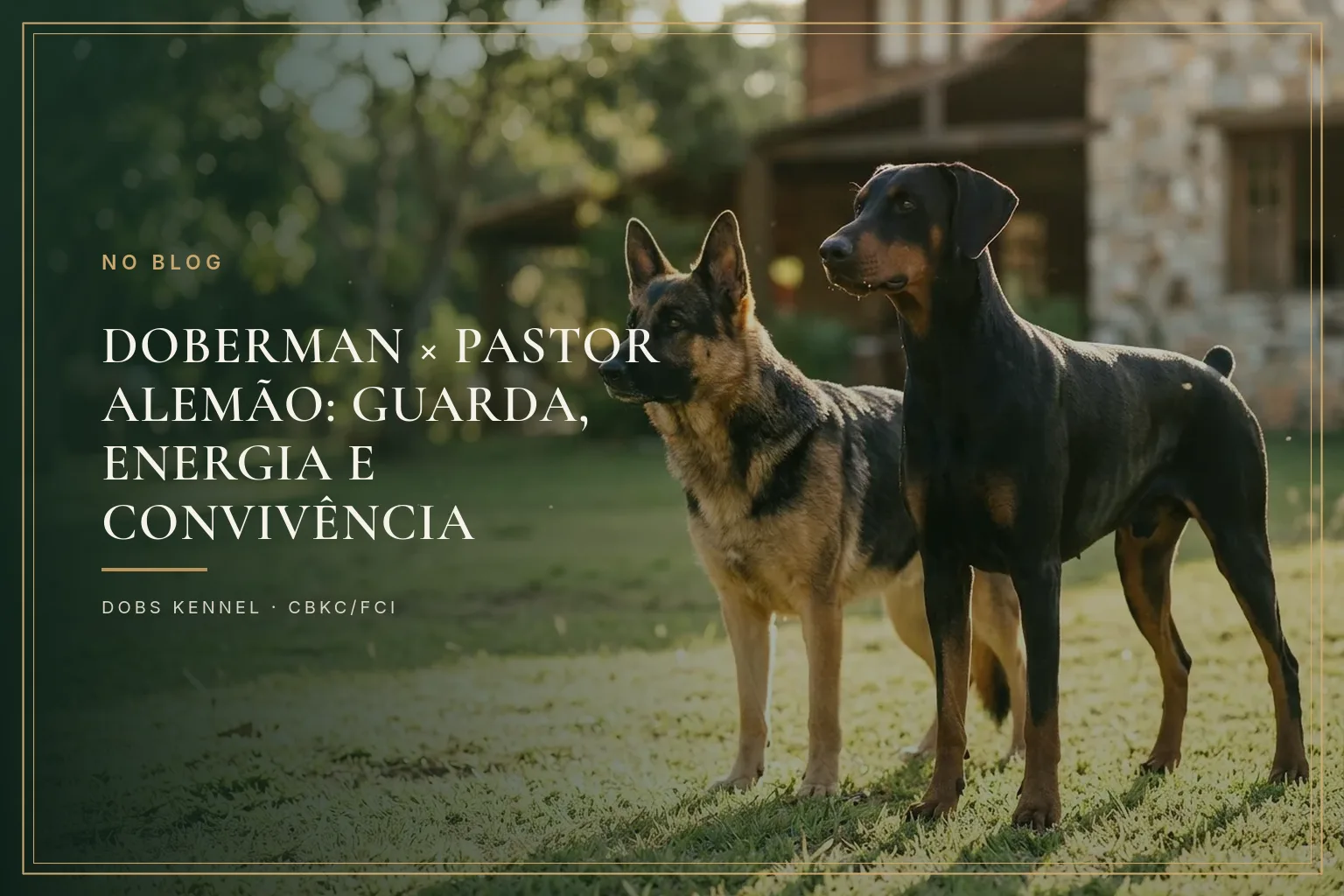
The Doberman and the German Shepherd are the two best family guard dogs there are, and the difference isn't which one protects better: it's what living together is like. The Doberman is closeness, speed and thin skin; the Shepherd is independence, stamina and hair all over the house. We breed Dobermans, but we're not going to sell you our breed if you'd be better off with the other one, because a buyer who regrets it isn't good business.
This piece is the conversation we have on the phone when someone calls saying "I'm torn between the two". Neither of them is the wrong dog. What's wrong is choosing without knowing what changes in daily life.
Each breed in one sentence
The Doberman was born in late nineteenth century Germany at the hands of a tax collector who needed a personal escort: a fast, athletic dog glued to his owner. The German Shepherd came shortly after, out of the work of moving flocks, and became the most widely used working dog in the world: police, army, search, guide work.
One was made to walk at your side. The other, to work at a distance and make decisions on its own. That explains nearly everything below.
The honest comparison, item by item
| What changes | Doberman | German Shepherd |
|---|---|---|
| Size of the adult male | 30 to 40 kg, the lean body of a sprinter | 30 to 40 kg, a sturdier and more angled body |
| Hair in the house | short and flat, sheds little and vanishes on the floor | double and dense, sheds all year, with two heavy blowouts |
| Attachment | a shadow: sleeps at the bathroom door | loyal and present, but fine staying in another room |
| Guarding | presence and speed; intimidates before acting | a warning bark, more territorial and more vocal |
| Energy | explosive: needs running, not only walking | steady: holds up to hours of moderate work |
| Cold and heat | genuinely feels the cold, short coat and little fat | handles cold with room to spare; struggles more in humid heat |
| Health to watch | the heart (dilated cardiomyopathy) | hips and spine (dysplasia, myelopathy) |
| Training | learns fast, but switches off if the work is repetitive | learns fast and enjoys repeating, the easier student |
Arraste a tabela para o lado para ver todas as colunas.
Guarding: both protect, in different ways
People looking for a guard dog usually think the question is "which one bites harder". It isn't. A family guard dog settles almost everything before any contact happens, and there both are excellent by different routes.
The German Shepherd announces. He barks, marks the perimeter, holds the stranger at the fence and makes it clear the house has an owner. He is a declared guard.
The Doberman intimidates. He isn't the dog who barks most, he's the dog who appears. The silhouette, the locked attention and the speed do the work, and that's why he historically escorted people, not fences.
If you want a dog who reports movement at the gate, the Shepherd has the advantage. If you want a dog who moves with the family and reacts fast near them, the Doberman fits better. The comparison against the other options is in our piece on the best guard dog.
Energy: where most people get it wrong
Both are working dogs and neither is satisfied by a lap around the block. But the energy has different qualities.
- Doberman: needs to spend it in bursts. Off-leash running, fetch games, short and intense training. A Doberman who only walks turns into an anxious dog inside the house.
- German Shepherd: needs to spend it in steadiness and, above all, with his head. He was made to work for hours. Scent work, obedience, tasks. Without them he invents a job for himself, and the job he invents is usually barking and digging.
In practice: if you have 40 minutes a day, both work, as long as they're 40 real minutes. If you only have 15, neither of them is an honest choice for the dog.
Inside the house: hair, space and noise
This is where the decision usually settles itself.
Hair is the most underestimated item. The German Shepherd has a double coat and sheds all year, with two shedding seasons when the house looks snowed in. The Doberman has a short, flat coat: it falls, but it disappears. For anyone with allergies, a small child crawling on the floor or little patience for the vacuum, that weighs more than any guarding trait.
Noise comes next. The Shepherd is more vocal by nature, since barking is part of his job. In an apartment, that becomes a conversation with the neighbor. We wrote about the Doberman's routine in a small space in our piece on the Doberman in an apartment, and much of it applies to the Shepherd with one extra item: the sound.
And then there's the cold. The Doberman genuinely feels the cold, with his short coat and little fat. Here in Natal that's never a problem; in a mountain town it means a blanket and a bed up off the cold floor.
With children
Both live well with them, and both require the same thing: socialization from puppyhood and an adult who supervises. The difference is one of style. The Doberman tends to stick to the child and follow her around the house; the Shepherd tends to watch the group from slightly further off, the way he did with the flock.
One detail about the Shepherd worth knowing: the herding instinct sometimes shows up around a running child, so he circles, cuts across, bumps into her. It isn't aggression, it's herding working out of context, and it's corrected with training. Our guide to Dobermans with children has the step by step for introductions, which serves the other breed just as well.
Health and life expectancy
Both breeds live on average 10 to 13 years, and each one has its point of attention.
In the Doberman, the subject is the heart: dilated cardiomyopathy is the breed's main concern, and that's why a serious breeder talks about echocardiograms and Holter monitors before talking about anything else.
In the German Shepherd, the subject is the structure: hip and elbow dysplasia, and degenerative myelopathy in older dogs. The heavily angled line, which became common in some show breeding, made that worse.
In both cases the defense is the same, and it comes before the purchase: ask for the parents' test results. A breeder who answers "they're all healthy, thank God" without showing you paper is telling you a hope, not a fact.
What it costs to keep one
The monthly costs are similar: large-breed food, dewormer, annual vaccine, flea control. The difference shows up in two places. The German Shepherd weighs more on grooming (bathing, frequent brushing, a vacuum that can handle hair). The Doberman weighs more on coats for the cold and on cardiac follow-up from three years old on.
At purchase, both sit in a similar range when they come from serious breeding with pedigree and health testing. If the price is far below the market, the bargain is being paid for somewhere else, usually in the puppy's health. We explain that math in why cheap turns out expensive.
So which one should you choose?
Choose the German Shepherd if: you want a dog who announces and works, you tolerate hair in the house, you enjoy training with consistency and you prefer a slightly more independent dog.
Choose the Doberman if: you want a dog glued to the family, a house clear of hair, a presence that intimidates without the scene, and you're up for real running a few times a week.
If you're still comparing, we also have Doberman vs Rottweiler and the complete German Shepherd guide. And if your question is about the Doberman's temperament specifically, the piece on temperament from puppy to adult answers what most people ask.
One last thing, said by someone who breeds: the right breed is the one that fits the routine you actually have, not the routine you intend to have. People who choose by the dog of their dreams instead of by the life they lead end up with a frustrated dog and a worn-out family. If you'd like to talk it through before deciding, just reach out. We answer even when the answer is "that other breed suits you better".

Written by
Marcelo Vaz — breeder at Dobs Kennel
CBKC/FCI registered kennel in Natal, Brazil. Champion American and European bloodlines, proven health, and lifelong support for every family. Meet the kennel →